
Arc Fault Protection: What AFCI Breakers Do and Why They Cost More
An arc-fault circuit interrupter (AFCI) is a circuit breaker with a built-in microprocessor that detects dangerous electrical arcing in your wiring. Standard breakers can't see this type of fault. The 2023 NEC requires AFCI protection on most 120-volt living-space circuits. Colorado adopted the 2023 NEC statewide, and local jurisdictions may apply the requirement more broadly.
You got a quote for a panel replacement and the number was higher than you expected. Or your electrician mentioned "AFCI breakers" and you nodded, then looked it up later and still weren't sure what that meant for your project. That confusion is normal. This technology didn't exist when most Colorado homes were built, and it's not something anyone explains well.
The rest of this page covers how it works, why code now requires it, and what drives the cost. For an overview of all three types of circuit protection in modern panels, see our circuit protection guide.
This page is for general education only. Every home, panel, and wiring configuration is different. Nothing here replaces a hands-on evaluation by a licensed electrician who can see your specific setup. If you have questions about your electrical system, talk to a qualified professional before making decisions.
What an Arc-Fault Circuit Interrupter (AFCI) Does
A standard circuit breaker protects against two things: overloads (too much current for the wire size) and short circuits (a direct connection between hot and neutral or hot and ground). These are big, obvious electrical events. The breaker trips, the lights go out, and you go reset it. The system works.
But there's a third category of electrical fault that standard breakers can't see at all.
An arc fault is a spark jumping across a gap in damaged wiring. A nail through a cable behind drywall. A cord pinched under a dresser for years. A wire connection that's worked itself loose inside a junction box. These sparks are small. The current draw is low and erratic, nowhere near enough to trip a standard breaker. But the temperature at the arc point can reach thousands of degrees. Hot enough to ignite wood framing, insulation, paper backing on drywall.
Think of it this way. A standard breaker catches the equivalent of a massive water main break. Water everywhere, impossible to miss. An arc fault is the slow leak inside a wall that you don't find until the ceiling is stained and the framing is rotted. The damage happens quietly, out of sight, over time.
An AFCI breaker is built to catch that hidden problem. It monitors the electrical current on its circuit and looks for the specific signature of dangerous arcing. When it finds it, it kills the circuit before the arc can start a fire.
How It Works Inside the Breaker
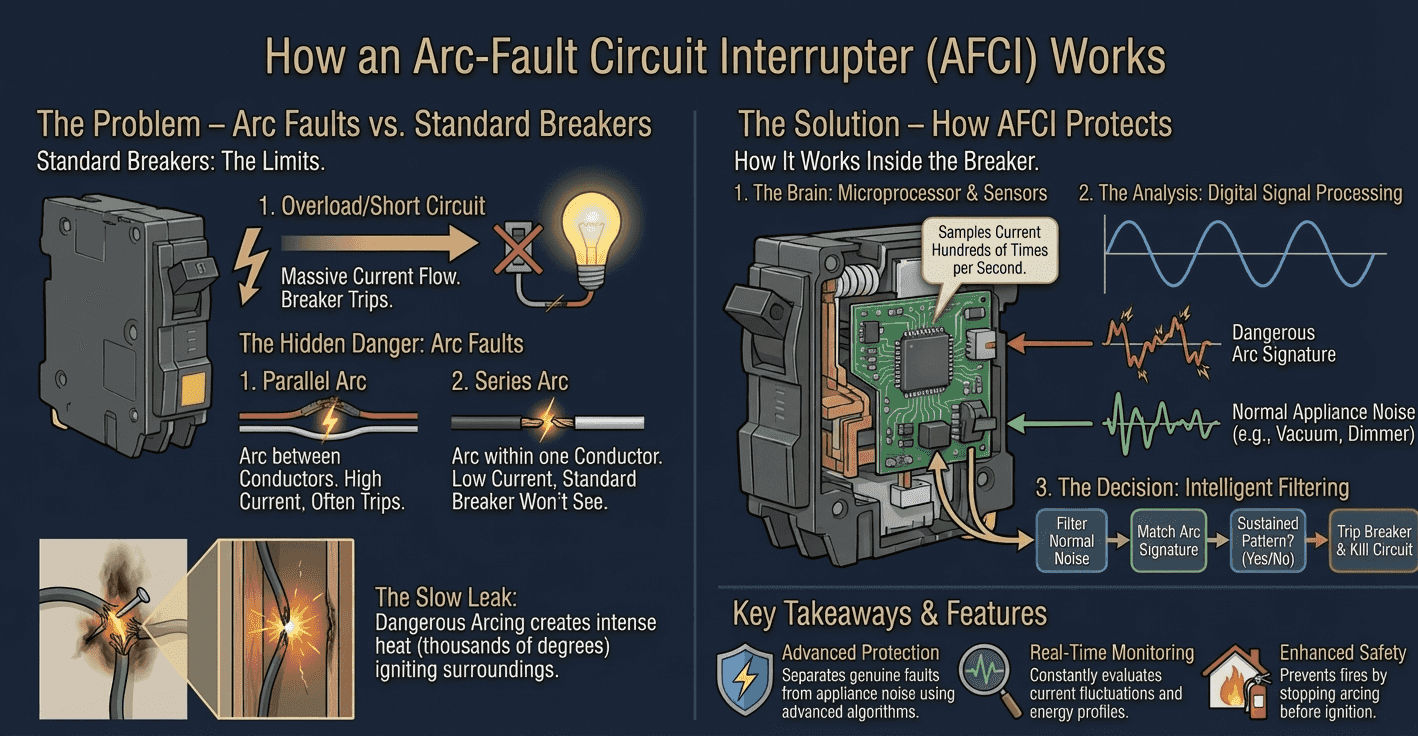
There are two types of arcing that matter here.
A parallel arc happens when current jumps between two different conductors, like hot to neutral or hot to ground. Damaged insulation is the usual cause. These can produce high currents and sometimes trip a standard breaker, but not always, and not fast enough.
A series arc happens when a single conductor is broken or has a loose connection. Current arcs across the tiny gap. Because the arc is in line with whatever appliance or light is drawing power, the current stays low. A standard breaker has no way to detect this. The wire just keeps arcing, getting hotter.
Inside an AFCI breaker, alongside the standard mechanical trip components, there's a printed circuit board with a microprocessor and current sensors.
The microprocessor samples the electrical current on the circuit hundreds of times per second. It's reading the shape of the alternating current (AC) wave and comparing it against known arc signatures stored in memory. The breaker doesn't trip on a single blip. It has to see a sustained pattern before it shuts the circuit off.
The hard part isn't detecting arcs. It's telling dangerous arcs apart from normal electrical noise.
Certain types of electric motors, like the ones in many vacuum cleaners, create literal sparks inside the motor every time they run. A dimmer switch chops the voltage wave on purpose. An air conditioning compressor starting up draws a heavy burst of current that distorts the wave. All of these look similar to arcing from the breaker's perspective. The algorithm has to filter them out and only trip on the real thing.
Early AFCI breakers struggled with this. They tripped too often on normal loads. Current designs use more advanced digital signal processing, tracking energy profiles and evaluating current fluctuations in real time to separate genuine faults from appliance noise. They're better than they used to be. They're still not perfect.
Why Code Requires It
In 1992, the Consumer Product Safety Commission (CPSC) asked Underwriters Laboratories (UL) to investigate technologies that could reduce residential electrical fires. At that time, the National Fire Protection Association (NFPA) and CPSC data estimated that electrical distribution and lighting equipment caused tens of thousands of residential fires each year, with arcing identified as the primary ignition source in the majority of those incidents.
That data is what drove changes to the National Electrical Code (NEC). Each expansion happened because the fire numbers showed the previous scope wasn't enough.
| NEC Edition | What Changed |
|---|---|
| 1999 / 2002 | First AFCI requirement. Bedroom circuits only, effective January 2002. |
| 2008 | Expanded to family rooms, dining rooms, living rooms, parlors, dens, sunrooms, recreation rooms, closets, and hallways. |
| 2014 | Added kitchens and laundry areas. |
| 2017 / 2020 | Added dormitories, hotel guest rooms, and patient sleeping rooms. Required AFCI when receptacles are replaced or branch circuits modified. |
| 2023 | Covers virtually all 120-volt, 15- and 20-amp branch circuits in living spaces. |
Colorado adopted the 2023 NEC statewide effective August 1, 2023.
The code didn't change on a whim. It changed because the fire data kept pointing to arcing as a primary cause of residential electrical fires, and standard breakers couldn't address it. AFCI technology was the response.
Under the 2023 NEC, certain areas are exempt from AFCI but require Ground-Fault Circuit Interrupter (GFCI) protection instead. Your electrician can tell you which circuits in your home fall into which category.
AFCI vs. GFCI
These two get confused constantly. They protect against completely different hazards using different technology.
| AFCI | GFCI | |
|---|---|---|
| Protects against | Arcing faults (fire hazard) | Ground faults (shock/electrocution hazard) |
| How it detects | Monitors the current waveform for arc signatures using a microprocessor | Compares outgoing current to returning current; trips if even a small amount is missing (leaking to ground through a person or water) |
| Trip threshold | Sustained arcing pattern within a fraction of a second | A tiny amount of missing current (less than what it takes to feel a shock) |
| Required where (2023 NEC) | Most living-space circuits | Wet and outdoor areas |
| Overlap areas | Some locations require both. A dual-function breaker handles this in one device. | |
They aren't interchangeable. A GFCI won't catch arcing. An AFCI won't catch ground faults. In locations where code requires both, a dual-function breaker combines AFCI and GFCI into a single unit.
Why AFCI Breakers Cost More
A standard residential breaker is a mechanical device. Metal contacts, a spring, a bimetallic strip that bends when it gets hot, and an electromagnet for short circuits. That's it. A handful of parts, simple manufacturing, decades of production volume behind it.
An AFCI breaker contains all of that plus a printed circuit board, a microprocessor, and current sensors. It's a small computer built into a breaker housing.
That electronics package is why an AFCI breaker runs roughly six to eight times the cost of a standard breaker. A dual-function breaker (AFCI plus GFCI combined) runs eight to ten times the standard price.
Scale that across a whole panel. A typical home has 20 or more circuits. When most of those circuits need AFCI protection, the breaker cost alone adds up fast compared to a panel full of standard breakers. That's the number you're seeing on your quote.
The price difference comes down to what's inside. A standard breaker is simple mechanical parts. An AFCI breaker is a computer. That gap isn't going away.
What Code Requires
When we replace a panel, certain items are required by the 2023 NEC regardless of jurisdiction:
- Whole-home surge protection (NEC 230.67)
- Exterior emergency disconnect so first responders or Xcel can cut power from outside without entering the home (NEC 230.85)
AFCI protection is different. Some jurisdictions require it on every panel replacement. Others only require it when existing circuits are changed. We confirm what applies to your location before quoting the job. When it's not required, we offer it as an option. The added safety is real. So is the cost, and so is the possibility of nuisance tripping in older homes. We walk through the trade-offs so you can make an informed decision.
The Nuisance Tripping Reality
There's a tradeoff. AFCI breakers catch hidden fire hazards. They also trip sometimes when there's no hazard at all.
In older homes (especially those built before 1980), newly installed AFCI breakers can trip when there's no actual fire hazard. The reasons:
- Worn outlet connections. Outlets from the 1960s and 1970s often used push-in "backstab" connections instead of screw terminals. After decades of heating and cooling, the spring tension weakens and the connection loosens. The AFCI detects the resulting micro-arcing. It's doing its job, but the fix is at the outlet, not the breaker.
- Shared neutral wires. Older homes sometimes ran two circuits on a single three-wire cable with a shared neutral. An AFCI compares outgoing and returning current. A shared neutral creates an imbalance that the breaker reads as a fault.
- Appliance interference. Certain vacuum cleaners, treadmills, older dimmer switches, and some LED drivers generate electrical noise that can look like arcing to the breaker.
- Degraded wiring insulation. Cloth and early thermoplastic insulation breaks down over time. Tiny amounts of current leak between conductors. The AFCI picks this up.
Some of these trips are the breaker catching a real problem (a loose connection that genuinely needed attention). Others are false positives from appliance noise or wiring configurations that predate the technology. Sorting out which is which takes diagnosis.
If your breakers are tripping after a panel upgrade, call us. We can diagnose the cause and walk you through the options. If you're not sure what panel you have, our panel identification guide covers the most common types found in Denver-area homes.
Frequently Asked Questions
What is an arc fault circuit interrupter?
An arc fault circuit interrupter (AFCI) is a circuit breaker with a built-in microprocessor that monitors the electrical current on a circuit hundreds of times per second. It looks for the specific waveform pattern of a dangerous electrical arc, which is a spark jumping across a gap in damaged or degraded wiring. When it detects that pattern, it shuts the circuit off. A standard breaker only responds to overloads and short circuits. An AFCI catches the smaller, hidden faults that standard breakers ignore completely.
Why are AFCI breakers so much more expensive than regular breakers?
A standard breaker is a mechanical device: a metal strip, a spring, and a set of contacts. An AFCI breaker adds a printed circuit board, a microprocessor, and current sensors. It is a small computer built into a breaker housing. That electronics package costs roughly six to eight times what a standard breaker costs. Dual-function breakers that combine AFCI and GFCI run eight to ten times the price of a standard breaker.
What is the difference between AFCI and GFCI?
They protect against different hazards. An AFCI detects electrical arcing, which causes fires. A GFCI detects current leaking to ground, which causes electrocution. AFCI monitors the waveform for arc signatures. GFCI monitors the balance between outgoing and returning current, tripping when even a tiny amount goes somewhere it should not. Some locations require both types of protection, which is where dual-function breakers come in.
Do I need AFCI breakers if I am just replacing my panel?
It depends on your jurisdiction. Some require AFCI on every panel replacement. Others only require it when existing circuits are changed. We confirm what applies to your location before quoting the job. When AFCI isn't required, we offer it as an option and walk you through the trade-offs.
Will AFCI breakers trip randomly in my older home?
Possibly. AFCI breakers are far more sensitive than what they are replacing. In older homes, worn outlet connections, degraded wiring insulation, shared neutral wires, and certain appliances can all cause trips that have nothing to do with a real fire hazard. This is the most common complaint after a panel upgrade in homes built before 1980. The trips are usually fixable, but they take diagnosis.
What is a dual-function breaker?
A dual-function breaker combines AFCI and GFCI protection in a single device. It monitors for both arcing faults (fire hazard) and ground faults (shock hazard) on the same circuit. The 2023 NEC requires dual-function protection in locations where both AFCI and GFCI coverage overlap, including kitchen countertop circuits, dishwasher circuits, and laundry circuits.
Sources
- CPSC technical document on arc-fault circuit interrupter fire technology. Consumer Product Safety Commission.
- NFPA reports on home electrical fires. National Fire Protection Association.
- "AFCIs Tell a Life Saving Story." NFPA, November 2021.
- National Electrical Code (NEC) 2023, Section 210.12 (AFCI requirements), Section 230.67 (surge protection), Section 230.85 (emergency disconnect).
- NEC 2008, 2014, 2017, 2020 editions: progressive expansion of AFCI scope.
- Jefferson County 2023 Residential Electrical Wiring Guide. Jefferson County, Colorado.
- UL 1699: Standard for Arc-Fault Circuit Interrupters. Underwriters Laboratories.
- "Protecting Like It's 1999: Changes in AFCI Requirements." Electrical Contractor Magazine.
- NAHB suggested amendments and analysis of AFCI fire data methodology. National Association of Home Builders.
- NAHB analysis of CPSC residential electrical fire data (2010-2012) and AFCI correlation methodology.
This page is for informational purposes. Electrical panel work should only be performed by a licensed electrician. Jesse Dunlap is a Colorado Licensed Master Electrician, in the trade since 1998.
Questions About Your Panel or AFCI Breakers?
Call us or request a free estimate. We'll walk you through what your home needs.