
GFCI Protection: What It Does, Where Code Requires It, and Breaker vs Outlet
A ground-fault circuit interrupter (GFCI) detects when electrical current is leaving its intended path and shuts the circuit off in under a tenth of a second. The 2023 National Electrical Code (NEC) requires GFCI protection in kitchens, bathrooms, garages, outdoors, basements, laundry areas, and near sinks. Colorado adopted the 2023 NEC statewide.
You've seen the outlets with the test and reset buttons. They're in your bathroom, maybe your kitchen, probably the garage. You press the test button, something clicks, and power goes off. Press reset, it comes back on. That's a GFCI, and it does something very specific: it keeps electricity from killing you.
If you're researching GFCI because of a panel replacement, a home inspection, or just because your outlet keeps tripping, this page explains what the device does, how it works, where the National Electrical Code (NEC) requires it, and the practical choice between putting that protection at the outlet or at the breaker. For an overview of all three types of circuit protection in modern panels, see our circuit protection guide.
This page is for general education only. Every home, panel, and wiring configuration is different. Nothing here replaces a hands-on evaluation by a licensed electrician who can see your specific setup. If you have questions about your electrical system, talk to a qualified professional before making decisions.
What a GFCI Does
In a normal circuit, all the electricity that flows out on the hot wire comes back on the neutral wire. The two amounts match perfectly. A GFCI watches that balance.
If some of that current goes somewhere else instead of coming back on the neutral wire, it means electricity is leaking. Through a person. Through water on a concrete floor. Through damaged insulation touching a metal appliance housing. That missing current is a ground fault, and the amount of current involved can kill you well before a standard breaker would notice anything wrong.
Standard breakers protect wiring from overloads and short circuits. They trip at 15 or 20 amps. A fatal shock involves a tiny fraction of one amp. Way below a standard breaker's threshold. The breaker doesn't react because, from its perspective, nothing abnormal happened.
A GFCI catches what a standard breaker can't. It's set to trip at a threshold low enough that the circuit shuts off before the shock becomes dangerous. The trip happens in a fraction of a second.
That's the whole point of the device. Not fire prevention, not equipment protection. Personnel protection. Keeping electricity from going through a person long enough to stop their heart.
How It Works
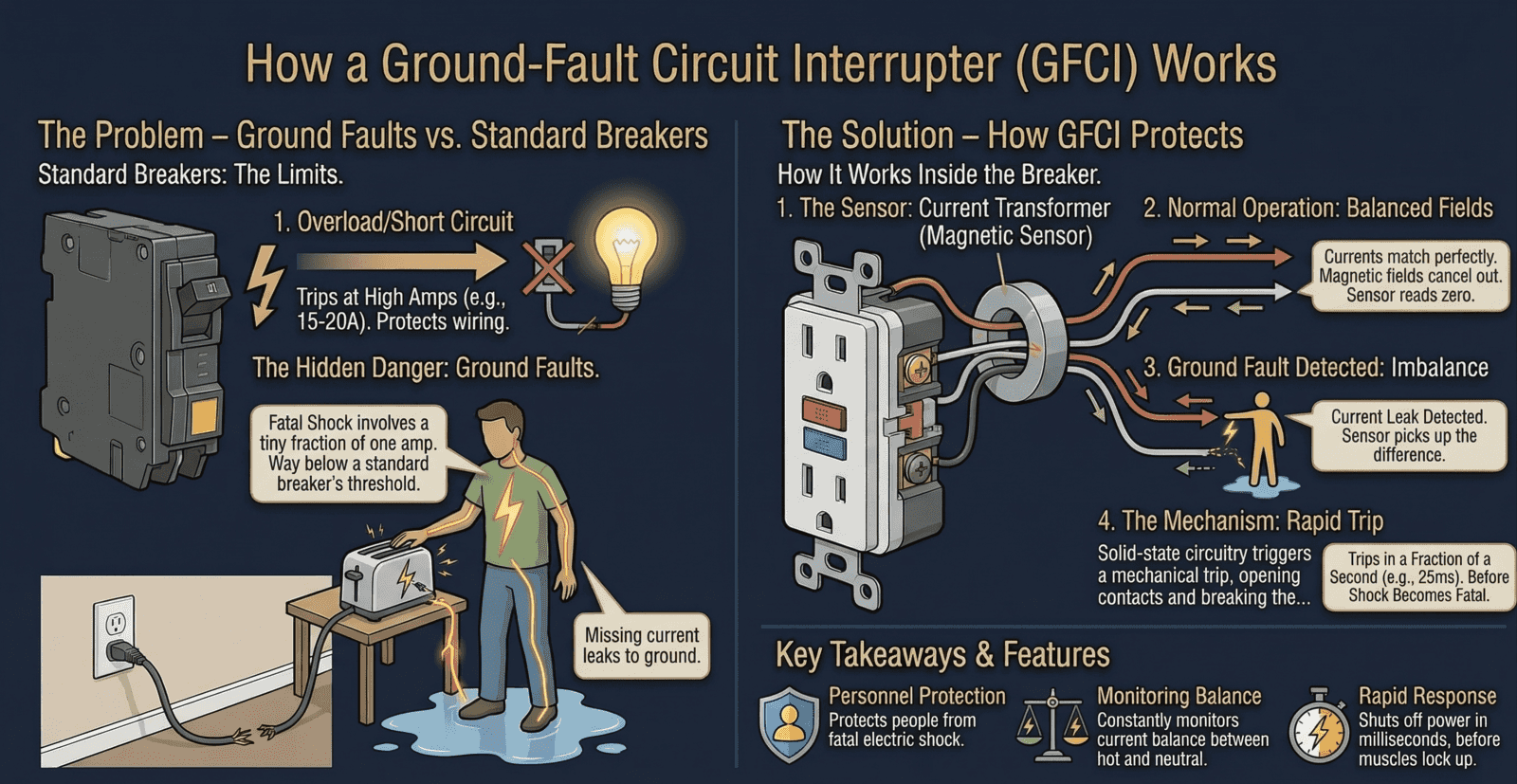
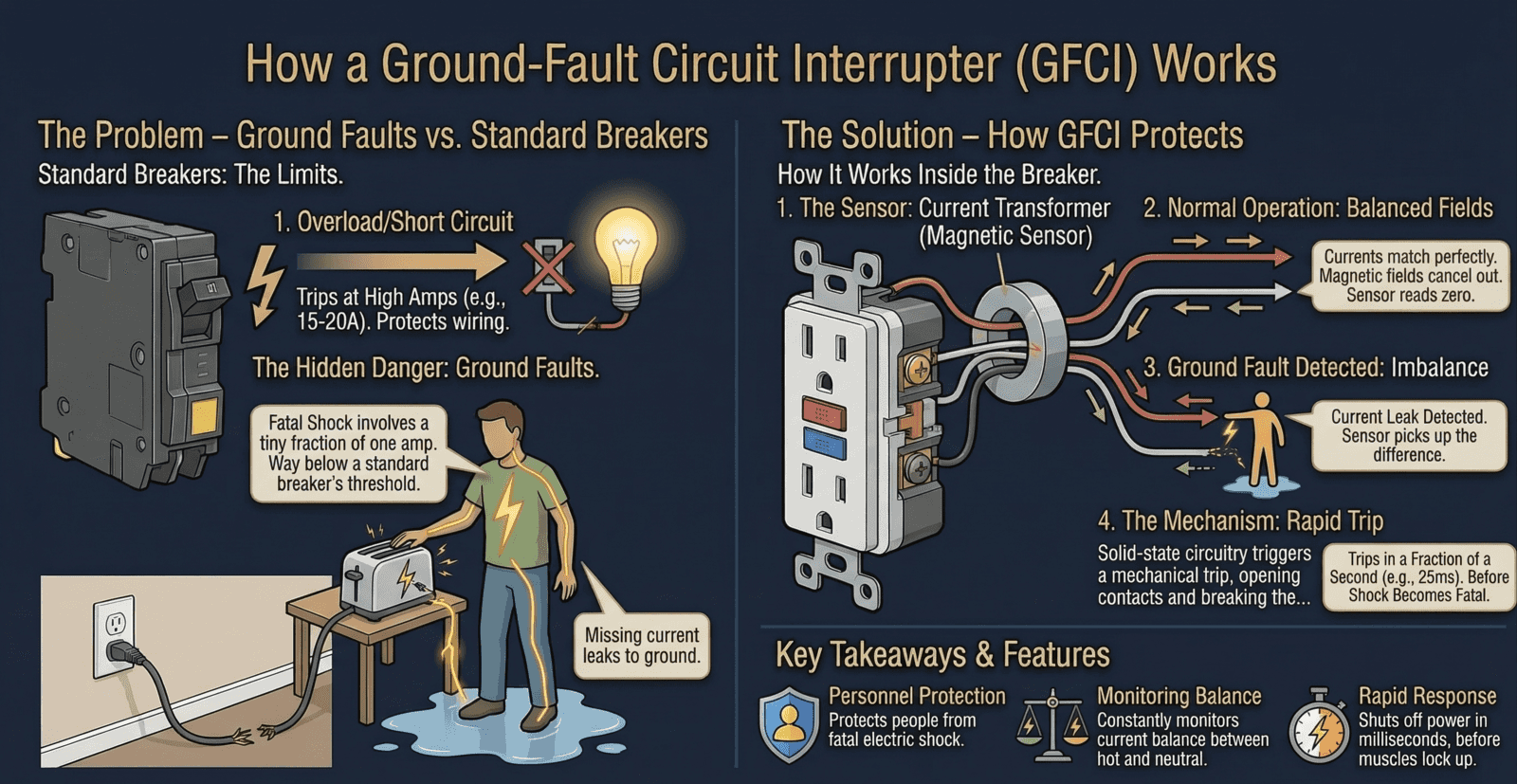
Inside every GFCI, the hot and neutral wires pass through a small ring called a current transformer. Think of it as a magnetic sensor. When equal current flows out on one wire and back on the other, the magnetic fields cancel out. The sensor reads zero. Everything is fine.
The moment current leaks out of the circuit, the balance breaks. The sensor picks up the difference, and solid-state circuitry triggers a trip mechanism that physically opens the contacts and kills the circuit.
How fast? Under normal conditions, well under a tenth of a second. For a severe fault, modern devices trip in about 25 thousandths of a second. That's fast enough to shut things down before the shock reaches the point where your muscles lock up and you can't let go of whatever you're touching.
That "can't let go" threshold is the critical line. The trip point is calibrated below it. The device reacts before your body loses the ability to pull away. That's what makes it a life-safety device rather than just another breaker.
How GFCI Differs from Arc-Fault Circuit Interrupter (AFCI) Protection
These two get confused often. They protect against different things entirely.
A GFCI detects current leaking out of the circuit, which causes electrocution. An AFCI detects electrical arcing inside wiring, which causes fires. Different hazards, different detection methods, different technology inside the device.
A GFCI won't catch arcing. An AFCI won't catch ground faults. They're not interchangeable.
In some locations, the 2023 NEC requires both types of protection on the same circuit. Kitchen countertop circuits, for example, need protection against both shock and fire. A dual-function breaker handles both in a single device. Our AFCI protection page covers arc-fault technology in detail.
Where Code Requires It
GFCI protection first appeared in the NEC in 1971, covering outdoor outlets only. Over 50 years, the code expanded it steadily as the safety data proved it worked. The pattern is simple: anywhere water and electricity are near each other, GFCI protection is required.
| NEC Edition | What Changed |
|---|---|
| 1971 | First requirement. Outdoor receptacles only. |
| 1975 | Bathrooms added. |
| 1978 | Garages added. |
| 1987 | Kitchen countertops within 6 feet of the sink. |
| 1990 | Crawl spaces and unfinished basements added. |
| 1996 | Laundry areas and all exterior outlets added. |
| 2005 - 2020 | Dishwashers, all kitchen countertops, boathouses, bathtub/shower proximity, indoor damp locations, and specific appliances added incrementally. |
| 2023 | Major expansion. All kitchen outlets (not just countertops), electric ranges, wall ovens, cooktops, clothes dryers, microwave ovens. Effectively every area with water or appliance contact. |
The 2023 NEC is the version Colorado adopted statewide, effective August 1, 2023. GFCI protection is now required for receptacles in bathrooms, kitchens (every outlet, not just countertops), garages, outdoors, crawl spaces, basements, laundry rooms, areas near sinks, and indoor damp or wet locations (NEC 210.8(A)). Specific appliances including dishwashers, electric ranges, clothes dryers, and microwave ovens also require GFCI protection (NEC 210.8(D)).
Before the 2023 NEC, kitchen GFCI requirements covered only countertop outlets. Now every single receptacle in the kitchen needs it. That's the biggest change homeowners notice on a panel replacement quote.
The data behind these expansions is hard to argue with. Before GFCI requirements existed, the U.S. averaged roughly 600 consumer electrocution deaths per year. By recent counts, that number is down to about 100 per year, despite a much larger population using far more electrical devices. The Electrical Safety Foundation International credits GFCI technology with an 81 to 95 percent effectiveness rate in preventing electrocutions where the devices are installed.
GFCI Breaker vs GFCI Outlet
Both devices use the same sensor technology. Same trip threshold. Same speed. The difference is where the protection lives and how much of the circuit it covers.
A GFCI outlet protects itself and any standard outlets wired downstream of it. A GFCI breaker sits in the panel and protects the entire circuit from the panel outward, including the wiring running through your walls. That wall wiring is something an outlet at the end of the run can't monitor.
The breaker costs roughly three to four times what an outlet does. Scale that across a whole house and it adds up. But there's a practical reason electricians prefer breakers during panel replacements: it puts all the protection in one spot.
Here's the scenario that breakers prevent. You're in your backyard, plug in a string trimmer, and the outdoor outlet is dead. No power. You check the panel. Breakers all look fine. The problem is actually a tripped GFCI outlet in your garage, buried behind storage bins, that feeds the outdoor circuit. You didn't know that outlet controlled anything outside the garage. Now you're moving bins.
With GFCI breakers in the panel, every protected circuit resets from one location. If something trips, you go to the panel. No treasure hunts.
| Feature | GFCI Outlet | GFCI Breaker |
|---|---|---|
| What it protects | The outlet itself and downstream outlets on the same circuit | The entire branch circuit from the panel |
| Covers wiring in walls | Only wiring downstream of the outlet | All wiring on the circuit, starting at the panel |
| Cost per device | Base cost | Roughly 3 to 4 times the outlet cost |
| Reset location | At the outlet (wherever it's installed) | At the panel |
| Best for | Adding protection to a single location without a panel change | Panel replacements where you want all protection centralized |
One thing to avoid: putting a GFCI outlet on a circuit that already has a GFCI breaker. It doesn't add safety. Both devices react to the same fault at the same time, and it's unpredictable which one trips first. Now you're checking two locations instead of one. It just makes diagnosis harder.
Older Homes and Two-Prong Outlets
Homes built before the early 1970s typically have two-wire circuits with no ground wire. That means two-prong outlets throughout the house. You can't legally install a standard three-prong outlet on a circuit with no ground wire. But you can install one if the circuit has GFCI protection.
The code specifically allows this (NEC 406.4(D)(2)). Because the GFCI detects current imbalance between the hot and neutral wires, it doesn't need a ground wire to do its job. The shock protection works the same way with or without a ground conductor.
A panel replacement with GFCI breakers brings shock protection to every circuit in the house. The old two-prong outlets can then be replaced with three-prong outlets, which means you can actually plug in modern devices. Each upgraded outlet has to be labeled "No Equipment Ground" and "GFCI Protected" so future electricians and homeowners know the wiring behind it doesn't include a ground wire. The shock protection is there. The equipment grounding that some electronics and surge protectors depend on is not.
For homes built in the 1950s through 1970s, this is one of the most practical upgrades that comes with a panel replacement. No tearing open walls. No rewiring. Just modern shock protection applied from the panel.
Testing and Lifespan
A GFCI is an electronic device, not a permanent fixture. The internal circuitry degrades over time from heat, moisture, and voltage spikes on the power grid.
Industry guidance puts the lifespan at 15 to 25 years. Devices in harsh environments (outdoor outlets, damp basements, unheated garages) wear out faster. Some fail in under 10 years.
Testing is simple. Once a month, press the test button. It creates a small intentional fault inside the device to verify the trip mechanism still works. The power should cut off immediately. Press reset to restore it. If the device doesn't trip when you press test, or won't reset afterward, it's failed and needs replacement.
Older GFCIs had a dangerous habit: when they failed internally, they kept delivering power without any protection. You'd never know the safety feature was gone. Modern devices are built to the opposite standard. When the internal circuitry can no longer protect you, the device locks out. It refuses to reset and won't deliver power at all. That's not a malfunction. It's the device telling you it's done and needs to be swapped out.
Frequently Asked Questions
What does GFCI stand for?
GFCI stands for ground-fault circuit interrupter. It is a protective device that monitors the electrical current flowing out on one wire and compares it to the current coming back on the other. If any current is missing, even a tiny amount, the device assumes that current is leaking through a person or through water and shuts the circuit off in a fraction of a second.
What is the difference between GFCI and AFCI?
GFCI protects people from electrocution by detecting current leaking out of the circuit. AFCI protects property from fire by detecting dangerous electrical arcing inside wiring. They guard against completely different hazards using different technology. In locations where code requires both, a dual-function breaker combines them into one device.
Do I need a GFCI breaker or a GFCI outlet?
Both use the same detection technology and trip at the same threshold. A GFCI outlet protects the outlet itself and anything wired downstream of it. A GFCI breaker protects the entire circuit from the panel, including the wiring inside your walls. The breaker costs roughly three to four times what an outlet does, but it puts all the protection in one place and eliminates the problem of a hidden tripped outlet killing power to part of your home.
Why does my GFCI keep tripping?
Common causes include moisture getting into an outdoor or bathroom outlet, a failing appliance that leaks a small amount of current, too many devices on one protected circuit whose tiny background leakage adds up, or the GFCI device itself reaching end of life. If a GFCI trips repeatedly, the cause needs diagnosis. It could be catching a real problem or it could be a device that needs replacement.
Can I replace two-prong outlets with three-prong if I have GFCI protection?
Yes. The NEC allows replacing old two-prong outlets with three-prong outlets when the circuit has GFCI protection, either from a GFCI breaker in the panel or a GFCI outlet upstream. The outlets must be labeled No Equipment Ground and GFCI Protected because the old wiring still lacks a ground wire. The GFCI provides shock protection without a ground wire, but it does not provide the equipment grounding that surge protectors and some electronics rely on.
How often should I test my GFCI?
Once a month. Press the test button on the outlet or breaker. The device should trip immediately and cut power to whatever is plugged in. Press the reset button to restore power. If the device does not trip when you press the test button, or if it will not reset afterward, the device has failed and needs to be replaced.
Sources
- Electrocutions Associated With Consumer Products: 2011-2020. U.S. Consumer Product Safety Commission.
- ESFI GFCI Preventing Electrocutions Since 1971. Electrical Safety Foundation International, 2025.
- National Electrical Code (NEC) 2023, Section 210.8 (GFCI requirements), Section 406.4(D)(2) (non-grounding receptacle replacement).
- UL 943: Standard for Ground-Fault Circuit Interrupters. Underwriters Laboratories.
- State Electrical Board Adopts 2023 National Electrical Code. Colorado Department of Regulatory Agencies (DORA), GovDelivery bulletin.
- Ordinance O-2024-20, adoption of the 2023 NEC. City of Lakewood, Colorado.
- 2022 Denver Building and Fire Code. City and County of Denver Community Planning and Development.
- GFCI Protection and Timelines. Historical NEC expansion timeline references.
- Charles Dalziel, "The Effects of Electric Shock on Man," 1956. University of California, Berkeley. Foundational research on electrical shock physiology.
- Comparing Four Decades of Electrical Injuries and Fatalities. National Fire Protection Association, 2023.
This page is for informational purposes. Electrical panel work should only be performed by a licensed electrician. Jesse Dunlap is a Colorado Licensed Master Electrician, in the trade since 1998.
Questions About GFCI Protection or Your Panel?
Call us or request a free estimate. We'll walk you through what your home needs.