
Whole House Surge Protection: What It Does, Why Code Requires It, and What Your Power Strip Can't Cover
A whole-home surge protective device (SPD) installs at your electrical panel and absorbs voltage spikes before they reach your circuits. It protects every hardwired appliance in your home, including the AFCI and GFCI breakers that provide fire and shock protection. The 2023 NEC (Section 230.67) requires one on every new panel installation in Colorado.
You've got a power strip behind the TV. Maybe a nice one with a light on it. It protects the TV, the streaming box, the game console. That's good. But what's protecting your furnace? Your refrigerator? Your garage door opener? Your air conditioner? Every appliance that's hardwired into your panel has zero surge protection unless something is protecting the panel itself.
This page explains what a whole-home surge protective device does, why the National Electrical Code (NEC) now requires it, and why the Front Range is one of the places where it matters most. For an overview of all three types of circuit protection in modern panels, see our circuit protection guide.
This page is for general education only. Every home, panel, and wiring configuration is different. Nothing here replaces a hands-on evaluation by a licensed electrician who can see your specific setup. If you have questions about your electrical system, talk to a qualified professional before making decisions.
What a Surge Is
Electricity is supposed to arrive at your outlets at a steady voltage. It usually does. But sometimes the voltage spikes well above that steady level for a fraction of a second. That spike is a surge.
Where do they come from? Three main places. Lightning strikes near a power line can send a massive burst of energy into the grid. The utility company switches equipment on and off throughout the day, and those transitions create smaller spikes. And your own appliances generate them too. Every time your air conditioner compressor kicks on, it pushes a small voltage spike back into your home's wiring.
The big ones get all the attention. A lightning-induced surge can fry everything in the house in a single event. But the small ones add up. Thousands of tiny spikes over months and years wear down the electronics inside your appliances. Circuit boards degrade. Microprocessors get stressed. The appliance dies earlier than it should, and you never know why.
Modern homes are full of things that don't tolerate voltage spikes. Your furnace runs on a circuit board. So does your dishwasher, your garage door opener, and your thermostat. Twenty years ago, most of that equipment was mechanical. It could shrug off a surge. Today's electronics can't.
How Whole-Home Surge Protection Works
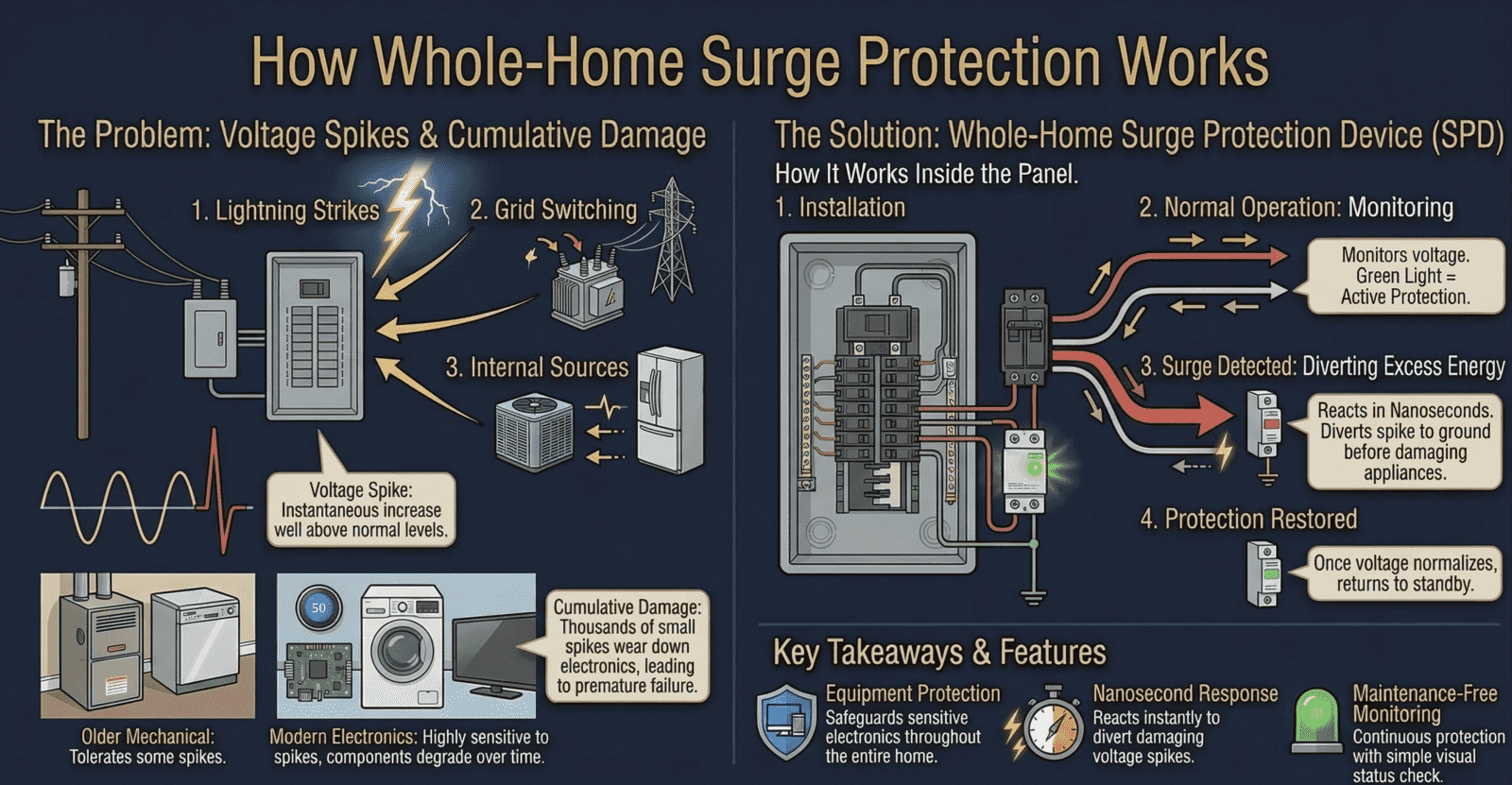
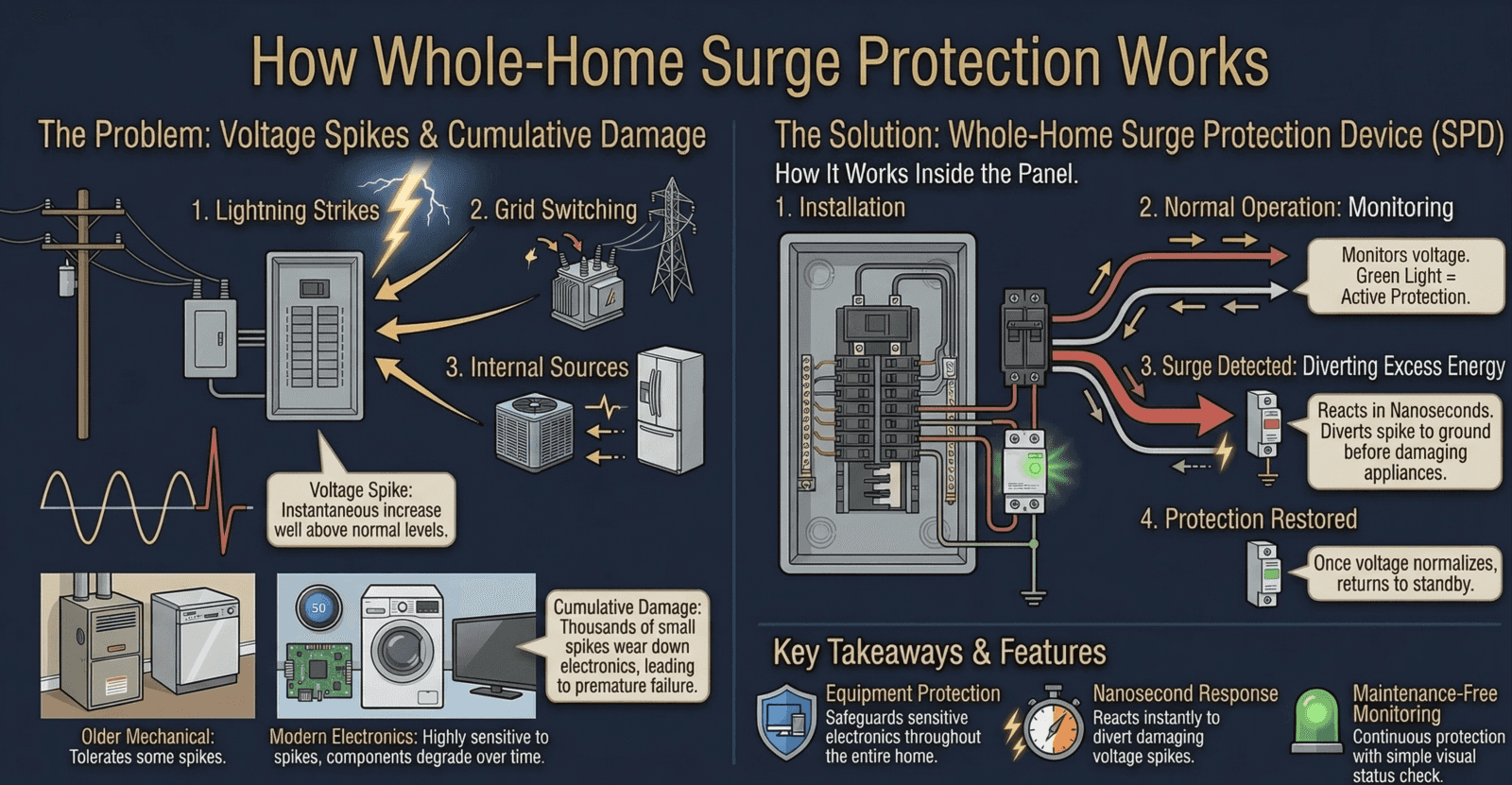
A whole-home surge protector installs at your electrical panel. It connects to a dedicated two-pole breaker and takes up two breaker spaces.
Think of it like a pressure relief valve for your electrical system. Under normal conditions, electricity flows through the panel to your circuits and the device does nothing. It sits there, monitoring voltage.
When voltage spikes above a set threshold, the device reacts in nanoseconds. It redirects the excess energy away from your branch circuits and sends it to the grounding system instead. The spike gets diverted before it reaches your appliances. Once the voltage drops back to normal, the device returns to its monitoring state.
That's it. No moving parts in normal operation. No interaction needed from you. It watches for spikes and diverts them to ground when they happen.
The device has a status indicator light, usually green. Green means it's working. If the light goes out, protection is gone and the unit needs to be replaced. We'll cover that more in the homeowner section below.
What It Doesn't Do
A whole-home surge protector handles voltage spikes from the grid and from your own appliances. But it has limits.
It won't protect against a direct lightning strike to the house. A direct hit carries millions of joules of energy. No panel-mounted device can absorb that. Direct strike protection requires a lightning rod system with dedicated grounding conductors. That's separate equipment, separate installation, separate purpose.
It won't keep the power on during an outage. That's what a battery backup does. A surge protector and a battery backup are different devices that solve different problems.
And it can't undo damage that's already happened. If your electronics have been absorbing small surges for years without protection, that cumulative wear is done. The device protects going forward.
Why the 2023 NEC Requires It
Whole-home surge protection became mandatory in the 2020 NEC (230.67). The 2023 NEC carried that requirement forward and expanded it. Colorado adopted the 2023 NEC statewide, effective August 1, 2023.
The requirement applies to every dwelling unit. And here's the part that matters for existing homes: it's not limited to new construction. Whenever existing electrical service equipment gets replaced or upgraded, NEC 230.67 applies. A panel replacement triggers the requirement.
Why did the code make this mandatory? The reasoning comes down to one thing: protecting the protectors.
Over the past two decades, the NEC has required arc-fault circuit interrupter (AFCI) breakers and ground-fault circuit interrupter (GFCI) breakers in more and more locations throughout the home. Those breakers are the primary defense against electrical fires and electrocution. Our AFCI protection page covers how arc-fault breakers work.
Here's the problem. AFCI breakers run on microprocessors. GFCI breakers rely on sensitive electronic circuitry. Both are vulnerable to voltage spikes. A surge that damages the electronics inside an AFCI breaker can cause it to fail silently. The breaker stays in the panel, looks normal, but can't detect the arcing faults it was installed to catch. The circuit loses its fire protection and nobody knows.
The code made surge protection mandatory because the safety devices that protect your home are themselves vulnerable to surges. Protect the panel, and you protect the breakers that protect the people.
The 2023 NEC also requires that installed surge protectors have a status indicator showing whether the device is still functioning (NEC 242.9). No guessing about whether it's working.
Power Strip vs Whole-Home Protection
Power strips work. For what they're designed to do, they're fine. The problem is that they only solve part of the problem, and most people don't realize that.
A power strip protects the devices plugged into it. One outlet, a few devices. That's its scope. Your TV, your computer, your router. If you bought a quality strip with a decent rating, those devices have some protection.
But your furnace isn't plugged into a power strip. Neither is your air conditioner, your oven, your dryer, your dishwasher, or your garage door opener. All of those are hardwired directly to your panel. A power strip can't reach them.
There's another issue. Power strips wear out silently. The protective components inside them degrade every time they absorb a surge. On many strips, the indicator light stays on even after the protection is gone. You think you're covered, but the strip is just passing power through with nothing between your equipment and the next spike.
The IEEE recommends using both. A whole-home device at the panel handles the big surges from the grid and protects everything downstream, including all the hardwired equipment. Quality point-of-use strips at your sensitive electronics handle any residual that gets through. The panel device is code-required. The point-of-use layer is optional but recommended for computers, home theater systems, and other sensitive equipment.
Why It Matters on the Front Range
Surge protection is code-required everywhere in the country. But on the Colorado Front Range, the local climate makes it especially relevant.
When lightning strikes a utility pole, a transformer, or the ground near a power line, the energy couples into the grid and travels to every home connected to it. The strike doesn't have to hit your house. It just has to hit somewhere on the same grid. That's a grid surge, and that's what the panel device catches.
Colorado's geography produces those grid surges at an unusually high rate. Warm, moist air pushes west from the plains and hits the Rocky Mountains. The mountains force that air upward rapidly, creating the intense afternoon thunderstorms that anyone who's lived here knows well. The storm activity concentrates along the entire Front Range corridor from Fort Collins through Denver to Colorado Springs.
The state ranks 32nd nationally in overall lightning flash density, but that average covers a lot of empty land. The strikes cluster along the populated corridor where the mountains meet the plains. Colorado averages roughly 500,000 cloud-to-ground lightning flashes per year according to the National Lightning Detection Network. A large share of those hit the Front Range during summer storm season.
Every one of those nearby ground strikes sends a transient voltage spike through the local utility infrastructure. Over a full summer, the homes along the Front Range absorb far more grid surges than homes in areas with calmer weather. That's why the device wears out faster here, and why checking the status light matters.
What Homeowners Need to Know
Once it's installed, you don't need to do anything with it. The device sits inside or next to your panel and works on its own. No buttons to press, no settings to adjust.
The one thing to check: the status light. A green light means the device is active and protecting your home. If that light goes out, the device has absorbed too many surges and its protective components are spent. It needs to be replaced.
Typical lifespan runs 5 to 10 years, depending on how many surges the device absorbs. In an area with stable power and low storm activity, you'll land on the longer end. On the Front Range, with heavy summer storm seasons and the occasional grid event, plan for the shorter end.
We include a whole-home surge protector on every panel replacement because the 2023 NEC requires it. It takes up two breaker spaces and connects to your grounding system. When we finish the installation, we show you where the status light is and what to look for.
Frequently Asked Questions
Do I need a whole house surge protector?
Yes. The 2023 NEC requires one on every panel replacement in Colorado. But beyond code, it protects everything in your home that a power strip can't reach. Your furnace, your air conditioner, your garage door opener, your kitchen appliances. None of those plug into a power strip.
Does a surge protector protect against lightning?
It protects against surges caused by nearby lightning strikes and utility grid disruptions. It cannot protect against a direct lightning strike to the home. A direct hit carries too much energy for any panel-mounted device to handle. That requires a separate lightning rod system.
Is a power strip the same as a whole-home surge protector?
No. A power strip protects the devices plugged into that one outlet. A whole-home device protects everything connected to the panel, including hardwired systems like your HVAC and oven. They work best together. The panel device handles the big hits, and a quality power strip handles residual noise for sensitive electronics.
How long does a whole-home surge protector last?
Typically 5 to 10 years. The device degrades with every surge it absorbs. A status light shows whether it is still working. When the light goes out, protection is gone and the unit needs replacement. On the Front Range, where storm activity is heavy, plan for the shorter end of that range.
Why is surge protection required by code now?
Modern safety devices like AFCI breakers run on microprocessors, and GFCI breakers rely on sensitive electronics. A surge that damages those devices disables your home's fire and shock protection. The code made surge protection mandatory to protect the devices that protect you.
Sources
- National Electrical Code (NEC) 2023, Section 230.67 (surge protection requirements), Section 242.9 (status indicator requirements). National Fire Protection Association.
- Colorado Lightning Statistics as Compared to Other States. National Weather Service.
- A High-Resolution Lightning Map of the State of Colorado. American Meteorological Society, Monthly Weather Review.
- Lightning Climatology for the State of Colorado. Hodanish and Wolyn, National Weather Service Pueblo, Colorado. Published by Vaisala.
- State Electrical Board Adopts 2023 National Electrical Code. Colorado Department of Regulatory Agencies (DORA), GovDelivery bulletin.
- UL 1449 5th Edition: Standard for Surge Protective Devices. Underwriters Laboratories.
- Home Fires Caused by Electrical Failure or Malfunction. National Fire Protection Association.
- NEMA Surge Protection Institute FAQs. National Electrical Manufacturers Association.
This page is for informational purposes. Electrical panel work should only be performed by a licensed electrician. Jesse Dunlap is a Colorado Licensed Master Electrician, in the trade since 1998.
Questions About Surge Protection or Your Panel?
Call us or request a free estimate. We'll walk you through what your home needs.