
Electrical Permits in Colorado
An electrical permit is a verification system. You pay a fee, the work gets done, and then a state-certified inspector checks it before anyone covers it up with drywall or turns the power back on. That inspector holds a Journeyman or Master Electrician license with at least five years in the field. The inspection is a peer review, not a rubber stamp.
The permit system exists because of what happened without one. In the 1880s and 1890s, electricity spread faster than the rules governing it. There were no installation standards. Electricians made their own rules. Buildings caught fire. People were electrocuted. Insurance companies started refusing to cover properties with electrical wiring because the losses were unsustainable. That's what led to the first National Electrical Code in 1897: a set of uniform safety standards so someone independent could verify the work before it was covered up and energized.
That's still what a permit does today. Electrical work is hidden. Once the panel is closed and the walls go up, nobody sees what's behind them. The permit process makes sure someone qualified looked at it while it was still visible.
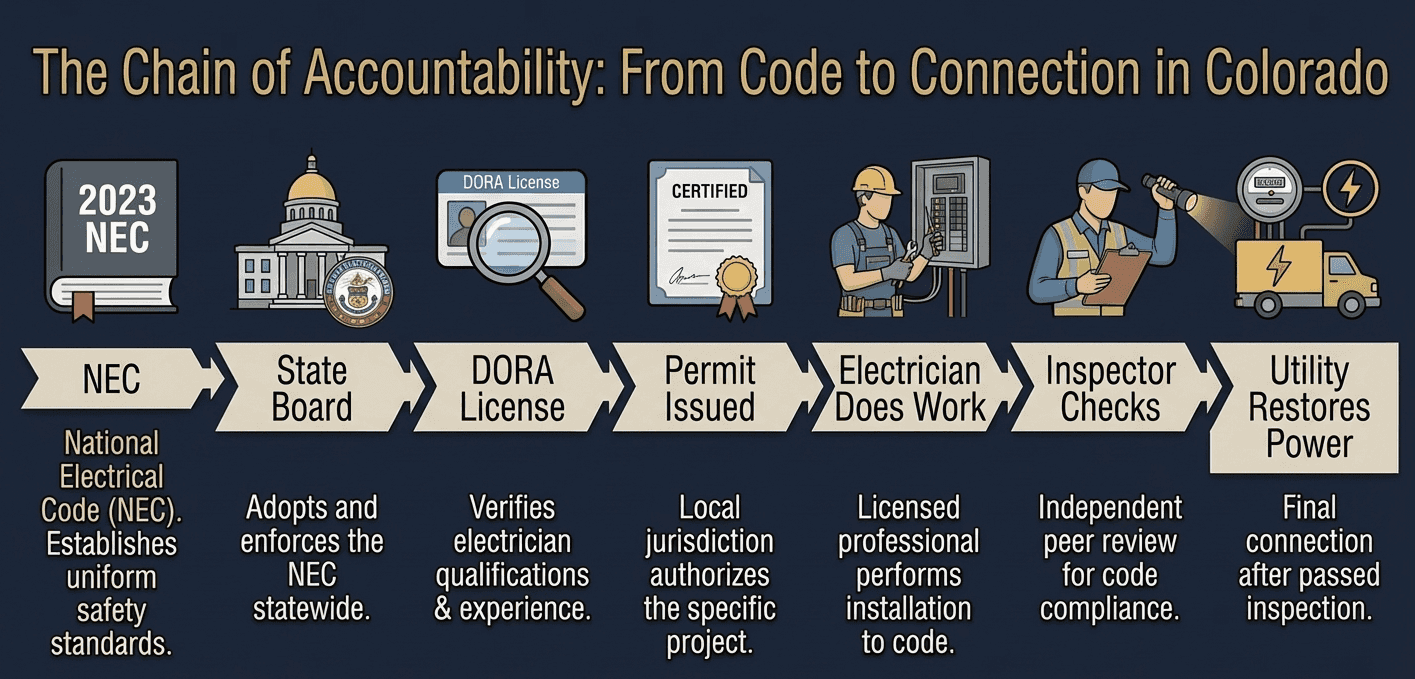
This page covers how electrical permits work in Colorado. Permit requirements, fees, and processes vary by jurisdiction. We handle the permit on every project we do.
What Needs a Permit
Colorado law requires a permit for any new installation, alteration, or extension of a permanent wiring system. In practice, this covers anything that changes how electricity is distributed in your home.
Permit required
- Panel replacements
- Service changes and upgrades
- Subpanel installations
- Transfer switches for generator hookup
- New circuits (EV charger, hot tub, dedicated appliance circuits)
- Any wiring added to a basement finish, addition, or remodel
No permit required
- Replacing an outlet, switch, or light fixture with the same type in the same location
- Replacing a blown fuse with one of the same rating
- Plugging in a cord-and-plug appliance
The line is straightforward. If the work changes the wiring, adds a circuit, or alters how power is distributed, it needs a permit. If it's a like-for-like swap of a device in the same spot, it doesn't.
Permit requirements are consistent across Colorado at the state level, but local jurisdictions can add stricter rules. Some cities require smoke and carbon monoxide detector verification during a panel permit. Others assess use taxes or plan review surcharges on top of the base permit fee. The fees and processes vary by city and county, but the requirement itself doesn't: permitted work gets inspected before it goes into service.
What the Inspector Checks
The inspector is there to verify that the installation meets the currently adopted National Electrical Code. In Colorado, that's the 2023 NEC, adopted statewide on August 1, 2023.
On a panel replacement or service change, the inspector looks at:
- Working clearance. 30 inches wide, 36 inches deep, 78 inches high in front of the panel. Enough room for an electrician to work safely when servicing the panel.
- Grounding and bonding. Ground rods driven to the required depth, cold water bond connected within 5 feet of where the pipe enters the building, all bonds continuous with no splices.
- Circuit protection. AFCI and GFCI breakers installed where your jurisdiction requires them. Surge protection device installed (NEC 230.67). Exterior emergency disconnect (NEC 230.85).
- Wire sizing. Every conductor matched to its breaker rating. No doubled-up connections on terminals designed for a single wire.
- Panel labeling. Every circuit identified by location on the panel directory.
- Removal of hazardous equipment. If the old panel was a documented hazard (Federal Pacific, Zinsco), the inspector verifies it's completely removed, not just disconnected.
The inspector isn't checking your taste in light fixtures or whether you chose the right paint color for the utility room. The inspection is focused on safety: will this installation protect the people living in this house?
Who the inspector is
Colorado requires electrical inspectors to hold a Journeyman or Master Electrician license with at least five years of practical experience in the trade (C.R.S. 12-23-115). When an inspector opens your panel and checks the connections, that's a peer review from someone who's done the same work professionally. Not a general building inspector. Not a code bureaucrat. A licensed electrician.
What Happens Without One
Unpermitted electrical work rarely stays hidden permanently. It surfaces during a home inspection, an insurance claim, a future renovation, or when the utility discovers an altered service.
Insurance
Homeowners insurance is underwritten on the assumption that the home meets local safety codes. If a fire starts in unpermitted wiring, the carrier has grounds to question the claim. That doesn't mean every claim gets denied, but it gives the insurer a reason to investigate and potentially limit or reject coverage for the portion of damage tied to the unpermitted work.
Selling your home
A buyer's inspector or title company may pull permit records. Unpermitted electrical work shows up as a gap: a panel that looks new but has no permit on file. That finding can delay or complicate a closing. Buyers ask for credits. Lenders on FHA and VA loans may refuse to close until the work is verified. Retroactive permits are difficult to obtain because the inspector often needs to see behind finished walls, which means opening drywall that was closed up months or years earlier.
Utility company
Xcel Energy and CORE Electric Cooperative both require a passed inspection before they'll energize an altered service or set a meter. If someone changes a panel or service entrance without a permit and the utility discovers it, they can refuse to reconnect until the permitting and inspection process is completed retroactively.
Code enforcement
If the municipality discovers unpermitted work, they can issue a stop-work order and require the homeowner to bring the work into compliance. That process falls on the property owner, regardless of who performed the work.
What We Handle
We pull the permit, schedule the inspection, and coordinate with the utility. You don't go to the building department, fill out applications, or call the inspector. That's part of the project.
The permit fee varies by jurisdiction, but on a panel replacement or service change, it's typically a small fraction of the total project cost. What that fee buys is an independent, third-party verification that the work is safe, documented, and on file with the municipality. It's the cheapest quality assurance in the project.
Verifying Your Electrician
The Colorado Department of Regulatory Agencies (DORA) maintains a public license lookup on their website. Search by the electrician's name or company name. The results show:
- Whether the license is active or expired
- The license type (Apprentice, Residential Wireman, Journeyman, Master)
- Whether the business is registered as an Electrical Contractor
- A "Board/Program Actions" section that lists any disciplinary history, citations, or fines. A clean record reads: "There is no Discipline or Board Actions on file for this credential."
A licensed master electrician working under a registered electrical contractor is the standard for panel and service work in Colorado. The master license requires 10,000 hours of field experience, specialized supervision hours, and a state exam. The contractor registration requires active insurance and a master electrician as the responsible party for the company.
Licenses renew every three years. Each renewal requires 24 hours of continuing education, including at least 4 hours specifically on changes in the current National Electrical Code. When the NEC updates, every licensed electrician in Colorado is required to learn what changed before they can renew. The person working on your home isn't going off what they learned years ago. More about our background and credentials on the about page.
A licensed electrician performs the work in accordance with the NEC and stakes their professional license and business insurance on the safety of the installation. That's what you're paying for. If two quotes are far apart on the same project, the difference is often what's behind them. The lower price reflects what's missing, not a better deal.
Frequently Asked Questions
Do I need an electrical permit to replace my panel?
Yes. Panel replacements, service changes, subpanel installations, and transfer switches all require an electrical permit in every Colorado jurisdiction. The permit ensures the work is inspected by a qualified electrical inspector before power is restored.
Can I do my own electrical work in Colorado?
Colorado law allows homeowners of single-family detached homes to perform electrical work on their own primary residence. The exemption covers licensing only. You still need to pull a permit, pass inspection, and meet the current NEC. The utility will not restore power without a passed inspection on file.
What happens if electrical work is done without a permit?
Unpermitted electrical work can affect your homeowners insurance coverage if a claim involves the unpermitted work. It can complicate a home sale when the buyer's inspector or lender discovers it. The utility company can refuse to energize a service that was altered without a permit and passed inspection. And the municipality can require the work to be exposed, inspected, and brought up to code at the homeowner's expense.
How do I verify that an electrician is licensed in Colorado?
The Colorado Department of Regulatory Agencies (DORA) maintains a public license lookup tool. You can search by name or license number to verify an electrician's license status, type, and any disciplinary history.
Why does permitted work cost more than hiring someone without a license?
The permit fee itself is a small part of the project cost. The real difference is what's behind it: a licensed master electrician, proper insurance, code-compliant materials, and an independent inspection verifying the work is safe. Work done without a permit skips all of that. The lower price reflects what's missing.
Who does the inspection?
In Colorado, electrical inspectors must hold a Journeyman or Master Electrician license and have at least five years of field experience. The inspection is a peer review by someone who has done the same work professionally.
This page is for informational purposes. References to the National Electrical Code (NEC) are based on the 2023 NEC as adopted by Colorado at the time of writing and are for context only. They do not replace the currently adopted code in your jurisdiction. Your local Authority Having Jurisdiction (AHJ) and electrical inspector determine what applies to your project. Electrical work should only be performed by a licensed electrician. Jesse Dunlap is a Colorado Licensed Master Electrician, in the trade since 1998.
Questions About Your Project?
We handle the permit, the inspection, and the coordination. Free on-site estimates for Lakewood and surrounding communities.