
Do You Need an Electrical Permit?
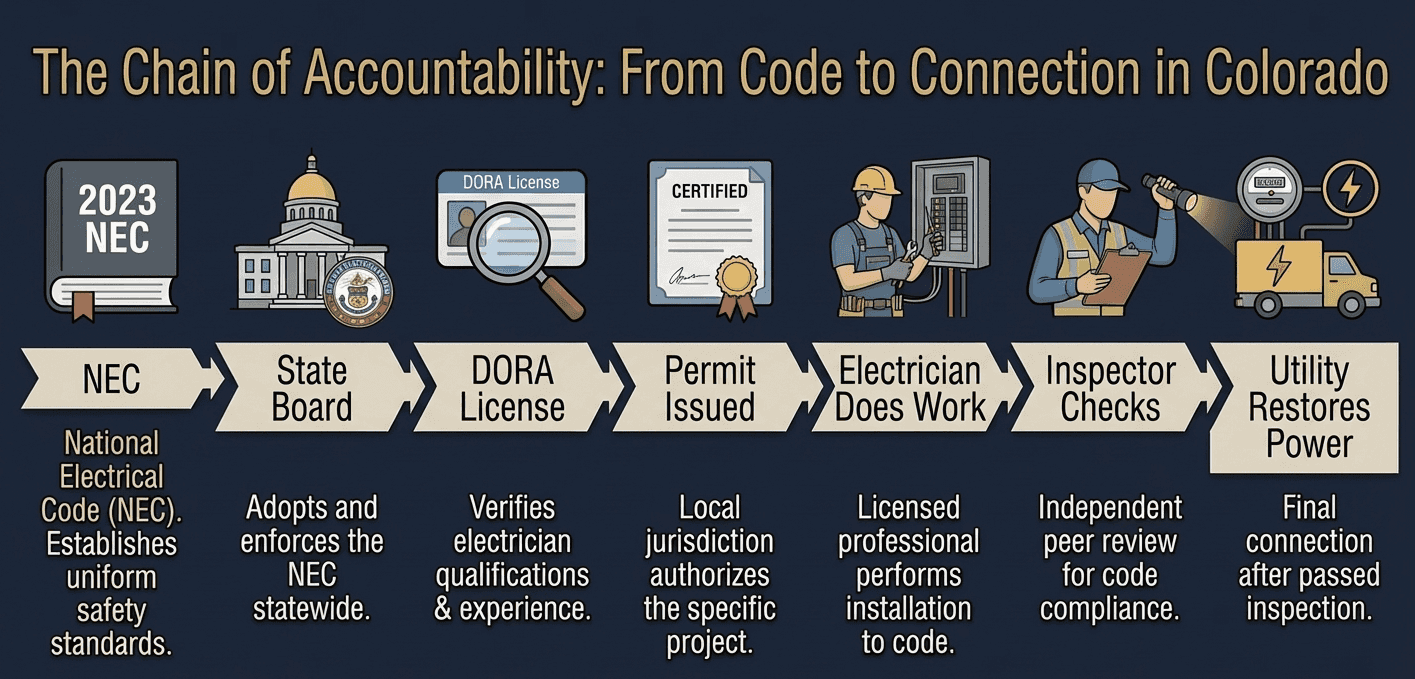
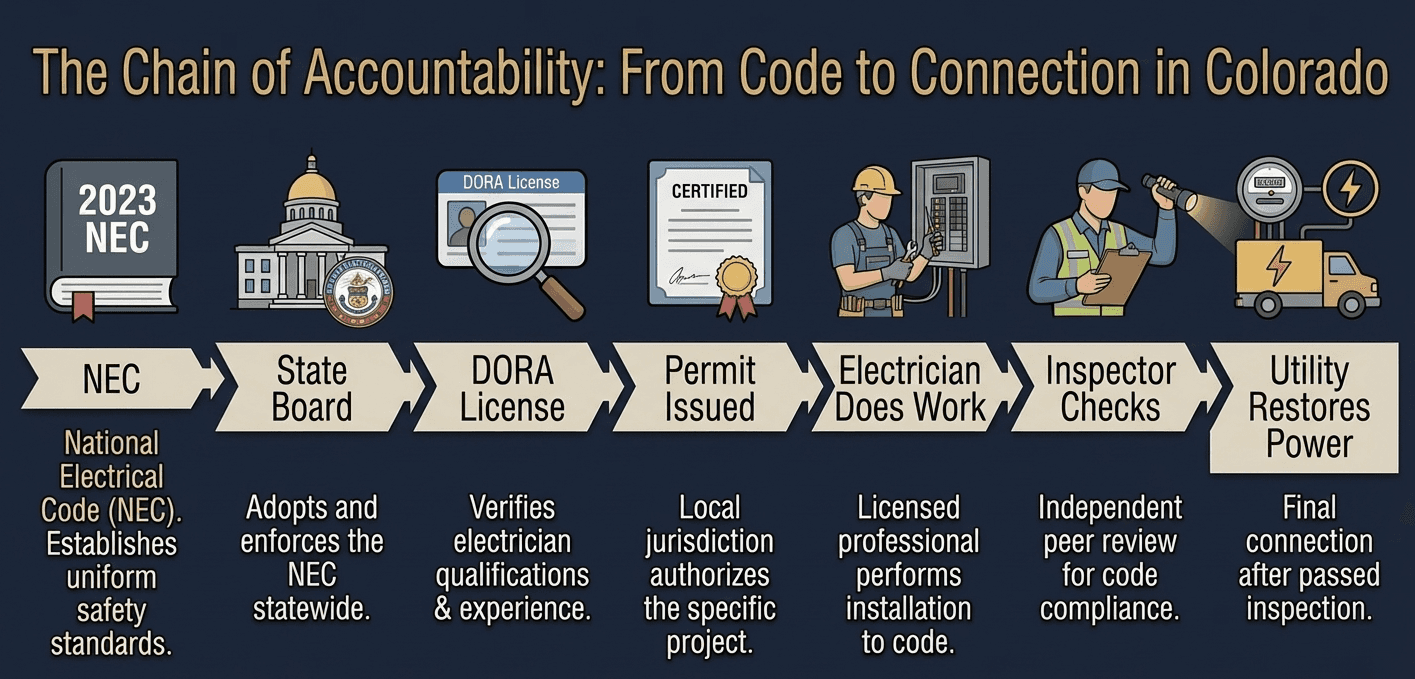
Yes. If you're replacing a panel, upgrading your service, adding a subpanel, or installing a transfer switch or an EV charger, you need a permit. An electrical permit is a verification system: you pay a fee, the work gets done by a licensed contractor, a state-certified inspector checks it, and then the utility restores power. Colorado requires one for any new installation, alteration, or extension of permanent wiring. Below: what needs a permit, who should pull it, what the inspector checks, what happens if work isn't permitted, and what we handle on every project.
What Needs a Permit
Colorado law requires a permit for any new installation, alteration, or extension of a permanent wiring system. If the work changes the wiring, adds a circuit, or alters how power is distributed, it needs a permit. If it's a like-for-like swap of a device in the same spot, it doesn't.
Common projects that require a permit, among others
- Panel replacements
- Service changes and upgrades (overhead or underground)
- Subpanel installations
- Transfer switches for generator hookup
- New circuits (Level 2 EV charger, hot tub, dedicated appliance circuits)
- Wiring added to a basement finish, addition, or remodel
Common projects that don't
- Replacing an outlet, switch, or light fixture with the same type in the same location
- Replacing a blown fuse with one of the same rating
- Plugging in a cord-and-plug appliance
These lists are examples, not a complete catalog. When in doubt, the general rule above is what applies: wiring changes need a permit; device-for-device swaps in the same spot don't.
Who Should Pull the Permit
This is where homeowners run into trouble. There are three ways a permit gets pulled in Colorado, and they carry very different levels of protection.
Your electrician pulls it under their license
This is the standard for any permitted electrical work. A registered Electrical Contractor files the permit under their company's license. The work, the inspection, and the liability are on them. If the work fails inspection, the contractor fixes it. If something goes wrong down the road, the contractor's insurance and license are behind the installation.
You pull it yourself as the homeowner
Colorado allows homeowners of single-family detached homes to perform electrical work on their own primary residence. This is a licensing exemption only. You still need the permit, you still need to pass inspection, and the work still has to meet the current National Electrical Code (NEC). Utilities in Colorado typically will not restore power without a passed inspection on file.
This exemption was written for homeowners who genuinely do the work themselves. It does not apply to townhomes, condos, or duplexes in most jurisdictions.
Your contractor tells you to pull it for work they're doing
When the permit is in your name, the liability for the work is yours. That's true even if you didn't do the work. The municipal inspector's authority runs to the permit holder. If the work fails, you're the one responsible for correcting it.
In Colorado, state regulations specifically prohibit a contractor from performing electrical work under a homeowner's permit. Colorado's Department of Regulatory Agencies (DORA) rules require the contractor to pull a permit in their own name (3 CCR 710-1). The homeowner exemption exists for homeowners doing their own work. When a contractor or handyman asks you to pull the permit for work they plan to perform, they're asking you to assume the legal responsibility for their installation.
We pull the permit under our own license because we stand behind our work. A homeowner permit isn't for covering a contractor's work.
Planning a project? Text us a photo of your panel. We'll walk the job with you and lay out the scope, the jurisdiction, and the timeline from permit to power. Text us a photo →
What the Inspector Checks
The inspector verifies that the installation meets the currently adopted National Electrical Code. In Colorado, that's the 2023 NEC, adopted statewide on August 1, 2023.
The inspector is a licensed electrician checking another electrician's work. Colorado requires electrical inspectors to hold a Journeyman or Master Electrician license (C.R.S. 12-115-119). The inspection is a peer review from someone who has done the same work professionally.
These requirements apply under the 2023 NEC as adopted in Colorado (current as of April 20, 2026). Your local Authority Having Jurisdiction (AHJ) may have additional or different requirements. Codes update on regular cycles, so this page may not reflect the current cycle; check directly with your building department for your specific project.
On a panel replacement or service change, the inspector looks at:
- Working clearance. 30 inches wide, 36 inches deep, 78 inches high in front of the panel.
- Grounding and bonding. Ground rods driven to the required depth, cold water bond connected, all bonds continuous.
- Circuit protection. Arc-fault circuit interrupter (AFCI) and ground-fault circuit interrupter (GFCI) breakers where required. Surge protection device installed (NEC 230.67). Exterior emergency disconnect (NEC 230.85).
- Wire sizing. Every conductor matched to its breaker rating. No double-tapped connections on terminals designed for a single wire.
- Panel labeling. Every circuit identified on the panel directory.
- Removal of hazardous equipment. If the old panel was a documented hazard (Federal Pacific, Zinsco), the inspector verifies it's completely removed.
The inspection is focused on safety: will this installation protect the people living in this house? Once it passes, the work is documented, on file with the municipality, and the utility can restore power.
What Happens Without One
Unpermitted electrical work rarely stays hidden permanently. It surfaces during a home sale, an insurance claim, a future renovation, or when the utility discovers an altered service.
Insurance
Homeowners insurance is generally underwritten on the assumption that the home meets local safety codes. If a fire or other damage involves unpermitted wiring, the carrier may investigate whether the unpermitted work contributed to the loss. That investigation could affect coverage. The permit and passed inspection create a documented record that the work was checked and met code at the time of installation. Without that record, there's no third-party verification to point to.
Insurance carriers are not bound by local building code grandfathering. Even if your municipality considers an older system "grandfathered," a carrier may evaluate it differently under their own underwriting criteria. Unpermitted work has been cited as a factor in coverage disputes and policy cancellations.
Selling your home
A buyer's inspector or title company may pull permit records. Unpermitted electrical work shows up as a gap: a panel that looks new but has no permit on file. That finding can delay or kill a closing.
Buyers ask for credits or demand the work be corrected before closing. Lenders on FHA and VA loans may refuse to fund until the work is verified. Retroactive permits are difficult because the inspector needs to see the wiring, which often means opening finished walls that were closed up months or years earlier.
Utility
Utilities in Colorado, such as Xcel Energy and CORE Electric Cooperative, require a passed inspection before they'll energize an altered service or set a meter. If the inspection fails or the paperwork isn't right, the utility doesn't reconnect until everything clears. That can mean days without power after the work is done. A contractor who doesn't navigate permits and inspections carefully exposes you to that delay.
The same rule applies if unpermitted work is discovered later. If the utility finds an altered service without a permit, they can refuse to reconnect until the permitting and inspection process is completed. Either way: no power until the work is brought into compliance.
Municipal enforcement
If the municipality discovers unpermitted work, they can issue a stop-work order and require the homeowner to bring the work into compliance at the homeowner's expense. Retroactive permit fees are typically higher than standard permit fees. The work falls on the property owner regardless of who performed it.
I Found Unpermitted Work in My Home
If you bought a home and discovered that a previous owner did electrical work without a permit, you're not the first. Finished basements, added circuits, and panel swaps done without permits are common findings during renovations and home sales.
Many Colorado municipalities, such as Denver, Lakewood, Arvada, Golden, Jefferson County, Douglas County, and Arapahoe County, have a retroactive permit process for unpermitted work discovered after purchase. The process typically involves pulling a retroactive permit and having the work inspected. That can mean opening finished walls so the inspector can see the wiring. The scope depends on what the inspector needs to verify.
Retroactive permits usually require the inspector to see enough of the work to verify compliance, which can mean opening finished walls. The scope of the rework depends on the inspector's judgment and the electrician navigating the process. If the problem surfaces during a sale or remodel, a licensed electrician familiar with your local building department is the right starting point.
What's Actually Involved
A permitted electrical project involves more than the day the work gets done. Before your electrician ever touches a wire, someone has to figure out which building department handles your address. Municipalities such as Lakewood, Arvada, Golden, and Denver each have their own portal, and Jefferson, Douglas, and Arapahoe Counties each have theirs.
The permit gets filed through that portal. The utility disconnect application, whether Xcel Energy, CORE Electric, or whichever utility serves your address, gets submitted and scheduled around the utility's timeline. The inspector gets lined up for after the work is complete. None of that is the work itself. All of it has to happen for the work to finish.
We handle all of it.
Here's what that covers on every project we pull a permit for:
- Jurisdiction identification. Lakewood, Arvada, Golden, Denver, Jefferson County, Douglas County, and Arapahoe County, among others, all have different building departments, different portals, and different processes. Some homes with a Lakewood mailing address are actually in unincorporated Jefferson County. We figure out which office handles your address before the project starts.
- Permit filing. We submit the application, pay the fee, and manage the paperwork. You don't visit any office or create an account in any portal.
- Utility coordination. Panel replacements and service changes require the utility, whether Xcel Energy, CORE Electric, or whichever utility serves your address, to disconnect and reconnect power. We submit the disconnect request, schedule the work around the utility timeline, and confirm the reconnect. You don't call the utility company.
- Inspection scheduling. After the work is complete, we schedule the city or county inspector. If anything needs correction, we handle it and reschedule. You don't manage the inspection process.
The permit fee on a panel replacement or service change is typically a small fraction of the total project cost. What that fee buys is an independent, third-party verification that the work is safe, documented, and on file. It's the cheapest quality assurance in the project.
Verifying Your Electrician
The Colorado Department of Regulatory Agencies (DORA) maintains a public license lookup on their website. Search by the electrician's name or company name. The results show:
- Whether the license is active or expired
- The license type (Apprentice, Residential Wireman, Journeyman, Master)
- Whether the business is registered as an Electrical Contractor
- A "Board/Program Actions" section that lists any disciplinary history, citations, or fines. A clean record reads: "There is no Discipline or Board Actions on file for this credential."
A licensed master electrician working under a registered electrical contractor is the standard for panel and service work in Colorado. The master license requires 10,000 hours of field experience, supervised work under another master, and a state exam. The contractor registration requires active insurance and a master electrician as the responsible party.
Licenses renew every three years. Each renewal requires 24 hours of continuing education, including at least 4 hours specifically on changes in the current National Electrical Code. The person working on your home isn't going off what they learned years ago. More about our background and credentials on the about page.
If two quotes are far apart on the same project, the cheaper one is usually leaving something out.
Frequently Asked Questions
Do I need an electrical permit to replace my panel?
Yes. Panel replacements, service changes, subpanel installations, and transfer switches all require an electrical permit in every Colorado jurisdiction. The permit ensures the work is inspected by a licensed electrical inspector before power is restored.
My contractor told me to pull the permit. Is that normal?
No. In Colorado, the homeowner permit exemption is meant for homeowners doing the work themselves on their own single-family home. If someone else is doing the electrical work, that person needs to be a licensed electrical contractor pulling the permit under their own license. When a contractor asks you to pull the permit for work they're performing, the liability for that work shifts to you.
Does my electrician need to be a master electrician to pull a permit?
In Colorado, electrical permits are pulled by registered Electrical Contractors. The contractor registration requires a master electrician as the responsible party. A journeyman electrician can perform the work, but the permit is tied to the contractor registration and the master electrician behind it.
Could unpermitted work affect my insurance coverage?
It could. Insurance carriers generally assume the home meets local safety codes. If a loss involves unpermitted electrical work, the carrier may investigate whether the unpermitted work was a contributing factor. That investigation could affect the outcome of a claim. The permit and inspection create a documented record that the work was checked by a licensed inspector and met code at the time of installation.
I bought a house and found unpermitted electrical work. What do I do?
Contact a licensed electrician. Many Colorado municipalities have a retroactive permit process for unpermitted work discovered after purchase. The process usually involves pulling a retroactive permit and having the work inspected. Finished walls may need to be opened so the inspector can see the wiring. A licensed electrician familiar with your local building department can navigate the process.
Who does the electrical inspection?
In Colorado, electrical inspectors must hold a Journeyman or Master Electrician license (C.R.S. 12-115-119). The inspection is a peer review: a licensed electrician checks another licensed electrician's work, verifying the installation meets the adopted electrical code before the utility restores power.
Why does permitted work cost more than hiring someone without a license?
The permit fee itself is a small part of the project cost. The real difference is what's behind it: a licensed master electrician, proper insurance, code-compliant materials, and an independent inspection verifying the work is safe. Work done without a permit skips all of that. The lower price reflects what's missing.
Sources
- Colorado Revised Statutes, Title 12, Article 115: Electricians and Electrical Contractors. Licensing requirements and homeowner exemption.
- C.R.S. 12-115-119. Electrical inspector qualification requirements: Journeyman or Master Electrician license.
- Colorado Department of Regulatory Agencies (DORA). State Electrical Board Rules and Regulations, 3 CCR 710-1. Permits, inspections, and contractor/homeowner permit scope.
- Colorado Department of Regulatory Agencies (DORA). State Electrical Board adoption of the 2023 National Electrical Code, effective August 1, 2023.
- National Fire Protection Association. NFPA 70: National Electrical Code, 2023 Edition.
- National Association of Insurance Commissioners (NAIC). Consumer guidance on homeowners insurance policies and code-compliance assumptions.
- Industry sources on insurance-vs-code-compliance distinction and policy cancellation on discovery of unpermitted work: Harry Levine Insurance; Anderson & Associates; RISMedia; Econosurance.
- Utility company service-requirement documentation: Xcel Energy Electric Service Requirements; CORE Electric Cooperative Electric Service Rules and Regulations. Utility-company policy for service-change and new-meter energization, including inspection-record requirements before meter-set or reconnect.
- Colorado municipal building department documentation for retroactive / after-the-fact permit processes across jurisdictions including Denver, Lakewood, Arvada, Golden, Jefferson County, Douglas County, and Arapahoe County. Converging sources include Pikes Peak Regional Building Department retroactive-permit documentation and industry-source case reporting.
This page is for general education only. Every home, panel, and wiring configuration is different. Nothing here replaces a hands-on look by a licensed electrician who can see your specific setup. This information is based on current Colorado front-range standards. Building codes change frequently and vary by municipality; your local Authority Having Jurisdiction (AHJ) and electrical inspector determine what applies to your project. References to the National Electrical Code (NEC) are based on the 2023 NEC as adopted by Colorado at the time of writing and are for context only. If you have questions about your electrical system, talk to a qualified professional before making decisions. Electrical work should only be performed by a licensed electrician.
Get the Permit Pulled Right the First Time
We handle the permit, the inspection, and the utility coordination on every job we do.
There's no charge for the assessment. No obligation. Or call (303) 775-3221 directly.