
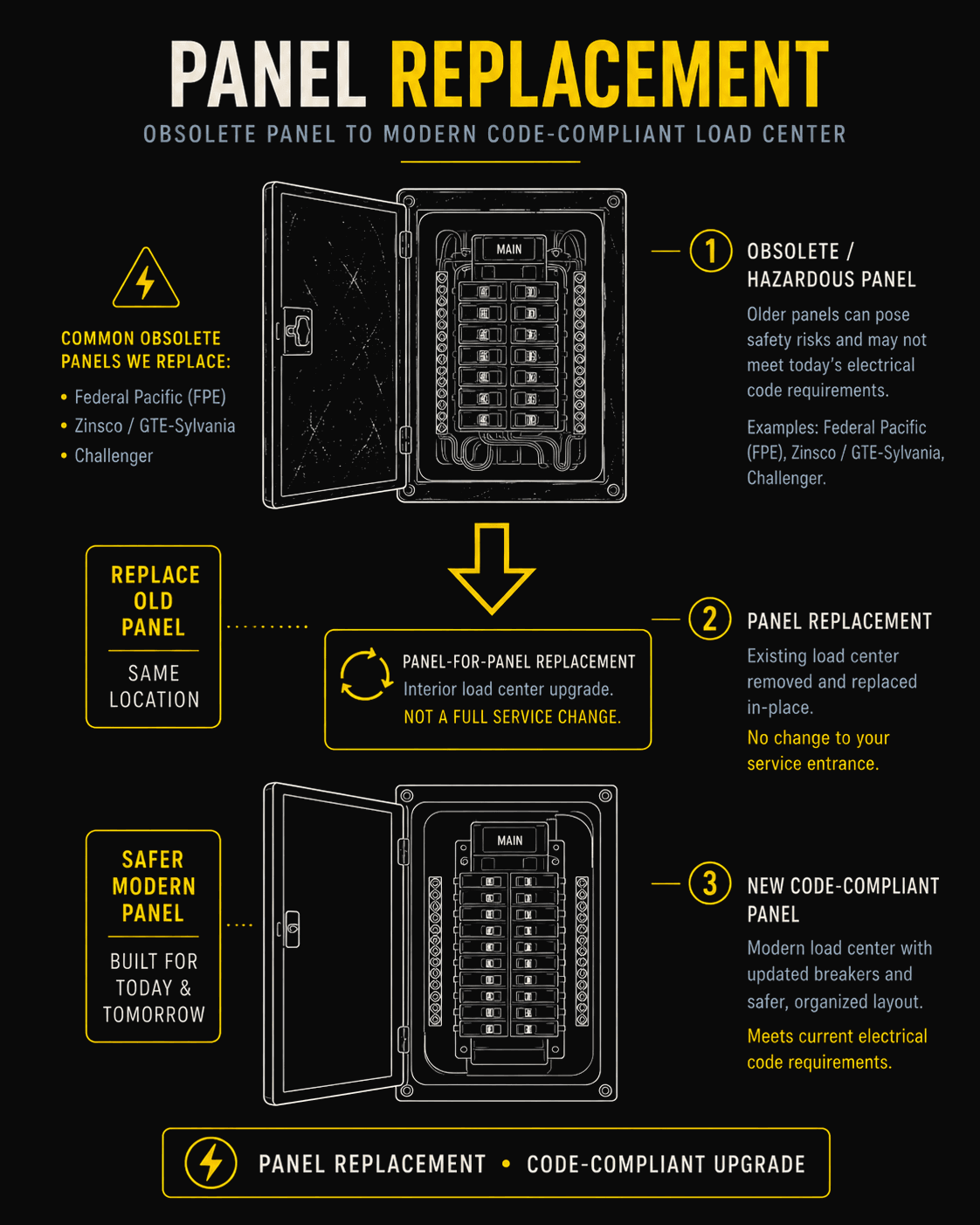
Where your panel lives depends on the house. Many are indoor-rated NEMA Type 1 enclosures (National Electrical Manufacturers Association) mounted in a garage, basement, utility closet, or hallway. Along the Front Range, many are outdoor-rated (NEMA 3R) on an exterior wall. Some of those are standalone panels fed from a separate meter, and they swap much like an indoor panel. Others are combined meter-mains, where the meter and the panel are one unit, so replacing them pulls in the meter base and becomes a service change. In a straight panel replacement we remove the old panel and install a new one with new breakers, and the service entrance, the meter, and your amperage stay the same.
What Gets Replaced
The panel is the box that divides your home's electricity into individual circuits. Each circuit has its own breaker. When one of those circuits draws too much current, the breaker trips and cuts power to that circuit before the wiring overheats.
In a panel replacement, we remove the old enclosure, bus bars, breakers, and all the internal wiring connections. A new panel goes in the same location. Every circuit in the house gets reconnected to the new equipment.
The service entrance (the wires from the utility to your meter, and from your meter into the panel) stays in place. Your amperage doesn't change. If the service entrance also needs work, that's an expanded project called a service change.
Under the 2023 National Electrical Code (NEC), the new panel requires surge protection, an exterior emergency disconnect, and circuit protection the original panel never had.
Why Panels Get Replaced
Panels come out for a handful of reasons: a brand with documented safety defects, a panel that's obsolete and can't accept modern protection, an insurance carrier or home inspector flagging it, or a panel that's actively failing (breakers that won't stay on, buzzing from the enclosure, scorch marks, or a burning smell). The insurance and inspection cases usually need the same thing on record: a permitted replacement with a passed final inspection.
Which reason applies to you depends on what's on your wall. Each panel type has its own story, and the panel guides cover what's wrong with each one, the insurance and home-sale implications, and how to identify it: Federal Pacific, Zinsco, Challenger, Pushmatic, fuse boxes, and split-bus panels.
What the 2023 NEC Requires on a Panel Replacement
Colorado adopted the 2023 NEC statewide. When a panel gets replaced, the new installation has to meet these standards. Local jurisdictions can add stricter requirements on top.
Whole-home surge protection
A Type 1 or Type 2 surge protective device is required on all new or replaced services serving dwelling units (NEC 230.67). It protects electronics and appliances from voltage spikes on the grid.
Exterior emergency disconnect
An accessible disconnect on the outside of the home is required so first responders can cut power before entering (NEC 230.85). On homes where the panel is inside, this means adding a disconnect between the meter and the panel. That's work on the exterior of the house, not just inside at the panel.
Arc-fault and ground-fault protection
Arc-Fault Circuit Interrupters (AFCI) detect dangerous electrical arcing that can start fires inside walls. Ground-Fault Circuit Interrupters (GFCI) shut off power when electricity flows through an unintended path, like through water or a person. The 2023 NEC defines where each is required: AFCI on most 120-volt living-space circuits (NEC 210.12), GFCI on circuits serving bathrooms, kitchens, garages, outdoors, basements, and other specified areas.
How AFCI and GFCI apply to a straight panel replacement depends on the local jurisdiction. Some require full protection on every panel replacement. Others only require it when existing circuits are modified. We confirm what your jurisdiction requires before quoting the job. When AFCI isn't required by the local authority, we offer it as an option and walk through the trade-offs: the added protection is real, and so is the cost and the possibility of nuisance tripping in older homes. Our AFCI protection page covers how it works, what drives the cost, and the tripping issue.
Surge protection and the exterior disconnect are required statewide on every panel replacement. AFCI and GFCI requirements vary by jurisdiction. The inspector checks all applicable requirements before signing off.
Panel Replacement vs. Service Change
A panel replacement swaps the distribution equipment while the wires from the street, the meter, and your amperage stay in place. A service change goes further, replacing the service entrance conductors, meter base, and panel, and it can increase your amperage. It's a bigger project with a longer timeline because it involves utility coordination for the disconnect and reconnect.
Which one you need comes down to two things: whether your home needs more power than it's set up to receive, and whether the existing service entrance equipment is still sound. If your demand fits your current amperage and the meter base and wiring are in good shape, a panel replacement handles it; if not, it's a service change. We determine which applies during the on-site evaluation. The service change page lays out the full side-by-side comparison and what each project involves.
The Process
On-site evaluation
We look at the panel, the service entrance, the wiring condition, and local code requirements. No quote gets written without seeing the panel first.
Permit
Panel replacements require a permit in every Colorado jurisdiction. We pull the permit and handle the paperwork. The permit fee and the time to file and coordinate everything is part of the project.
Power disconnection
We can't work on the panel with power flowing through it. Depending on your meter setup, power is disconnected through a lever bypass at the meter or by coordinating with your utility provider (Xcel Energy for most of our service area, though some areas are served by other providers). We handle whichever applies.
The work day
Power goes off in the morning. The old panel comes out. The new panel goes in. Every circuit gets reconnected and tested. Power is off for the full working day. Refrigerators and freezers hold safe temperatures with the doors closed through the day.
We need access to every room in the house to trace circuits and verify the panel directory.
Inspection
The city or county inspector reviews the installation. Once it passes, power is restored.
Documentation
You get a passed inspection on file with the jurisdiction and a panel directory identifying every circuit by location. We provide a 1-year parts warranty from the date of final inspection and a workmanship warranty. Full warranty terms →
Payment
A 50% deposit is due when the work is scheduled, which locks in the date and lets us start the permit and utility coordination. The remaining 50% is due after the inspection passes and power is restored.
Planning Ahead
A straight panel replacement doesn't trigger Colorado's Electric Ready requirements (HB 22-1362). Those apply to new construction and major renovations, not maintenance-level electrical work.
But if you're replacing a panel anyway, there's one decision worth making now: the internal busbar size. A slightly larger busbar costs very little more at the time of installation, but it determines how much solar your home can support later under NEC interconnection rules (NEC 705.12). Choosing the smaller option now could mean replacing the panel a second time if you add solar, an electric vehicle (EV) charger, or a heat pump later.
This isn't a code requirement on a straight panel replacement. We bring it up during the evaluation so you can make an informed decision while the panel is already open.
Frequently Asked Questions
How long does a panel replacement take?
Most are completed in one day. Complex panels with high circuit counts or significant conduit work can extend the timeline, but single-day completion is typical.
Will I need to be home during the panel replacement?
Yes. We need access to every room to trace and identify circuits. Pets should be secured. The inspector also needs access for the final inspection.
Do I need a permit for a panel replacement in Colorado?
Yes. Colorado law requires an electrical permit for any work on the service equipment. The permit ensures the installation gets inspected by a third party before permanent power is restored. Unpermitted work can void insurance coverage and create problems when selling the home.
What happens if the inspection doesn't pass?
We correct whatever the inspector flags and schedule a re-inspection. The job isn't finished until it passes.
Will my new AFCI breakers trip more than my old ones?
They can. AFCI breakers detect electrical arcing, and they're more sensitive than standard breakers. Older appliances with worn motors (vacuums, treadmills, older power tools) can produce minor operational arcs that AFCI breakers will catch. A trip after the replacement usually means the breaker is detecting something in the circuit that the old breaker was ignoring. Our AFCI protection page covers this in detail.
Should I upgrade to 200 amps while the panel is being replaced?
Only if you need more capacity. A panel replacement keeps your existing amperage. If your loads work within that, a panel replacement is the right scope. If you're planning to add an EV charger, heat pump, or other large loads, that's a different project (a service change) and we assess it during the evaluation.
Who does the work at Dunlap Electric?
The master electrician who evaluates your panel oversees the work through final inspection. A panel replacement is scoped to the panel and breakers. The amperage, meter base, and service entrance stay in place.
This page describes general project scope and is not a quote, diagnosis, or commitment. References to the National Electrical Code (NEC) are based on the 2023 NEC as adopted by Colorado at the time of writing and are for context only. They do not replace the currently adopted code in your jurisdiction. Your local Authority Having Jurisdiction (AHJ) and electrical inspector determine what applies to your project. The specific scope and requirements for your home can only be determined by a licensed electrician during an on-site evaluation.
Need Your Panel Evaluated?
Free on-site evaluation across the Denver metro.