
Why Backup Power Matters Along the Front Range
In April 2024, Xcel Energy shut off power to over 52,000 customers across the Denver foothills. Wind gusts up to 100 mph threatened to bring down power lines, and Xcel de-energized 680 miles of distribution lines rather than risk a wildfire. Some areas went four days without service. That was the first Public Safety Power Shutoff (PSPS) in Colorado. It won't be the last. Xcel has committed $1.9 billion to wildfire mitigation, and planned shutoffs are now a formal part of that program.
Even without planned shutoffs, the foothills lose power more often than the metro. Genesee, Evergreen, and Conifer each average six to nine hours of outage per year from routine equipment failures alone. Storm damage can add days.
Four hours without power in January and the house is losing heat. A well pump goes down and there's no running water. A freezer full of food starts to thaw. Medical devices like a CPAP or oxygen concentrator shut off. A generator helps with all of this, but only if there's a safe way to connect it to the house.
What Backfeeding Is and Why It's Dangerous
Backfeeding kills people. A generator plugged directly into a wall outlet sends power backward through the meter and onto the utility lines. A utility worker restoring service after a storm expects a dead line. If a generator is backfeeding, that line is carrying voltage. OSHA has documented fatalities from this exact scenario.
The National Electrical Code (NEC), Article 702, requires a transfer mechanism that physically prevents utility and generator power from being connected to the house at the same time. A transfer switch does this mechanically. When the switch is in the Generator position, the utility side is disconnected. No path for power to flow backward.
Never run a generator indoors or in an attached garage, even with the door open. Carbon monoxide is odorless and kills within minutes. Place the generator at least 20 feet from any window, door, or vent, and point the exhaust away from the house.
How a Transfer Switch Works
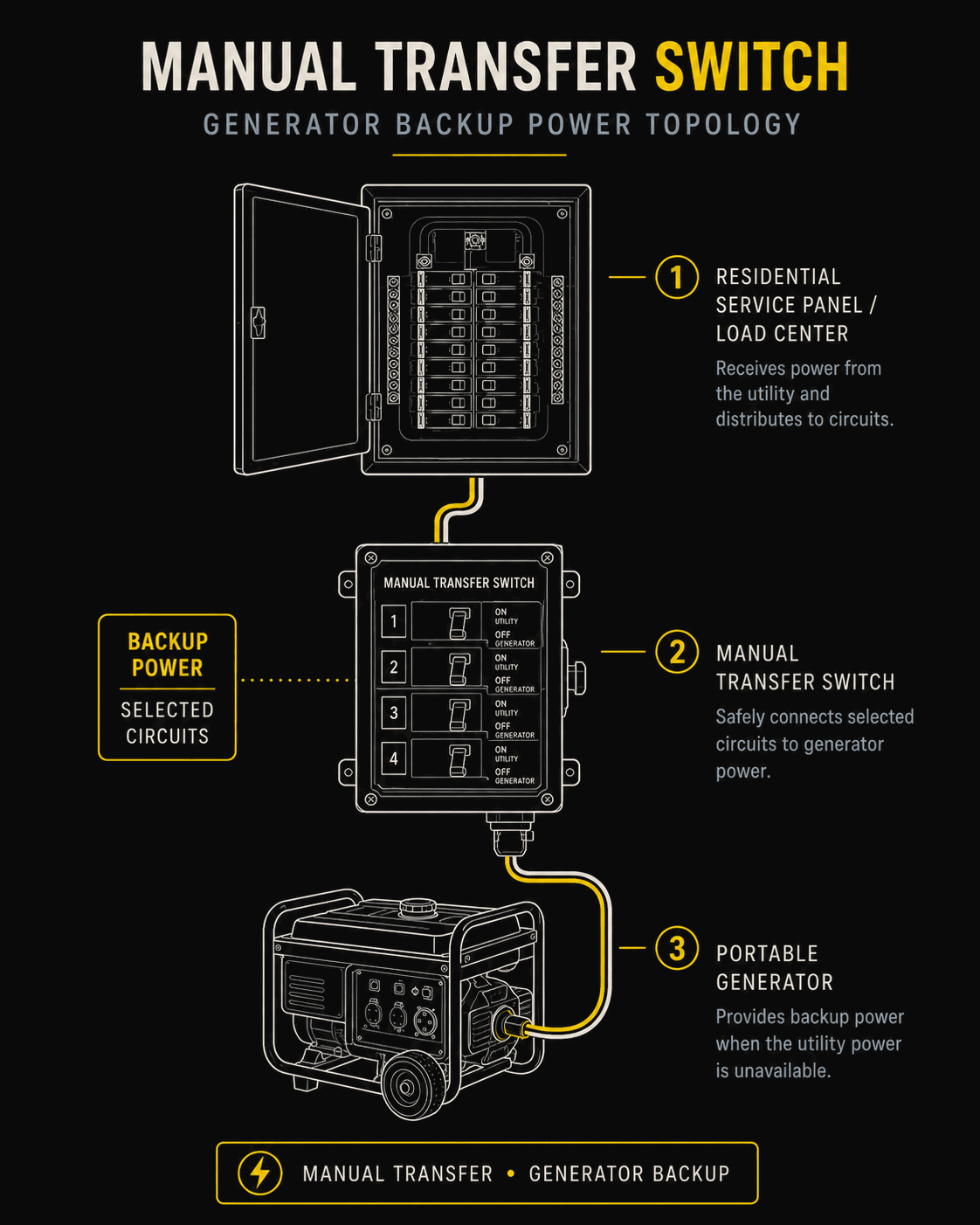
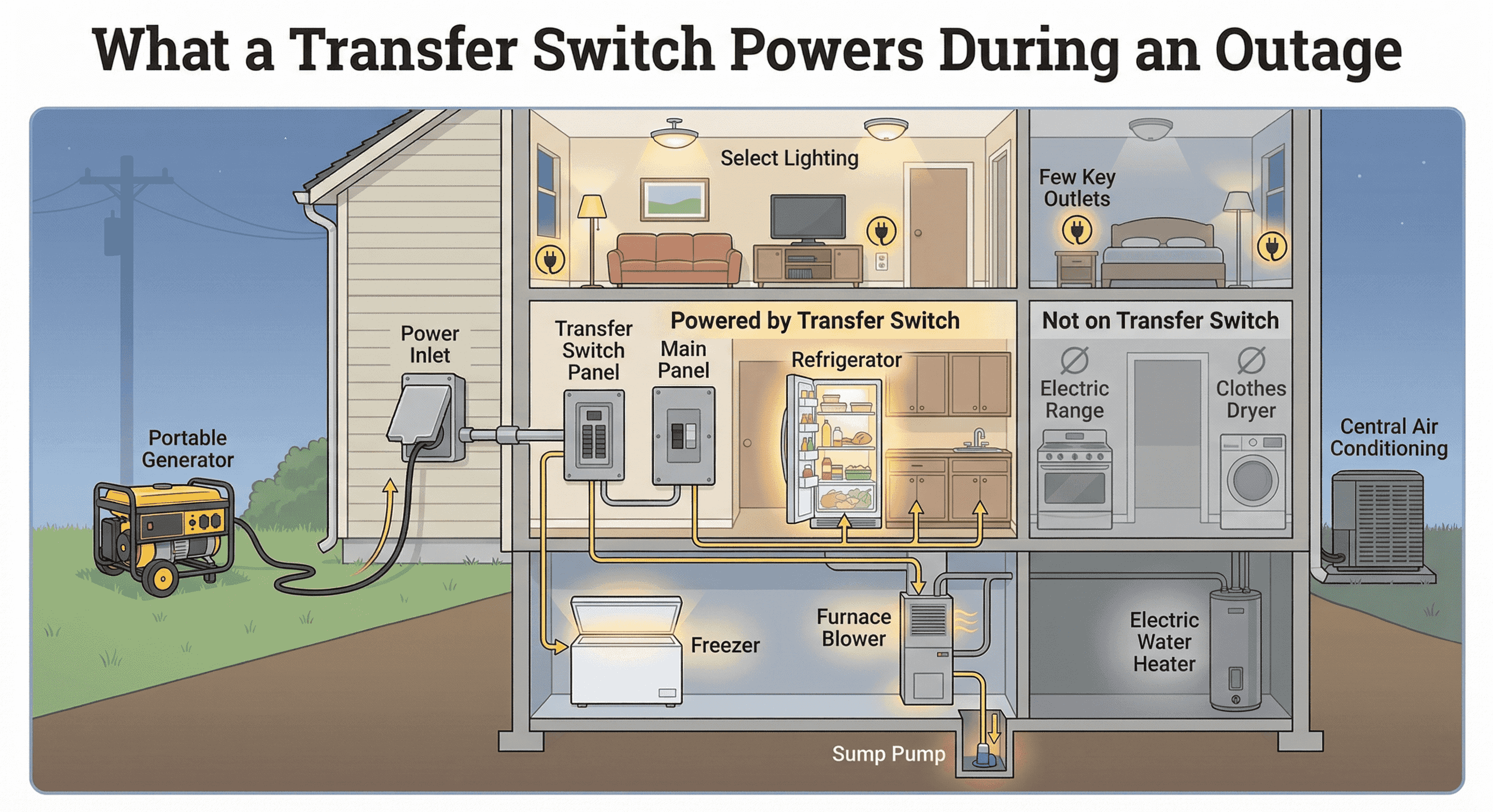
A manual transfer switch is a small panel mounted next to your main electrical panel. It has its own breakers for the circuits you select. An inlet box mounts on the exterior of your house, and a cord runs from your generator to that inlet.
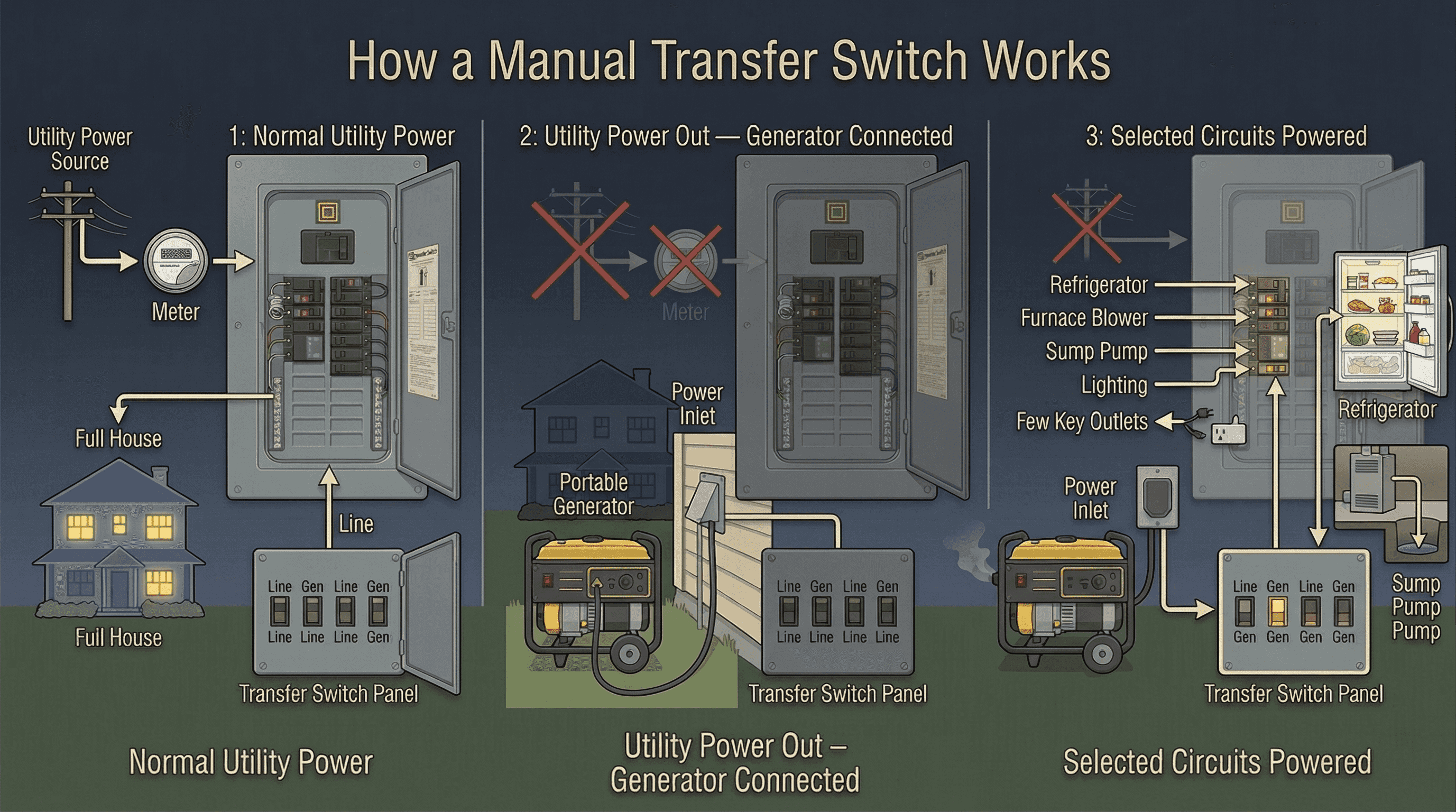
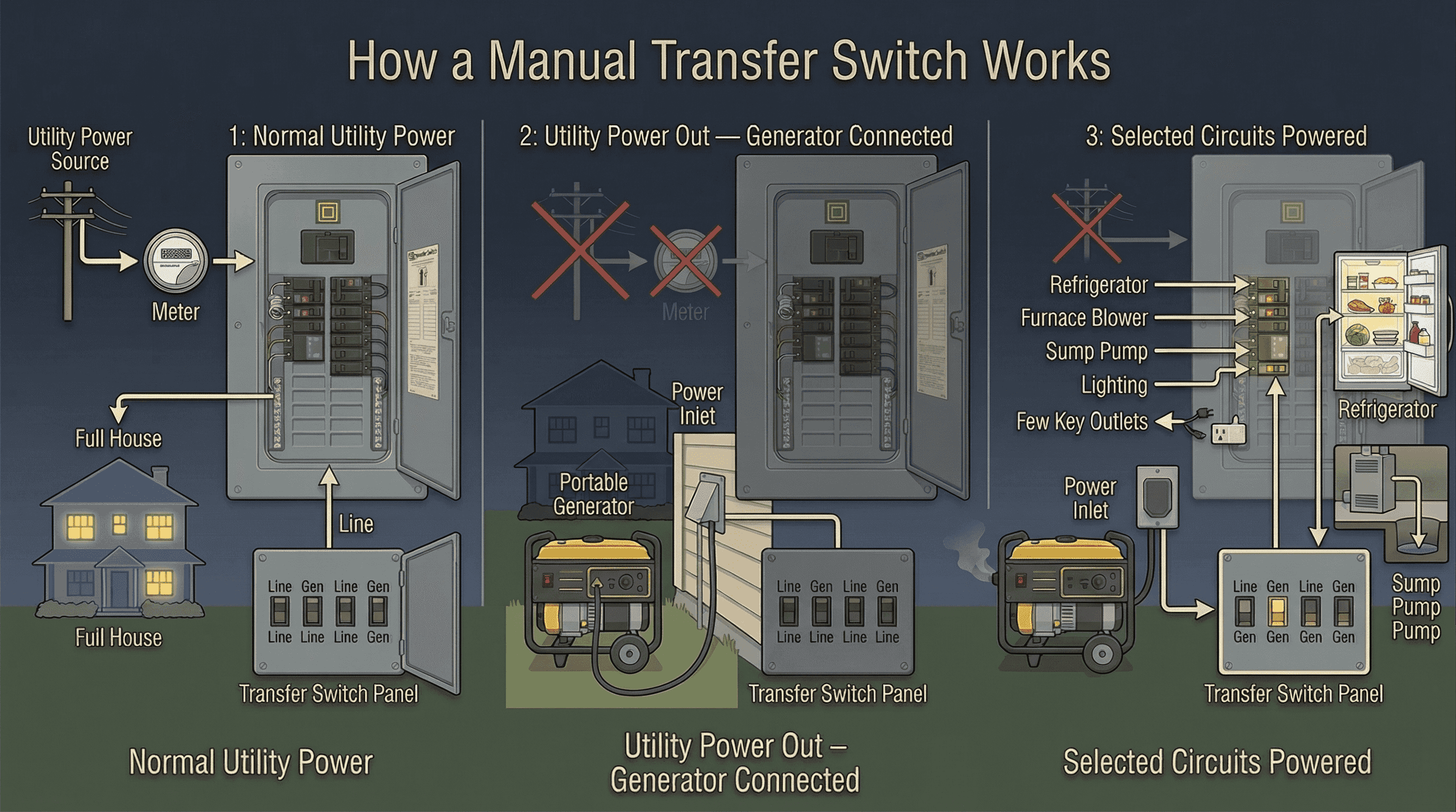
When the power goes out: start your generator outside, plug into the inlet box, and flip the transfer switch inside from Utility to Generator. An indicator light confirms which source is active. Your selected circuits come on.
When utility power returns, flip the switch back, unplug, and shut down the generator.
How this differs from an interlock kit
An interlock kit is a different approach. It requires a multi-step sequence at the main panel during every outage, carries a risk of overloading the generator if the wrong breakers are left on, and is not accepted by all municipalities. There are also other documented problems, so we don't install or recommend them.
What We Install
We install 50-amp manual transfer switches that work with most portable generators. Whether you have a 30-amp unit today or a 50-amp unit down the road, the same installation handles both. One switch operates all of your selected circuits at once.
Why we start at 50 amps
The cost difference between 30-amp and 50-amp components is small, and starting at 50 means you aren't locked into a specific generator size. The inlet box, wiring, and transfer switch are all rated for 50 amps. If you own a 30-amp generator today, a standard adapter cord is all you need. When you need a larger generator, you swap the cord.
Choosing your circuits
During the on-site evaluation, we go through your panel and figure out which circuits belong on the transfer switch. That depends on what matters to you and what your generator can support.
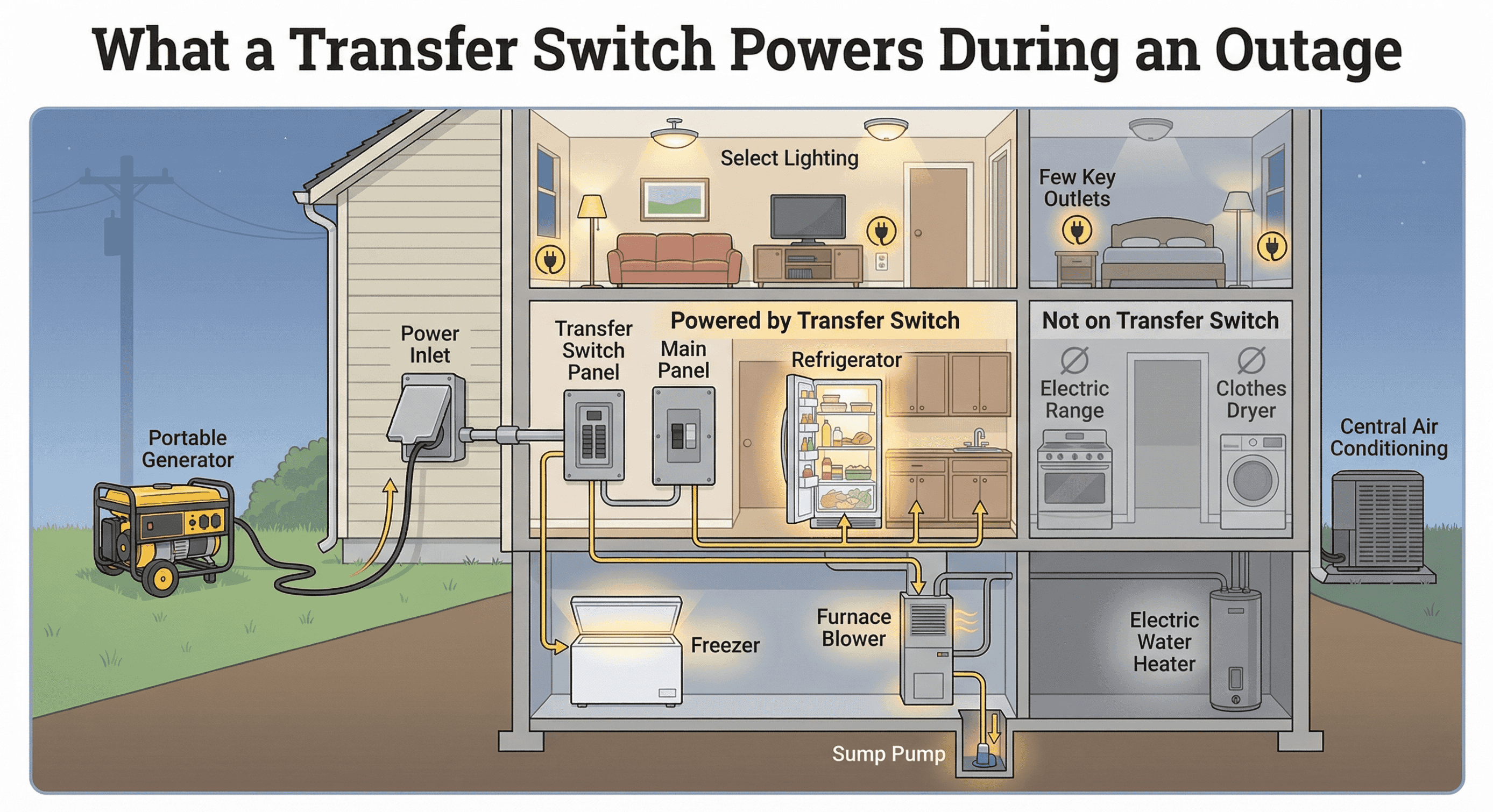
Typical priorities include the refrigerator and freezer, the furnace blower, a well pump if you're on a well, a sump pump, a few lighting circuits, and the internet router. You can shift loads around by turning one circuit off and another on. A gas stove with a 120-volt circuit still works on generator power.
Panel location
The transfer switch mounts next to your main panel. An indoor panel gets a standard enclosure for the transfer switch. An outdoor panel means the transfer switch also needs a weatherproof enclosure.
The Installation Process
Evaluation
We look at your panel, assess mounting locations, and talk through what you need backup power for.
Circuit Selection
We walk through your panel together and pick the circuits that matter most: fridge, furnace, well pump, lighting.
Quote & Permit
Detailed quote covering equipment, circuits, and mounting. Once approved, we pull the electrical permit.
Installation
One to four hours. Transfer switch, selected circuits, and exterior inlet box. Tested before we leave.
Inspection
The city or county electrical inspector verifies the installation meets code.
Payment
50% when the work is scheduled. 50% at completion.
Ready to talk about backup power for your home?
Planning Ahead
Because the installation is 50-amp from the start, it supports most portable generators from a small 30-amp unit up to a full 50-amp unit, which covers generators up to about 12,000 watts. Beyond that is a different scope of work.
If your backup power needs grow beyond a portable generator, the installation may support a transition to a permanent standby unit depending on the equipment involved. We can discuss that during the evaluation.
Frequently Asked Questions
How many circuits can a transfer switch handle?
That depends on the switch and your generator. How many circuits you can run at the same time is determined by your generator's capacity and the loads on each circuit. We figure out the right selection during the on-site evaluation based on your priorities and your generator.
Can I use a 30-amp generator with a 50-amp transfer switch?
Yes. We install 50-amp infrastructure on every job. A standard adapter cord connects your 30-amp generator to the 50-amp inlet. When you need a larger generator, you swap the cord.
What is the difference between an interlock kit and a transfer switch?
An interlock kit requires a multi-step sequence at the main panel during every outage and carries a risk of overloading the generator. It is also not accepted by all municipalities. A transfer switch uses pre-selected circuits and a single switch to transfer everything at once. We install transfer switches, not interlock kits.
Do I need a permit for a transfer switch?
Yes. An electrical permit is required. We pull the permit, schedule the work, and coordinate the final inspection as part of every installation.
How long does installation take?
Most installations take one to four hours depending on the panel location, where the inlet box mounts on the exterior, and how far apart they are. It is typically a single visit.
Can I upgrade to a permanent standby generator later?
If your needs grow beyond a portable generator, the installation may support a transition to a permanent standby unit depending on the equipment involved. We can discuss that during the evaluation.
What happens during a power outage with a transfer switch?
Start your generator outside and plug the cord into the inlet box on the exterior of your house. Inside, flip the transfer switch from Utility to Generator. An indicator light confirms the source. Your selected circuits come on. When utility power returns, flip the switch back, unplug, and shut down the generator.
Sources
- Colorado Public Utilities Commission, Proceeding 24M-0173E, April 2024 windstorm investigation and PSPS bi-monthly reports
- Xcel Energy PSCO Service Quality Map, 2024 reliability data by Census Block Group, accessed via ArcGIS FeatureServer
- Xcel Energy Wildfire Mitigation Plan, $1.9 billion commitment, Enhanced Powerline Safety Settings program documentation
- National Electrical Code 2023, Article 702: Optional Standby Systems
- OSHA, documented utility worker fatalities from generator backfeeding incidents
This page describes general service scope and is not a quote, diagnosis, or commitment. References to the National Electrical Code (NEC) are based on the 2023 NEC as adopted by Colorado at the time of writing and are for context only. They do not replace the currently adopted code in your jurisdiction. Your local Authority Having Jurisdiction (AHJ) and electrical inspector determine what applies to your project. The specific scope and requirements for your home can only be determined by a licensed electrician during an on-site evaluation.
Want Generator Backup for Your Home?
Free on-site evaluation across the Denver metro.