
What you're actually getting
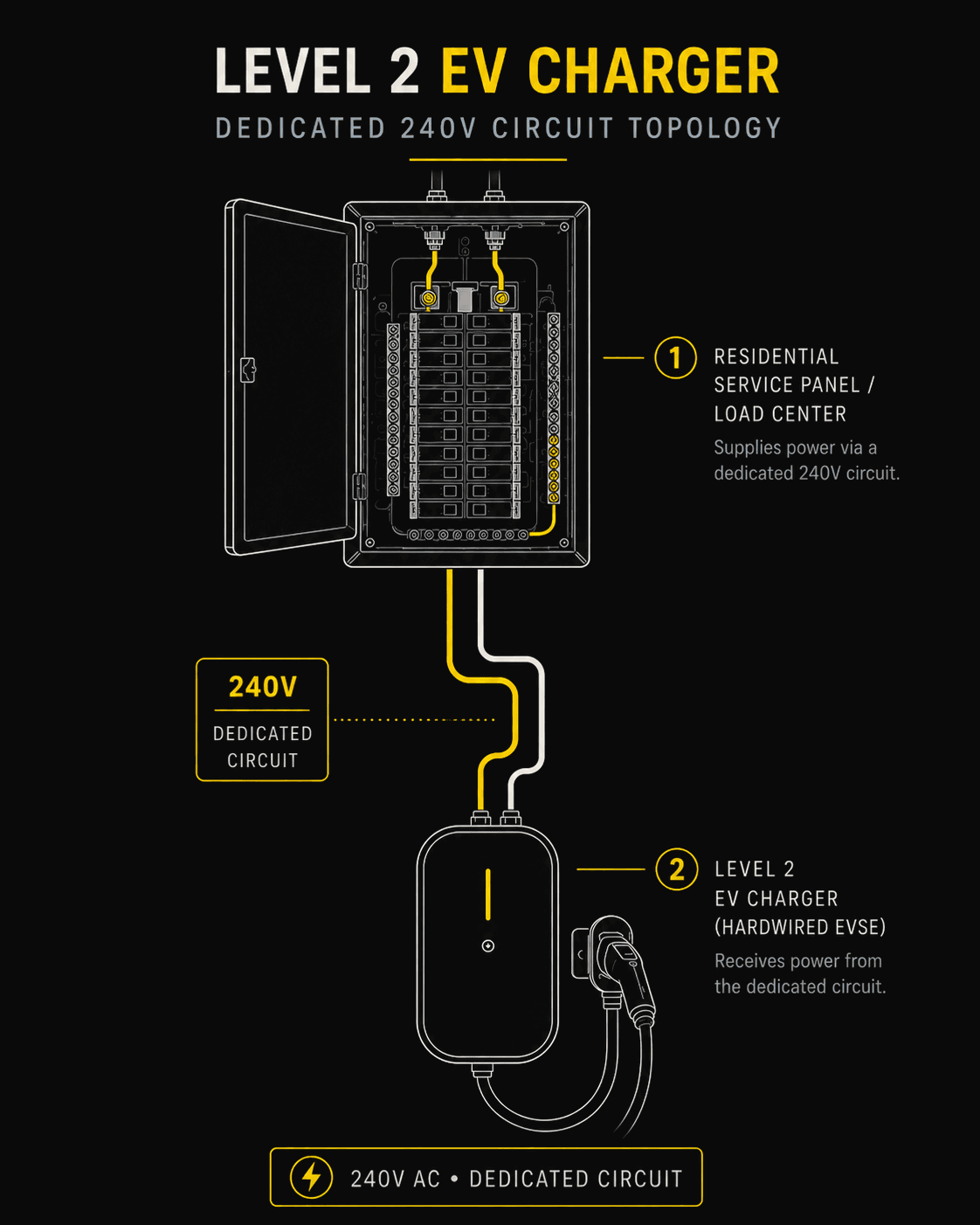
A Level 2 charger is a dedicated 240-volt circuit, installed and permitted, that gives an electric vehicle (EV) a full overnight charge for a normal day's driving. We hardwire it, pull the permit, and stay through the final inspection. Before any of that, we look at your panel and your service to answer the question the dealership skipped: can your home carry the load today, or does the charger show a capacity problem? That answer is a load calculation, not an automatic upgrade. Most homes need a right-sized circuit, not the biggest one a salesperson can quote.
What a real Level 2 install involves
The car came home and the charging didn't keep up. That is the usual starting point. The 120-volt cord, if one even came in the box, adds only a few miles of range an hour, and on the Front Range a cold battery spends the overnight trickle warming itself, so you can wake up to almost nothing gained. What felt optional in the showroom turns urgent the first cold week.
Level 2 is the fix for daily driving. It's a dedicated 240-volt circuit, the same class of supply a range or dryer runs on, sized for the charger and connected for the long haul. We install it hardwired by default rather than on a plug.
The dealer makes the sale without explaining any of that. We'd rather you know it before we ever quote the work: why a regular wall outlet won't keep an EV charged. If you're sorting out which plug your car uses and whether the charger matches, that's covered too: connector types and what they mean for your install.
The code compliance and climate-specific information provided on this site is based exclusively on Colorado front-range building standards. Building codes and environmental factors vary significantly by jurisdiction; out-of-state residents must not rely on this information and should consult a locally licensed professional.
Can your home carry it?
This is the worry most people arrive with: the house is old, or small, and the answer is going to be a huge expensive upgrade. Usually it isn't. An EV charger is a large, steady draw (it pulls hard for hours, not in bursts), so whether your existing service can take it is a real question. We run a load calculation as part of the assessment: it adds up what the home already runs against what the service can supply, and it tells us whether the charger fits on what you have.
A lot of homes have room. A 200-amp service often carries a charger without any change at all. An older 100-amp service already running a range and a dryer can come up short, and the reason it does is worth understanding, but the panel page covers it: how a panel's capacity gets used up, and why one home has room where another doesn't.
The instinct people bring from a dealer or an online quote is "I'll need a 400-amp service." Almost never. The load calculation decides the size; it does not default to the largest upgrade on the shelf. Where the math genuinely shows your service can't carry the new load, that's not a failed EV project. The EV simply revealed a service that was already undersized for a modern home, and the fix is its own piece of work: a service change and capacity upgrade when the service itself has to grow.
We don't size the charger to a headline number, either. Charging speed reads better as range-per-night-of-sleep than as peak kilowatts, and a modest 240-volt circuit replenishes far more overnight than a typical day uses. The biggest, fastest charger is usually the wrong answer for how people actually drive. If you want the math behind that: matching charging speed to how you drive.
Why we hardwire it
A charger is on for hours at a stretch, drawing near its limit the whole time. A hardwired connection handles that better than a cord-and-plug setup, with fewer connection points to loosen or heat up over years of nightly use. That reliability is the reason it's our default.
The shortcut people reach for is the dryer-outlet adapter or a cheap receptacle from the hardware store. It looks thrifty and it isn't. A plug-in install on the wrong protection trips over and over and leaves the car uncharged, and an undersized receptacle is exactly how connections overheat and cords fail. The honest answer is the right circuit, sized correctly, not the cheapest path to a 240-volt outlet. The full cost picture and the reason plug-in installs keep tripping the breaker is here: hardwired versus plug-in, and the ground-fault circuit interrupter (GFCI) nuisance-trip problem.
What the project looks like
It starts with an on-site assessment. We look at the panel, the service, the run from there to where the car parks, and how you drive. Out of that comes a short set of right-sized options and a price, not a remote estimate that falls apart when someone finally sees the panel.
From there the install is a defined piece of work: the dedicated 240-volt circuit, the conduit run, the hardwired connection, the permit, and the final inspection. We coordinate the permit and any utility steps. That's our job, not your homework. The principal who quotes the work is the one accountable for it, and he attends the inspection, which means fewer write-ups and a faster reconnect.
Two things the EV conversation often brings up:
- A second EV coming. If you know another is on the way, we can size the circuit or the panel work for it now, at the first install, instead of paying twice.
- An aging or problem-brand panel. An EV install sometimes shows a panel that was already due. If yours is a Federal Pacific, Zinsco, or Challenger panel, or simply old and full, the panel replacement route is where that gets handled.
There's a state EV-readiness code, but it applies to new construction. It does not require an existing home to upgrade anything to add a charger. And a rebate may be available for home charging; that's yours to claim, and we make sure the install is documented so the paperwork supports it. Programs change, so we keep the details to your assessment rather than printing numbers that go stale.
Why hire Dunlap for it
We're a licensed electrical contractor, and the person who assesses and prices your install is the one who owns the work, not a call center handing you off. We install what fits your home and your driving, not whatever brand carries the best margin. And we know this area: the Front Range housing stock, how winter cold changes what charging actually delivers, and how the older neighborhoods were sized. That means our number holds up when we get to your panel.
Common questions
Do I really need Level 2, or can I just use a regular outlet?
For a car you drive daily, a standard 120-volt outlet won't keep up. It adds only a few miles of range per hour, and Front Range winters cut even that. Level 2 is what makes home charging practical. The full reason is here.
Will I have to upgrade my whole electrical service?
Often not. Many homes, especially those on a 200-amp service, take a charger on the existing service. We run a load calculation during the assessment to know for sure. If the service genuinely can't carry it, that's a service change, and we'll tell you plainly rather than defaulting to the largest upgrade.
Can't I just use my dryer outlet?
We don't recommend it. A dryer circuit isn't sized or protected for a charger's hours-long continuous draw, and that mismatch is how connections overheat. A dedicated, properly sized circuit is the safe answer.
Should I get the biggest, fastest charger?
Usually no. A modest 240-volt circuit refills far more overnight than a normal day's driving uses, so the headline kilowatt number rarely matters at home. We size to how you actually drive.
Do you handle the permit?
Yes. The permit and any utility coordination are part of the job, and the principal attends the final inspection.
Do you install DC fast chargers or commercial stations?
No, those are a different class of work. We install Level 2 240-volt home charging.
Ready to talk through your install?
Your request reaches our team directly. We'll get back to you to set up an on-site look at a time that works for both of us, and the assessment is where we answer what your home actually needs.
This page is general educational information about Level 2 EV charger installation and residential electrical work in Colorado. Every home is different; nothing here is a diagnosis or a recommendation for any specific property, and the only way to know what your home needs is an on-site look.
Sources
- 2023 National Electrical Code, Article 625 (electric vehicle power transfer systems)
- 2023 National Electrical Code, Article 220 (load calculations for dwellings)
- Colorado House Bill 22-1362 (EV-ready new-construction requirements)
- Xcel Energy residential service and EV-charging program documentation
- UL 2231 and UL 2594 (EV charging equipment safety standards)