
What to Know Before Installing an EV Charger at Home
For most homes the right setup is a Level 2 charger on its own 240-volt circuit, which replenishes a full day of driving overnight. The real question is whether your electrical service can carry that load, and the only honest way to answer it is a load calculation on your specific home, not a guess from the curb.
A standard 120-volt outlet adds only a few miles of range an hour, which is why most electric vehicle (EV) owners move to a Level 2 charger fairly quickly. Level 2 runs on a dedicated 240-volt circuit and covers a normal day's driving while you sleep. Whether your home can take that circuit depends on a load calculation, the math that adds up what your electrical service (the power your home is set up to handle) already carries and what an EV would add. Often a right-sized circuit on your existing service is enough; the common belief that an EV needs 400-amp service is usually wrong. When the numbers do run tight, there is more than one path forward. Hardwiring is the cleaner default over a plug-in outlet, for reasons of code, reliability, and cost together. The install is permitted work, and a closed permit keeps rebate and resale paperwork clean.
Why a regular outlet isn't enough
There are three charging levels, and only two of them matter at home. Level 1 is a standard 120-volt wall outlet: roughly 1.4 kilowatts, a few miles of range per hour. Level 2 uses a dedicated 240-volt circuit and delivers somewhere around 5 to 11.5 kilowatts, enough to refill a full day of driving overnight. Level 3, the DC fast charging you see at public stations, is not a residential option and never enters the home conversation.
Within that Level 2 range, the circuit's amperage is what sets the charging speed:
| Charging level / circuit | Power delivered | Range added per hour |
|---|---|---|
| Level 1 (120V, ~12A) | ~1.4 kW | 3–5 miles |
| Level 2 — 16A circuit | ~3.8 kW | ~11 miles |
| Level 2 — 24A circuit | ~5.8 kW | ~17 miles |
| Level 2 — 32A circuit | ~7.7 kW | ~22 miles |
| Level 2 — 40A circuit | ~9.6 kW | ~28 miles |
| Level 2 — 48A circuit | ~11.5 kW | ~33 miles |
| Level 2 — 80A circuit (high-capacity trucks) | ~19.2 kW | ~50 miles |
Many drivers discover the Level 1 limit the hard way. New vehicles increasingly ship without the portable cord, the dealership rarely covers home charging at delivery, and a 120-volt outlet simply can't keep up with regular driving. On the Front Range there's a second reason. A lithium-ion battery won't take a full charge when it's cold, and below freezing the battery's own heater can eat most of what a 120-volt outlet delivers overnight, leaving you with close to no net charge by morning. Level 2's larger delivery overcomes that heater overhead, which is why a lot of local owners move off Level 1 by their first winter.
One thing is worth clearing up early. The "charger" that converts power for the battery actually lives inside your car. The wall unit, called the EVSE (electric vehicle supply equipment), supplies and controls the power, but your vehicle's onboard charger sets the top charging speed. That's why a bigger circuit won't make a slow-charging car charge faster. Most current EVs accept around 11 kilowatts; a few high-capacity trucks go up to about 19.2 kilowatts, and that upper tier is the one that strains an existing electrical service.
J1772 or NACS: which plug do you need?
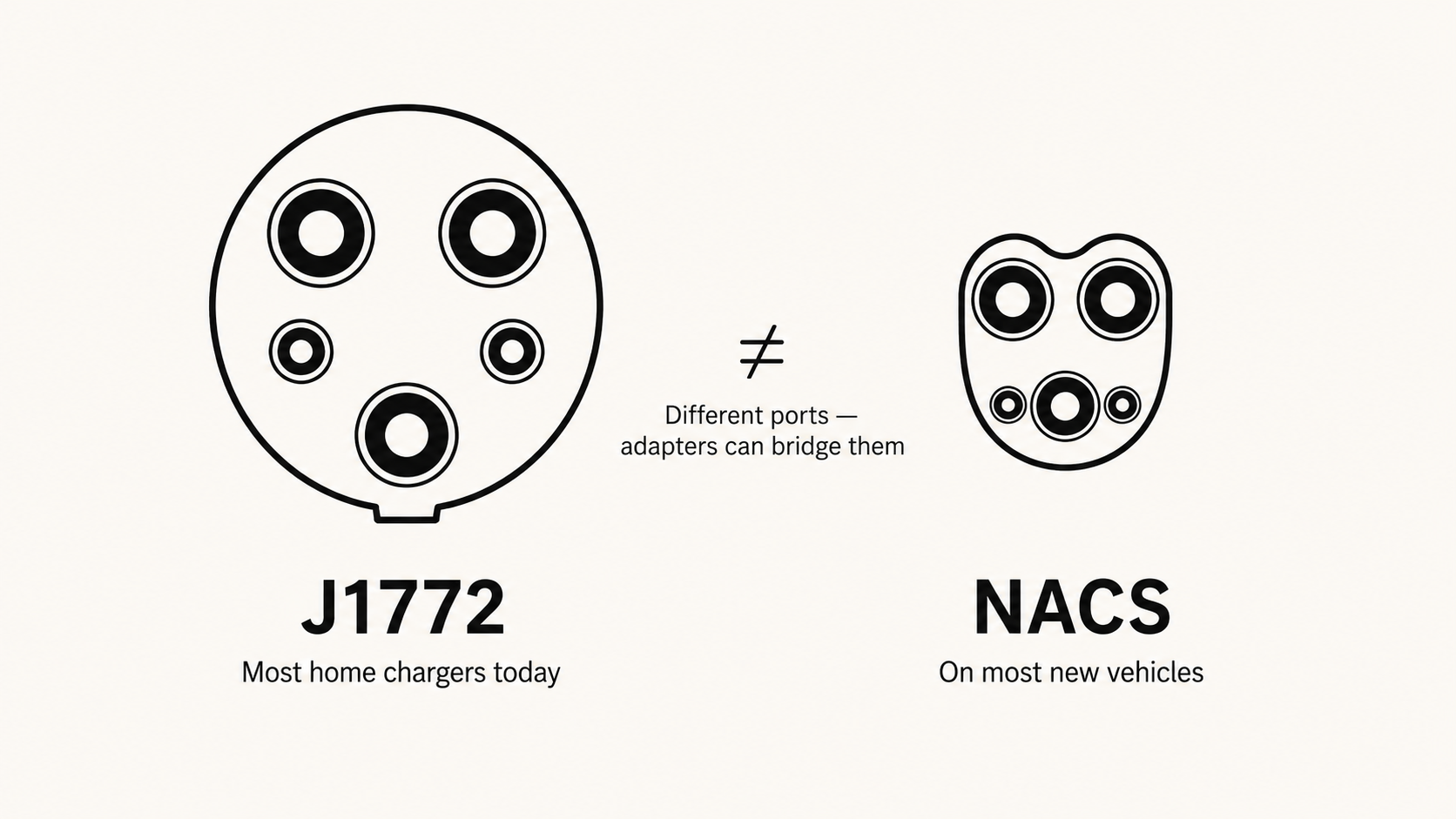
The connector standard is mid-transition, and the dealership rarely explains it. The J1772 connector has been the home-charging standard for about twenty years, so most installed home chargers use it. NACS, formally SAE J3400, is now being adopted across the industry, with new vehicles shifting over through 2025 and 2026. The installed base of home equipment still leans J1772, which means a new car and an off-the-shelf charger don't always match without an adapter. The right equipment depends on which vehicles are in your garage now and which are coming soon.
Can my panel handle an EV charger?
An EV charger is a continuous electrical load. It pulls near its maximum for hours at a stretch, the most thermally demanding sustained draw a home will ever see. The 2023 National Electrical Code (NEC) §625.41 requires the circuit and its breaker to be sized at 125% of the charger's maximum current. A 48-amp charger, for example, needs a 60-amp circuit. That sizing is built into the code, not a judgment call, which is part of why this is an electrician's work rather than a do-it-yourself one.
The code compliance and climate-specific information provided on this site is based exclusively on Colorado front-range building standards. Building codes and environmental factors vary significantly by jurisdiction; out-of-state residents must not rely on this information and should consult a locally licensed professional.
Whether your particular service can carry that load comes down to a load calculation, a method (the 2023 NEC Article 220 Optional Method is the common one for existing homes) that adds up everything your service already supplies and weighs it against what the charger would add. It's the only honest answer to the capacity question, and it's the work we do as part of assessing the install.
The widespread belief that an EV requires a 400-amp service upgrade is usually wrong. A right-sized circuit on your existing service is frequently enough, and the calculation tells the truth either way instead of defaulting to the biggest, most expensive upgrade on offer.
There is a real local wrinkle. Plenty of older Denver-metro homes, especially gas-heat neighborhoods built in the 1970s through the 1990s, run on 100-amp or 125-amp service. Two hundred amps is the modern default, but the older housing stock was built under a lower one, and the code's federal minimum is only 100 amps. Add a high-amperage EV load to a home already running an electric range, dryer, and air conditioning, and the calculation can genuinely come up short. When it does, the project forks three ways: a service upgrade, a managed-load approach, or a right-sized circuit that fits within what you already have. The math decides which.
Two misconceptions are worth heading off. Adding a subpanel (a second, smaller breaker box) doesn't help: it buys you breaker space, not load budget, because all that current still passes through the main breaker, the meter, and the wires that feed the house. And Colorado's EV-Ready rule (HB 22-1362) governs new single-family construction in jurisdictions that have adopted it, requiring a 200-amp panel and an EV-ready circuit; it does not trigger an upgrade on an existing home, though a home built since the rule took effect may already be prepped.
When a service genuinely can't carry the load, the next step is a service upgrade, sized to the home rather than to a sales target. You can review our service change service for what that involves.
What happens when the calculation runs tight
When the numbers land close to your service limit, common on 100- and 125-amp services, an upgrade isn't the only way forward. The 2023 NEC §625.42 allows the load calculation to use a certified energy-management system's set limit instead of the charger's full rated draw. A managed system caps how much the charger can pull when the rest of the house is busy, which can let the numbers work without enlarging the service.
These systems come in three general shapes: managing at the main service, managing at the panel with a smart panel that sheds non-essential loads, and managing at the circuit with dynamic balancing at the charger itself. Each carries its own trade-offs, including distance to the main panel, whether it means replacing the whole panel, and whether it relies on a data wire or Wi-Fi. The load calculation and your home's layout decide which fits.
Hardwired or plug-in?
A Level 2 charger attaches one of two ways: hardwired, where the conductors land directly in the unit, or plugged into a 240-volt outlet (usually a NEMA 14-50). For most installs, hardwiring is the cleaner default, and the reasons stack up together rather than coming down to preference.
Consider the outlet that looks like the cheaper path. A cheap, basic 14-50 outlet is inexpensive, but it isn't built for the constant, hours-long draw an EV demands. Its thin metal contacts wear out under that steady load, and there are documented cases of them overheating and melting. Doing the plug-in route properly means a heavy-duty outlet plus a ground-fault circuit interrupter (GFCI) breaker, which lands close to the cost of hardwiring anyway, while keeping a reliability problem hardwiring avoids.
That problem is nuisance tripping. The 2023 NEC §625.54 requires GFCI protection on a 240-volt outlet used for EV charging. A plug-in charger runs its own internal ground-fault self-test, and that self-test can read as a fault to the GFCI breaker and trip it, so you walk out to a car that never charged. Hardwired installs are exempt from the outlet GFCI requirement when the equipment is rated for hardwiring, because the unit's built-in protection stands in. If you want the underlying mechanism, our page on why GFCI breakers trip explains it. Colorado utility EV-charger rebates have generally required hardwiring to qualify, so reliability and rebate eligibility point the same direction.
Sizing the charger to how you actually drive
The biggest charging number the dealership advertises is usually the wrong target. The right charger is sized to how your household drives, not to the biggest kilowatt figure on the brochure. A modest Level 2 circuit replenishes far more overnight than an average commute uses, so the better measure is range per hour of sleep, not maximum amperage. The "I need the biggest charger" instinct is what drives a lot of unnecessary service-upgrade requests.
If a second EV is on the horizon, and in a lot of households the second one arrives within a year or two, plan the first install with that in mind. Leaving room in the conduit, a subpanel, or open slots in the panel costs little now and saves a lot later, and the 2023 NEC §625.40 allows certified load-sharing across more than one charger on a single circuit.
Sometimes the lower-tech path is the right one. A low-mileage second vehicle, such as a short commuter, a teen's car, or a small-battery plug-in hybrid, can do fine on Level 1, which sidesteps the capacity question entirely.
Placement, weather, and homes that aren't standard
Where the charger goes matters more than people expect. The cord on a typical unit runs about 18 to 25 feet, and the right spot depends on which side your car's charge port is on, how the car parks, and whether more than one vehicle shares the garage. A cord that only just reaches becomes a daily annoyance.
If the charger lives outside, it needs weather-rated equipment, and some housings get brittle in the cold, which is worth keeping in mind. An enclosed or heated garage also keeps the battery warmer, which is a real reason to route the install through the garage when that's an option. On mountain trips, the I-70 and US-285 climbs use up noticeable driving range, and cold weather costs even more than the elevation gain. Much of that range returns on the descent, but a well-sized home setup is what makes the trips practical to begin with.
Some homes don't fit the standard picture. Townhomes, condos, shared-wall properties, and HOA communities come with rules, approvals, and wire runs that touch shared structure, situations a general guide can't resolve. The answer there is an on-site assessment that accounts for the specific building and its rules.
Permits and rebates
An EV charger installation is permitted work that ends in your jurisdiction's final inspection. The rules vary from one jurisdiction to the next; evaluating which ones apply and handling them is part of the job, not something you have to navigate. A closed permit also tends to be a prerequisite for utility rebates, and it protects your resale and insurance paperwork; unpermitted work can forfeit rebate eligibility outright. Rebates do exist at the federal, state, and utility levels, but the programs change without notice, so the figures aren't something to plan around. The closed permit is the part that consistently pays off.
The next step
Once you have the picture and you're ready to move, the next step is an assessment of your home: the load calculation that tells you, for your actual service and your actual driving, what the right install looks like. We have been in the electrical trade since 1998, we are a licensed electrical contractor, and we serve the Denver metro and Front Range. When you're ready, review our EV charger installation service, and we'll size it to your home, pull the permit, and handle the inspection.
This is general educational information about home EV charging and residential electrical work in Colorado. Every home is different, and nothing here is a diagnosis or a recommendation for any specific property; the only way to know what your home needs is an on-site look. Dunlap Electric Company, LLC, Colorado Electrical Contractor License #8223. In the electrical trade since 1998.
Sources
- 2023 National Electrical Code, Article 625 (Electric Vehicle Power Transfer Systems) — §625.40 (branch circuit), §625.41 (continuous-load 125% multiplier), §625.42 (energy management), §625.54 (GFCI protection for EV-charging receptacles); Article 220 Optional Method for existing-dwelling load calculations.
- UL 2231-1 and UL 2231-2 — Personnel Protection Systems for Electric Vehicle Supply Circuits.
- UL 2594 — Electric Vehicle Supply Equipment.
- Colorado HB 22-1362 and the Colorado Model Electric Ready and Solar Ready Code — new-construction EV-Ready scope; does not apply to existing homes.
- Xcel Energy "Standard for Electric Installation and Use" — Colorado Front Range residential service standards.