
Challenger Electrical Panels
Challenger panels were installed in hundreds of thousands of homes between 1981 and the late 1990s. Not all Challenger panels are the same. Early models are rebadged Zinsco panels with dangerous aluminum bus bars. Those need to come out. Later models use a different bus bar design, but the breakers in those panels are aging mechanical devices that degrade over time. Both types need professional evaluation.
Here's the reality: no independent lab has ever published a failure rate for standard Challenger breakers. The Consumer Product Safety Commission (CPSC) has never studied them. The 1988 recall covered 9,000 GFCI (ground-fault circuit interrupter) breakers, not the whole product line. But insurance companies flag the brand name anyway, and that's often what forces the decision.
This page is for general education only. Every panel, wiring configuration, and home is different. Nothing here should replace a hands-on evaluation by a licensed electrician who can see your specific equipment. If you have questions about your panel, talk to a qualified professional before making any decisions.
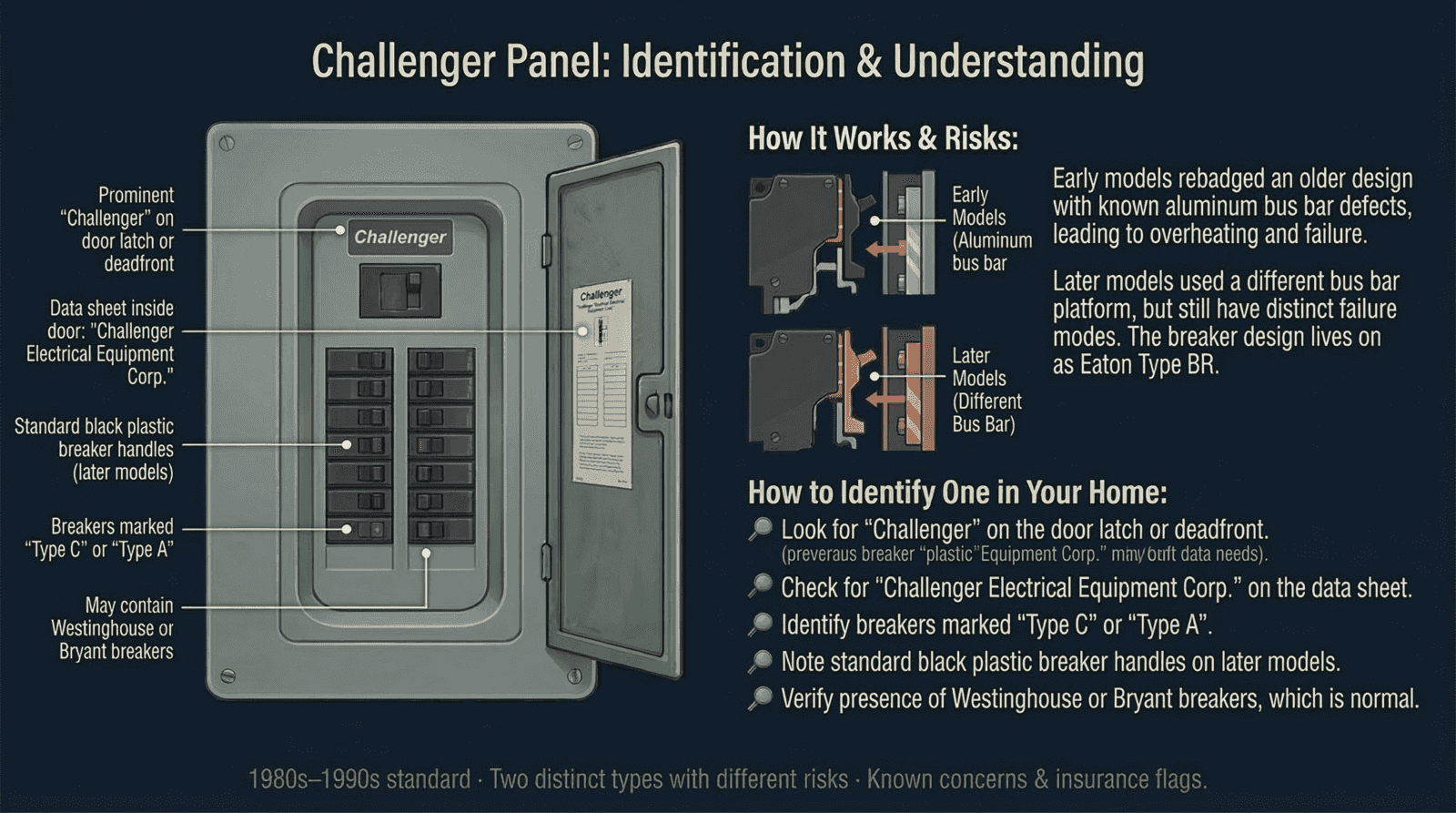
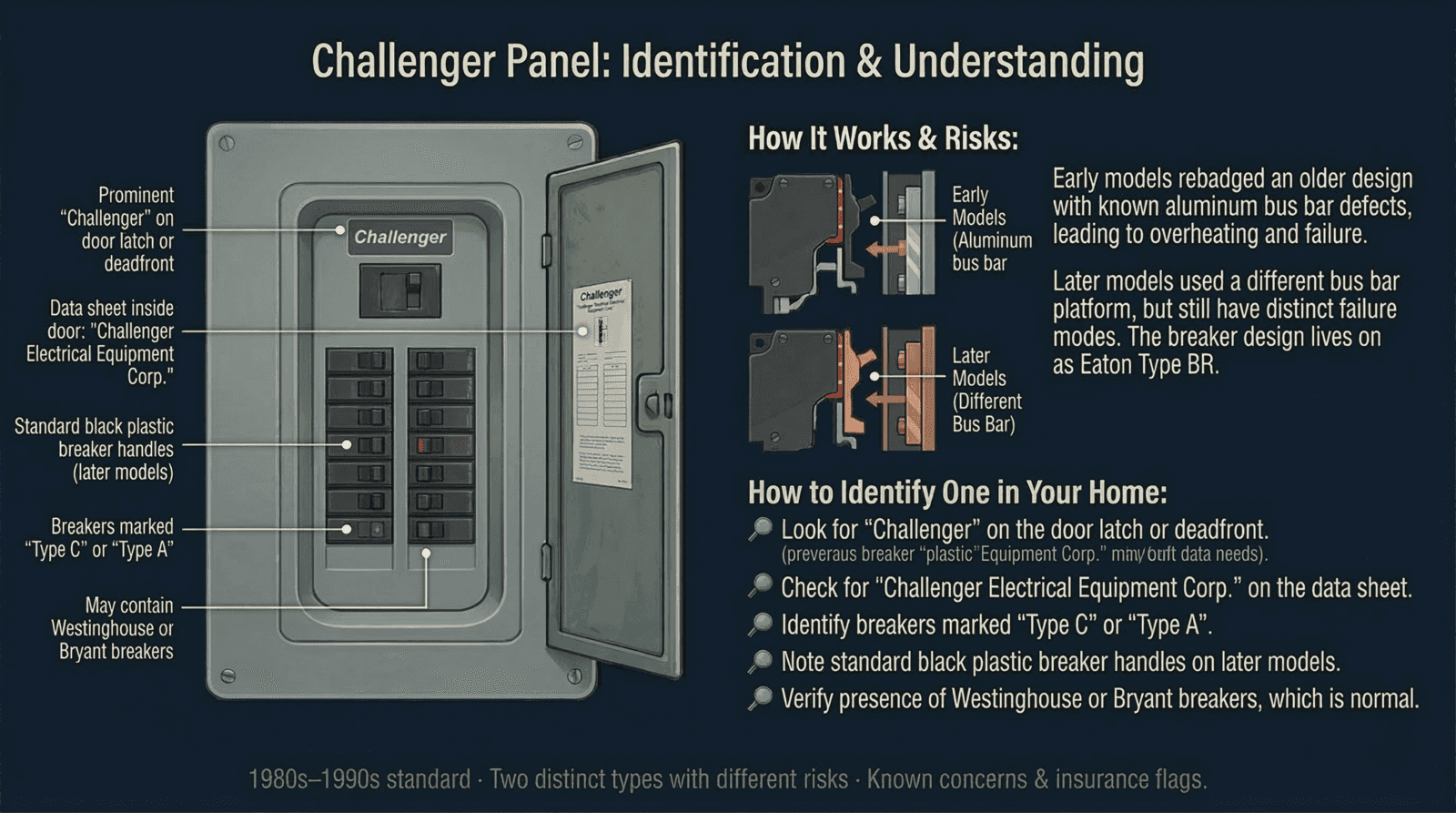
What Is a Challenger Panel?
Challenger was a brand of residential electrical panel installed in homes from 1981 through the late 1990s. These panels were popular with tract builders during one of the biggest construction booms in Denver metro history. If your home was built during that window and still has the original panel, there's a good chance it says "Challenger" on the door.
Here's what makes Challenger different from other problem panels: there are two completely different products under one brand name. Early models were rebadged versions of an older panel design with a known aluminum bus bar defect. Later models used a different bus bar platform. The breaker handles tell you which one you have, and the distinction matters because the failure modes are different.
The Challenger brand no longer exists. Eaton Corporation owns the intellectual property today. The breaker design that Challenger developed lives on as the Eaton Type BR line, which is one of the most widely installed residential breaker platforms in the country.
How to Identify One in Your Home
Your electrical panel is usually in the garage, basement, or a utility closet. Open the outer swinging door and look for these markers:
- "Challenger" printed on the panel door latch or stamped into the metal deadfront
- "Challenger Electrical Equipment Corp." on the manufacturer's data sheet (typically glued to the inside of the door)
- Breakers marked "Type C" or "Type A" on the side or front sticker
- Standard black plastic breaker handles (on later models)
Because of the corporate history, you might also see Westinghouse or Bryant breakers inside a Challenger-labeled panel. That's normal. Those brands shared the same bus bar design after the Westinghouse acquisition.
The Critical Distinction: Which Type Do You Have?
This is the most important thing on this page. There are two fundamentally different panels that both carry the Challenger name.
| Feature | Early Model (Zinsco Rebadge) | Later Model (Type C / BR Bus) |
|---|---|---|
| Breaker handles | Brightly colored: blue (15A), red (20A), green (30A) | Standard black plastic |
| Bus bar | Aluminum, prone to oxidation and arcing | Copper or tin-plated aluminum, different design |
| Era | Pre-1981 (Zinsco/Sylvania era, rebadged as Challenger) | 1981 onward (Challenger's own design) |
| Risk level | High. Full replacement required. | Moderate. Breakers are the concern, not the enclosure. |
If you see colored breaker handles inside a Challenger-labeled panel, you have the dangerous version. Don't wait on that one.
⚠️ Don't remove the inner metal cover (the deadfront). Leave that to a licensed electrician. The bus bars behind it carry full household voltage.
What's Wrong With Challenger Panels?
The Honest Answer: It Depends on Which One You Have
Most of what you'll read online about Challenger panels is either oversimplified or flat-out wrong. The problems break down into two categories, and they're not the same problem.
Early Models: The Zinsco Problem
The early Challenger panels that used the original Zinsco frame have an aluminum bus bar with a serious metallurgical flaw. Aluminum expands and contracts more than copper as electrical current heats and cools it. Over decades of this thermal cycling, the connection between the breaker clip and the bus bar loosens. An oxide layer builds up on the aluminum surface, increasing resistance at the contact point.
More resistance means more heat. More heat means more expansion. The cycle accelerates until the connection starts arcing. That arc reaches thousands of degrees. Eventually it fuses the breaker to the bus bar. At that point, the breaker can't trip. It's welded in place.
If you have one of these, the bus bar itself is the problem. No breaker swap fixes a damaged bus bar. The panel needs to come out.
Later Models: The Breaker Question
The panels Challenger designed on their own, starting around 1981, use a completely different bus bar. It's essentially the same architecture that Eaton still manufactures today for their BR line. The bus bars in these panels maintain good structural tension and aren't inherently defective.
The concern with these panels is the Type C breakers themselves. Field reports from electricians describe dried internal lubricants and weakened spring tension in aging breakers. When the internal trip mechanism binds, the breaker won't trip during an overcurrent event. Current keeps flowing through wiring that's already overloaded.
Here's what matters: there is no independent lab data quantifying how often this happens. Other problem panels have been subjected to formal testing under the UL (Underwriters Laboratories) 489 standard, producing documented failure rates. No one has done the same work for standard Challenger Type C breakers. The CPSC has never published a failure study for them.
That doesn't mean the concerns aren't real. Electricians across the country report finding melted Challenger breakers in the field. But no one can give you a failure percentage, because that testing hasn't been done. Competitors who throw around specific numbers for Challenger are either confusing them with other products or making things up to sell you a panel.
The 1988 Recall: What It Actually Covered
You'll see the 1988 CPSC recall mentioned on a lot of contractor websites. Usually they present it as proof that all Challenger breakers are defective. That's not what happened.
On November 12, 1988, the CPSC announced a voluntary recall of approximately 9,000 Challenger GFCI breakers. Two specific models: HAGF-15 and HAGF-20. They were manufactured between February 22 and April 29 of 1988. Quality control testing found that a mechanical component could detach, preventing the ground-fault protection from working.
The CPSC's own notice stated: "The normal circuit breaker functions are not affected by this problem."
That's it. Two GFCI models. Nine thousand units. Made over a two-month span. Not a recall of all Challenger breakers. Not a recall of all Challenger panels. Not evidence that standard thermal-magnetic Challenger breakers are defective.
Misrepresenting that recall to scare homeowners into a $5,000 panel replacement is dishonest. The facts matter.
The UL Listing
Another claim you'll see: that Challenger panels had their UL listing revoked. There's no evidence of this in UL's public directories, CPSC archives, or historical industry records. UL doesn't retroactively withdraw listings for discontinued products unless there's a federal regulatory intervention or proof of systemic fraud. The Challenger product lines simply went out of production. When Eaton acquired the intellectual property in 1994, the underlying UL approvals transferred with it.
Challenger vs. a Modern Panel
| Feature | Challenger | Modern Panel (Square D, Eaton, Siemens) |
|---|---|---|
| Bus bar connection | Early models: friction-fit clip into aluminum slot, loosens with thermal cycling. Later models: plug-on jaw similar to modern BR design. | Bolted or heavy-duty plug-on jaw with mechanical lock. |
| Trip reliability | No independent lab data. Field reports of binding and failure in aging Type C breakers. Early Zinsco-rebadge models: breakers can fuse to bus bar. | Less than 0.01% failure rate. Meets UL 489. |
| AFCI (Arc-Fault Circuit Interrupter) | Does not exist for this platform. No AFCI breakers were ever made for Challenger panels. | Standard on most circuits per NEC (National Electrical Code) 2023. |
| GFCI protection | Available, but the 1988 CPSC recall covered Challenger GFCI models for a mechanical defect. | Detects leakage as small as 4-5 milliamps. Trips in 1/40th of a second. |
| Surge protection | None. | Whole-home required per NEC 230.67. |
| Emergency disconnect | Not required when installed. | Required per NEC 230.85. Allows first responders to cut power from outside. |
| Insurance / lending | Flagged by inspectors. Many carriers deny or surcharge regardless of model type. | Accepted by all carriers and lenders. |
What Arc-Fault Circuit Interrupters (AFCI) Do
An arc fault is a spark caused by damaged wiring. A nail driven through a wire behind drywall. A cord pinched behind furniture. A connection that's worked loose inside an outlet box. These sparks reach temperatures high enough to ignite wood framing, insulation, and drywall paper. Arc faults are a leading cause of electrical fires in homes.
A standard circuit breaker can't detect an arc fault. The current draw from a spark is too small and too irregular to trigger a traditional overcurrent trip. The breaker only responds to sustained overloads or dead shorts. A dangerous arc doesn't look like either of those.
An AFCI breaker has a microprocessor that continuously reads the electrical waveform on the circuit. It distinguishes the erratic signature of a dangerous arc from the normal sparking that happens when you flip a light switch or start a motor. When it detects a hazardous arc pattern, it shuts the circuit down.
Challenger panels can't accommodate AFCI breakers. No manufacturer ever produced an AFCI breaker for the Challenger bus bar platform. The trip mechanism in a Challenger Type C breaker is a mechanical bi-metal strip and electromagnet. No microprocessor. No waveform analysis. No ability to detect arcing. This technology didn't exist when these panels were made, and it was never retrofitted.
What This Means for Your Insurance
Insurance companies don't distinguish between the two types of Challenger panel.
Insurance companies in Colorado have become aggressive about flagging older electrical panels. Carriers like State Farm, American Family, and Farmers use 4-point inspection data to identify panels by brand name. They don't send an engineer to evaluate your bus bar. They see "Challenger" on the panel door and check a box.
If your Challenger panel gets flagged, you'll typically get 30 to 60 days to replace it or face non-renewal. Some carriers refuse to write new policies on homes with Challenger panels. Others apply surcharges or electrical fire exclusions.
What This Means When You Sell Your Home
When a home with a Challenger panel goes on the market, the home inspector flags it. The buyer's insurance company refuses to write a policy or requires replacement before binding. The buyer's lender won't close without insurance. The deal stalls.
Even after work is done on a Challenger panel, the word "Challenger" on the panel door can still trigger a lender's or underwriter's rejection. The brand name alone is enough. That's frustrating, but it's the reality.
Replacing the panel before listing gives you control over the timeline and cost. Doing it mid-negotiation with a closing date looming costs more and limits your options.
Modern Electrical Demands
Challenger panels were sized for 1980s and 1990s electrical loads. Most are 100-amp or 150-amp panels. Today's homes often need 200 amps to handle air conditioning, heat pumps, home offices, and the general increase in plug-in devices over the last 30 years.
These panels also lack modern safety features that current code requires: arc-fault circuit interrupters (AFCI), whole-home surge protection, and an exterior emergency disconnect. You can't retrofit those into a Challenger panel. A replacement panel brings all of that.
Age Alone Is a Factor
Even setting aside the brand name, the earliest Challenger panels are now over 40 years old. The later ones from the mid-1990s are approaching 30.
Circuit breakers are mechanical devices. They rely on springs, bimetallic strips, and contact surfaces that degrade with use and time. After decades of thermal cycling, breaker springs lose tension. Contact surfaces oxidize. Internal lubricants dry out. The breaker still flips on and off by hand, but its ability to trip automatically at the rated threshold declines. No panel manufacturer publishes a specific calendar lifespan for residential breakers, but the mechanical wear is real and cumulative.
A Challenger panel installed in 1985 has been through 40 years of load cycles. Every breaker in that panel has been heating up and cooling down, every day, for four decades. At some point, age alone is reason enough to have the panel evaluated by a licensed electrician.
Denver Area: Where These Panels Are Found
Challenger's peak production years, roughly 1981 to the late 1990s, line up with one of the biggest building booms in Denver metro history. The area added approximately 4,700 single-family homes per year through the 1980s alone. Challenger equipment was popular with large-scale tract builders because it was competitively priced and widely available through regional supply houses.
| Area | Primary Build Period | Notes |
|---|---|---|
| Highlands Ranch (Douglas County) | 1980s-1990s | Major planned community, heavy tract builder activity |
| Centennial (Arapahoe County) | 1980s-1990s | Incorporated 2001, built largely during Challenger era |
| Littleton (Arapahoe County) | 1980s-1990s | Expansion areas south and west of historic core |
| Lakewood (Jefferson County) | 1980s-1990s | Western expansion zones, Green Mountain area |
| Golden (Jefferson County) | 1980s-1990s | Residential growth along Highway 93 corridor |
| Ken Caryl / Columbine (Jefferson County) | 1980s-1990s | Planned communities |
| Aurora (east Arapahoe / Adams County) | 1980s-1990s | Rapid annexation and development period |
| DIA-adjacent areas (Adams / Denver County) | Late 1980s-1990s | Expansion zones near airport development |
Builders like Richmond American Homes and Shea Homes were active in these areas during the Challenger production era. Exact brand-to-permit data isn't digitized in county records, so there's no way to pinpoint which neighborhoods have the highest concentration. But if your home was built between 1981 and 1998 in the Denver metro and the original panel hasn't been replaced, there's a reasonable chance it's a Challenger.
Not every old panel is a problem panel. Square D, GE, Murray, Siemens, and Cutler-Hammer were all installed in Denver-area homes during the same era, and none of them carry the same safety concerns. Homes built before 1981 may also have other panels with known issues from earlier production periods. If you're not sure what you have, our panel identification guide covers the most common problem panels found in Denver-area homes.
Your home's build year is on your property tax records or your county assessor's website. That's the starting point. The only way to know for certain is to look at the panel.
Can a Challenger Panel Be Repaired?
The answer depends entirely on which type you have.
If your panel has the colored breaker handles and aluminum bus bar from the Zinsco era, the bus bar itself is the problem. No breaker swap fixes that. Full replacement.
For later-model Challenger panels, the answer depends on what we find when we open it: bus bar condition, signs of thermal damage, corrosion, wiring condition, and the overall state of the service entrance. This isn't something to assess from a webpage.
In either case, any partial repair doesn't add AFCI protection, whole-home surge protection, or an exterior emergency disconnect. And the panel door still says "Challenger," which creates the same insurance and resale friction whether the breakers inside are new or old. We need to see your panel to tell you what it needs.
What Does Replacement Look Like?
If a full panel replacement is the right call, here's the actual process:
- We come look at it. We check the existing panel, the wiring, the service entrance, the meter base, and figure out the full scope. No charge for the estimate.
- Permit. We pull the electrical permit with your local jurisdiction. Lakewood, Littleton, Centennial, Golden, wherever you are. A permit is required by law for panel work in Colorado. No permit means no inspection, no equipment warranty, and problems when you sell.
- Xcel coordination. Your service wires are always live from the utility side. We submit a disconnect request through Xcel's builder portal and schedule the meter pull. That typically takes 5 to 10 business days.
- The work. Plan for a full day without power. The old panel, bus bars, and breakers all come out. The new panel goes in with:
- A new lever bypass meter with a built-in handle that lets Xcel or a first responder cut power from outside (NEC 230.85)
- Modern breakers meeting UL 489 standards
- AFCI protection where NEC 2023 requires it (NEC 210.12)
- GFCI protection in kitchens, bathrooms, garages, and other required locations
- Whole-home surge protection (NEC 230.67)
- An intersystem bonding bar for cable, phone, and data grounding (NEC 250.94)
- Two driven copper ground rods, bonded together and back to the panel (NEC 250.52, 250.53)
- Ground connection to the main cold water pipe within the first 5 feet of where it enters the foundation (NEC 250.52(A)(1))
- Every circuit properly sized, torqued to spec, and labeled
- Inspection. A local electrical inspector checks the entire installation: connections, grounding, bonding, breaker sizing, labeling, code compliance.
- Power restored. Once the inspector signs off, they submit a meter release to Xcel Energy. Xcel installs the meter and turns power on.
The full process from first visit through final inspection takes days to weeks when you factor in permits and Xcel scheduling.
Payment
A 50% deposit is required before work begins. That locks in your date and lets us start the permit and Xcel coordination. The remaining 50% is due after the inspection passes and power is back on.
Warranty
Parts: One year on all electrical parts, starting from the date of final inspection.
Workmanship: We stand behind our installation work. Full warranty terms →
Frequently Asked Questions
Are all Challenger panels dangerous?
No. Early models (pre-1981) are rebadged Zinsco panels with aluminum bus bars and colored breaker handles. Those are dangerous and need full replacement. Later models (1981 and after) use a different bus bar design, but the breakers are aging mechanical devices that degrade over time. Both types need professional evaluation. Insurance companies flag the brand name regardless of which type you have.
Is there a recall on Challenger panels?
There's no blanket recall. In 1988, the CPSC recalled about 9,000 GFCI breakers (models HAGF-15 and HAGF-20) made between February and April of 1988. A mechanical part could detach and prevent the ground-fault feature from working. The CPSC explicitly stated that normal circuit breaker functions were not affected. That recall covered two GFCI models. It did not apply to standard Challenger breakers.
Can I just swap the breakers instead of replacing the whole panel?
That depends on which type of Challenger panel you have, the condition of the bus bar, and what your insurance company requires. A breaker swap doesn't add AFCI protection, surge protection, or an exterior emergency disconnect. And insurance companies flag the brand name regardless of what's inside. I need to see your panel to tell you what it needs.
How do I know if mine is the dangerous Zinsco type?
Look at the breaker handles. Brightly colored handles (blue for 15 amp, red for 20 amp, green for 30 amp) mean it's a Zinsco-rebadge with the problematic aluminum bus bar. That needs full replacement. Standard black plastic handles marked "Type C" or "Type A" mean you have the later design. The panel door may say "Challenger" either way. The breakers are the identifier.
Will my insurance drop me for having a Challenger panel?
Possibly. Some Colorado carriers flag Challenger panels during underwriting or at renewal. They may deny a new policy, issue a non-renewal notice with 30 to 60 days to replace, or apply surcharges. Insurance companies use simplified checklists. They don't distinguish between early Zinsco-type Challengers and later BR-bus models. The brand name alone is often enough to trigger action.
Is a Challenger panel as dangerous as a Federal Pacific panel?
No. The evidence is different. FPE Stab-Lok breakers have independent lab testing showing failure rates between 51% and 65%, plus a court finding of consumer fraud. No equivalent independent lab testing exists for standard Challenger Type C breakers. The CPSC has never published a failure study for Challenger. The early Zinsco-rebadge Challengers share the known Zinsco problems, but later-model Challengers with the BR-style bus bar are in a different category entirely. Treating them all the same isn't accurate.
Not Sure What You Have?
Send us a photo. We'll tell you what you have and whether it needs attention.
Why So Many Names on One Panel
Challenger went through multiple corporate acquisitions between the 1970s and 2012. That's why you'll see panels and breakers labeled Challenger, GTE-Sylvania, Westinghouse, Bryant, Cutler-Hammer, or Eaton that all share the same internal design. This timeline tracks who owned what and when.
| Year | Event |
|---|---|
| Late 1920s | Emile Zinsmeyer founds Zinsco in Los Angeles |
| 1943 | Martin Zinsmeyer renames the company to Zinsco Electric |
| 1973 | GTE-Sylvania acquires Zinsco |
| 1981 | GTE-Sylvania divests its electrical division. Challenger Electrical Equipment Corp. formed. Zinsco panel production ceases. |
| 1980s | Westinghouse acquires Challenger |
| 1994 | Eaton acquires Westinghouse Distribution and Control Business Unit for $1.1 billion, absorbing Challenger and Bryant intellectual property. Thomas & Betts acquires Zinsco breaker molds separately. |
| 2005 | Eaton drops the Challenger name. Thomas & Betts ceases Zinsco breaker production and destroys the molds. |
| 2012 | ABB acquires Thomas & Betts for $3.9 billion |
Sources
- CPSC Recall #88-095: Challenger Electrical Equipment Corp. Offers Replacement Program for 9,000 GFCI Circuit Breakers. November 12, 1988.
- Eaton Knowledge Hub: "Breaker Replacement in a Challenger Panel." Confirms Eaton BR breakers are UL listed and cross-classified as Type C for use in Challenger panels.
- Eaton Knowledge Hub: "Find Replacements for Westinghouse and Challenger Breakers."
- Colorado DORA: State Electrical Board Adopts 2023 National Electrical Code, effective August 1, 2023.
- Eaton Corporation corporate history. Acquisition of Westinghouse Distribution and Control Business Unit for $1.1 billion, 1994.
- ABB Ltd. acquisition of Thomas & Betts, $3.9 billion ($72/share), closed May 16, 2012.
- Denver's Single-Family Homes by Decade: 1980s. DenverUrbanism, 2012.
- NEC 2023: Sections 110.3(B), 210.12, 230.67, 230.85, 250.52, 250.53, 250.94. As adopted by Colorado metro municipalities.
- Xcel Energy Colorado Service Guide.
- Independent laboratory testing of Zinsco-design breakers under UL 489 conditions. 25% failure-to-trip rate documented. (Applies to early Zinsco-rebadge Challenger panels.)
This page is for informational purposes. References to the National Electrical Code (NEC) are based on the 2023 NEC as adopted by Colorado at the time of writing and are for context only. They do not replace the currently adopted code in your jurisdiction. Your local Authority Having Jurisdiction (AHJ) and electrical inspector determine what applies to your project. Electrical work should only be performed by a licensed electrician.