
Federal Pacific Electric (FPE) Stab-Lok Panels
Builders installed Federal Pacific Electric panels in an estimated 25 to 28 million American homes between the 1950s and late 1980s. Independent testing has shown that their Stab-Lok breakers fail to trip at rates between 51% and 65%, depending on use and age. A 2002 New Jersey court found that FPE committed fraud to obtain its safety certifications. Underwriters Laboratories had already revoked the Stab-Lok listing in 1980, the year the deception was uncovered. These panels are associated with an estimated 2,800 house fires per year nationally.
If you have an FPE panel, it needs to be replaced. There's no repair that fixes a fundamental design flaw, and waiting doesn't make them safer.
This page is for general education only. Every panel, wiring configuration, and home is different. Nothing here should replace a hands-on evaluation by a licensed electrician who can see your specific equipment. If you have questions about your panel, talk to a qualified professional before making any decisions.
What Is a Federal Pacific Panel?
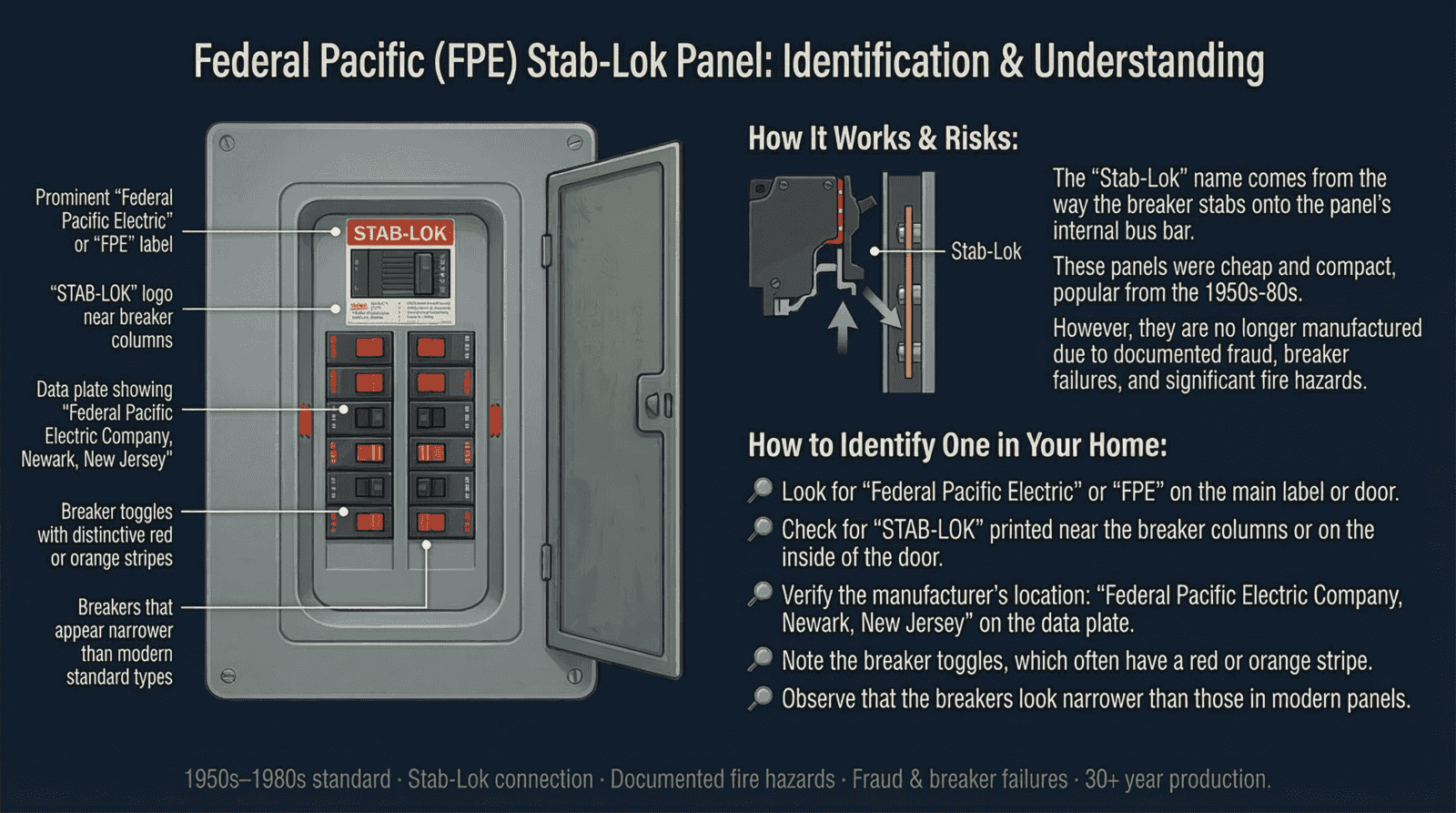
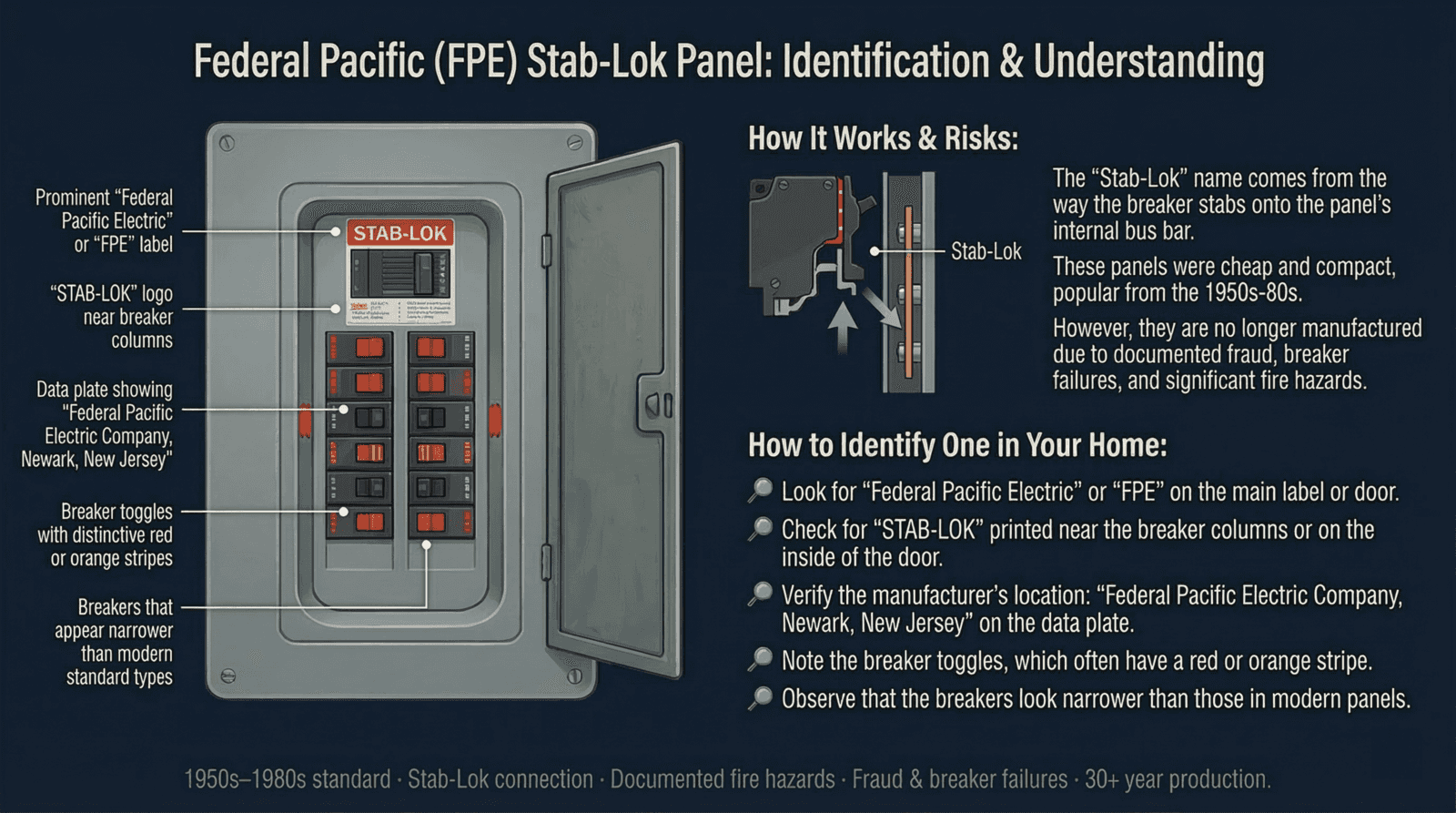
Federal Pacific Electric was one of the largest manufacturers of residential circuit breaker panels in the United States from the early 1950s through the mid-1980s. Their product line was called "Stab-Lok," named for the way the breaker connects to the panel's internal bus bar (the copper or aluminum strip that distributes power to all the breakers).
These panels were cheap and compact, which made them popular with developers building large subdivisions during the post-war housing boom. Millions went into homes across the country during a 30-plus year production run.
FPE is no longer in business. They stopped manufacturing residential electrical products in the mid-1980s after investigators exposed the fraud. But the panels they made are still sitting in basements and garages in homes all over the Denver metro area and across the country.
There is a separate, unaffiliated company operating today under the name "Federal Pacific." It's a division of Electro-Mechanical, LLC, established in 1987 when they acquired FPE's industrial transformer division and kept the name. They make commercial transformers and switchgear. No connection to the residential panels discussed here.
How to Identify an FPE Panel
Your electrical panel is usually in the basement, garage, or a utility closet. It can also be mounted on the outside of your home or on the interior wall directly behind your electrical meter. Open the outer swinging door and look for these identifiers:
⚠️ Do not remove the inner metal cover (the deadfront). FPE breakers sit on the bus bar with a friction-fit clip. They can shift or fall out when the deadfront comes off, leaving live bus bars exposed. That's full household voltage with nothing between it and your hands. Leave the deadfront to a licensed electrician.
What to look for with the outer door open:
- "Federal Pacific Electric" or "FPE" on the label
- "Federal Pacific Electric Company, Newark, New Jersey" on the data plate
- "STAB-LOK" printed near the breaker columns or on the inside of the door
- Breaker toggles with a red or orange stripe
- Breakers that look narrower than what you'd see in a modern panel
If you see "Federal Pacific" anywhere, that's your answer.
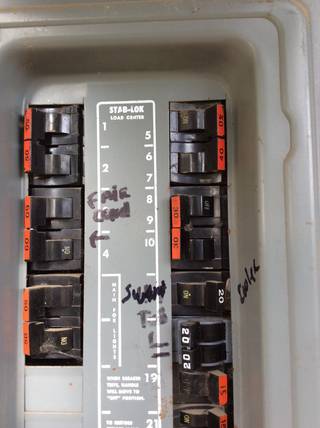
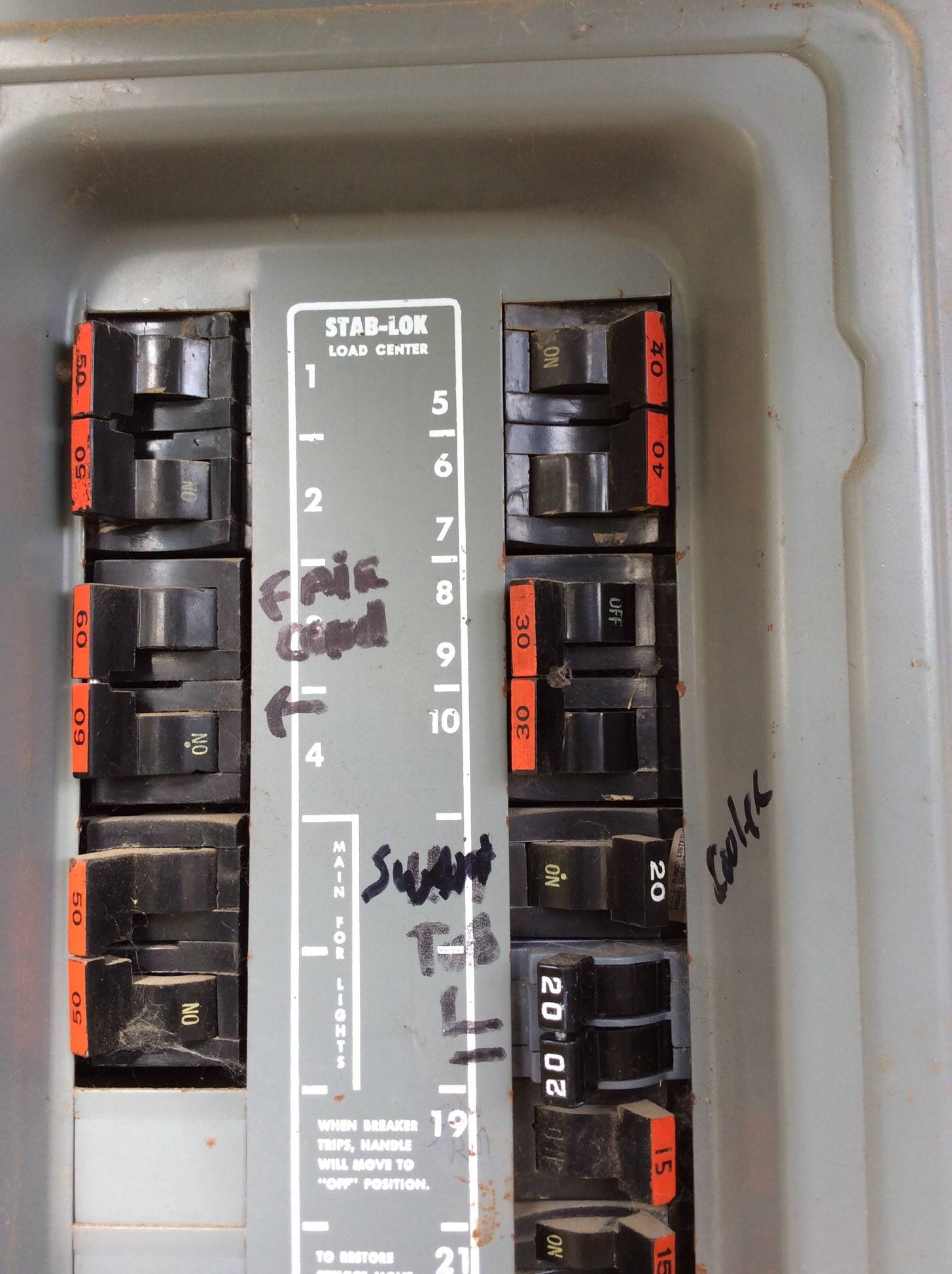
Not sure what you're looking at? Take a photo of the label and the breakers and send it to us. We can usually identify it from a clear photo.
What's Wrong With These Panels
The Short Version
A circuit breaker has one job: cut the power when a wire carries more current than it's rated for. That's the mechanism that prevents overheated wiring from starting a fire inside your walls.
FPE Stab-Lok breakers fail at this job at a rate that is thousands of times higher than what's acceptable. Independent testing has documented this over several decades.
The Testing
Dr. Jesse Aronstein, a mechanical engineer and materials scientist, has been testing FPE Stab-Lok breakers since the early 1980s. The Consumer Product Safety Commission (CPSC) originally hired him through the Wright-Malta Corporation to evaluate the breakers. When the CPSC closed its investigation, he kept going on his own. Over the decades since, homeowners and electricians across the country have donated thousands of field-harvested breakers for his testing.
His methodology follows the UL (Underwriters Laboratories) 489 testing standard, which is the same standard used to certify new circuit breakers. The test ramps current from 100% of the breaker's rating up to 135% over one hour. If the breaker doesn't trip, current is held at 135% for an additional hour. If it still doesn't trip, current increases to 200% of the rated load. A breaker that doesn't trip at 135% within the required timeframe fails the test.
| Breaker Type | Condition | Failure Rate | Source |
|---|---|---|---|
| Single-pole | Never cycled (new from panel) | 51% | Aronstein, UL 489 calibration |
| Single-pole | After 500 on/off cycles | 65% | Aronstein, UL 489 calibration |
| Two-pole (240V) | Standard testing | Up to 70% | Aronstein, UL 489 calibration |
| GFCI combination | Standard fault testing | Up to 80% | Aronstein, UL 489 calibration |
| Jammed two-pole | After initial jam | 100% | Aronstein, UL 489 calibration |
| Modern breaker (any manufacturer) | UL 489 standard | Less than 0.01% | UL 489 certification requirement |
Over half of FPE single-pole breakers fail the same test that modern breakers pass 99.99% of the time. And the failure rate gets worse with use. After 500 toggle cycles (normal wear over the life of a breaker), the rate climbs to 65%.
The two-pole number matters because those breakers protect your 240-volt circuits: your dryer, water heater, oven, HVAC condenser. The GFCI (Ground-Fault Circuit Interrupter) number matters because those breakers are specifically designed to prevent electrocution in wet areas.
The jammed two-pole finding is the worst. When a two-pole breaker fails to trip and jams internally, the contacts lock closed. In testing, 100% of jammed breakers failed to trip on a second overcurrent event at any current level. The circuit becomes completely unprotected.
How the Failure Happens
The name "Stab-Lok" describes the connection method. The breaker has a spring-loaded metal clip that stabs into a slot on the panel's aluminum bus bar. It's a friction fit. There's no bolt, no mechanical lock, no clamping mechanism.
Over time, the normal heating and cooling of electrical current flowing through the connection causes the metal to expand and contract. The spring tension weakens. The contact loosens. As the connection degrades, electrical resistance at the contact point increases, which generates more heat, which accelerates the degradation.
When the breaker finally needs to trip during an overcurrent event, the internal trip mechanism binds due to mechanical friction in the linkage. The contacts stay closed. Current keeps flowing through wiring that's already overloaded.
There's an additional hazard specific to FPE. The breaker's toggle handle can be moved to the "off" position while the internal contacts remain stuck closed. The breaker looks off. It feels off. But the circuit is still live. Anyone working on downstream wiring under the assumption that they've killed the power is exposed to a serious shock hazard.
The Fraud
This isn't a case of a product that just aged badly. The breakers were never properly tested to begin with.
In 1980, Reliance Electric Company (which had acquired FPE from UV Industries in March 1979 for $345 million) discovered that FPE had been engaging in deceptive manufacturing and testing practices. Reliance halted shipments and reported the problem to the CPSC. A 1982 Securities and Exchange Commission filing by Reliance documented that previous UL listings on FPE products had been obtained by "deceptive means."
Later investigations and testimony revealed the specifics. FPE personnel rigged testing equipment and used a hidden remote control device to manually force breakers to trip during live UL inspections. Without that intervention, the breakers would have failed.
Underwriters Laboratories revoked the Stab-Lok certification in 1980, the same year Reliance reported the fraud. The UL revocation happened in 1980, not after the 2002 court ruling. UL acted immediately once the deception was uncovered.
The CPSC Investigation
The Consumer Product Safety Commission opened an investigation into FPE in 1980 after Reliance's disclosure. CPSC-contracted engineers at Wright-Malta confirmed the high failure rates.
On March 3, 1983, the CPSC issued Press Release #83-008 announcing they were closing the investigation:
"The Consumer Product Safety Commission announced today that it is closing its two year investigation into Federal Pacific Electric Stab-lok type residential circuit breakers. This action was taken because the data currently available to the Commission does not establish that the circuit breakers pose a serious risk of injury to consumers... The Commission staff estimates that it would cost several million dollars to gather the data necessary to assess fully whether those circuit breakers that are installed in homes but which may fail UL calibration tests present a risk to the public. Based on the Commission's limited budget ($34 million for fiscal year 1983), the known hazards the Commission has identified and must address (involving products of other manufacturers) and the uncertainty of the results of such a costly investigation, the Commission has decided not to commit further resources to its investigation of FPE's circuit breakers."
In 2011, the CPSC issued a clarification stating that the 1983 investigation was closed "without making a determination as to the safety of FPE circuit breakers or the accuracy of the manufacturer's position on the matter." They did not clear the panels. They ran out of money.
The Court Ruling
In 2002, Yacout v. Federal Pacific Electric Company and Reliance Electric Company (Docket No. L-2904-97, Superior Court of New Jersey, Law Division, Middlesex County) resulted in a finding that FPE had violated the New Jersey Consumer Fraud Act.
The court ruled that FPE had "knowingly and purposefully distributed circuit breakers which were not tested to meet UL standards as indicated on their label." The ruling entitled plaintiffs to treble damages (three times the cost of panel replacement).
The Fire Statistics
In a 2012 peer-reviewed paper published in IEEE Transactions on Industry Applications titled "Estimating Fire Losses Associated With Circuit Breaker Malfunction," Dr. Aronstein and statistician Richard Lowry estimated that FPE Stab-Lok panels are responsible for approximately 2,800 residential fires, 13 deaths, and over $40 million in property damage per year in the United States.
FPE Stab-Lok vs. a Modern Panel
| Feature | FPE Stab-Lok | Modern Panel (Square D, Eaton, Siemens) |
|---|---|---|
| Bus bar connection | Friction-fit spring clip into aluminum slot. Loosens over time as the metal heats and cools with use (thermal cycling). | Bolted or heavy-duty plug-on jaw with mechanical lock. |
| Trip reliability | 51-65% failure rate on single-pole. Up to 80% on GFCI. | Less than 0.01% failure rate. Meets UL 489. |
| Overcurrent protection | Thermal-magnetic, but internal linkage jams under load. | Thermal-magnetic with reliable trip mechanism. |
| AFCI (Arc-Fault Circuit Interrupter) | Does not exist for this platform. | Standard on most circuits per NEC (National Electrical Code) 2023. |
| GFCI protection | Available but 80% failure rate. | Detects leakage as small as 4-5 milliamps. Trips in 1/40th of a second. |
| Surge protection | None. | Whole-home required per NEC 230.67. |
| Emergency disconnect | Not required when installed. | Required per NEC 230.85. Allows first responders to cut power from outside. |
| Insurance / lending | Flagged by inspectors. Denied or surcharged by most carriers. | Accepted by all carriers and lenders. |
What Arc-Fault Circuit Interrupters (AFCI) Do
An arc fault is a spark caused by damaged wiring. A nail driven through a wire behind drywall. A cord pinched behind furniture. A connection that's worked loose inside an outlet box. These sparks reach temperatures high enough to ignite wood framing, insulation, and drywall paper. Arc faults are a leading cause of electrical fires in homes.
A standard circuit breaker can't detect an arc fault. The current draw from a spark is too small and too irregular to trigger a traditional overcurrent trip.
An AFCI breaker has a microprocessor that continuously reads the electrical waveform on the circuit. It distinguishes the erratic signature of a dangerous arc from the normal sparking that happens when you flip a light switch or start a motor. When it detects a hazardous arc pattern, it shuts the circuit down.
FPE's trip mechanism is a mechanical bi-metal strip and electromagnet. No microprocessor. No waveform analysis. No ability to detect arcing. This technology didn't exist when these panels were made.
What This Means for Your Insurance
This usually comes up during a policy renewal or when buying a home. In Colorado, the major carriers (State Farm, USAA, American Family, Farmers, Allstate, Liberty Mutual, Nationwide) all have underwriting guidelines on FPE panels. What that looks like in practice:
- New policies: Carriers will often refuse to bind coverage on a property with an identified FPE panel.
- Existing policies: Many carriers require a 4-point inspection when a home reaches 30-40 years. If that inspection turns up an FPE panel, expect a non-renewal notice with 30 to 60 days to replace it.
- Surcharges and exclusions: In some cases, coverage continues but with a higher premium or with electrical fire damage specifically excluded.
What This Means When You Sell Your Home
When a home with an FPE panel goes on the market, the typical sequence is:
- The buyer's home inspector identifies the panel and flags it as a safety hazard
- The inspection report uses standard language from InterNACHI (International Association of Certified Home Inspectors) or ASHI (American Society of Home Inspectors) categorizing it as an immediate safety concern requiring evaluation by a licensed electrician
- The buyer's insurance company refuses to write a policy, or requires replacement before binding
- The buyer's mortgage lender won't close without active insurance
- The buyer negotiates a price reduction or demands replacement before closing
For multifamily properties, as of February 13, 2025, Fannie Mae's updated Property Condition Assessment guidelines (Form 4099.G) classify FPE Stab-Lok panels as requiring immediate replacement. This mandate currently applies to multifamily properties, not single-family homes, but the single-family path leads to the same place through the chain described above.
Replacing the panel before you list gives you time to plan the work and do it right. Doing it mid-negotiation with a closing date bearing down is stressful, rushed, and usually costs more.
The Fire Risk
FPE panels are linked to 2,800 fires, 13 deaths, and over $40 million in property damage per year nationally (Aronstein & Lowry, IEEE Transactions on Industry Applications, 2012).
The way it happens: a circuit overloads, the breaker fails to trip, and the wiring overheats until it ignites the surrounding materials. Wood framing, insulation, drywall paper.
This is a latent defect. The panel sits there for decades looking normal. It works fine day after day because nothing is asking the breakers to trip. Then one day, a circuit overloads. And the breaker that's supposed to protect you doesn't trip. There's no warning.
Can an FPE Panel Be Repaired?
No.
The problem isn't a bad breaker. It's the panel. The bus bar, the stab connection points, the way the whole thing is designed. Swapping parts doesn't fix that.
Some companies sell aftermarket breakers that fit Stab-Lok panels. Connecticut Electric makes them under the UBI brand. We don't install them. Dr. Aronstein tested UBI replacement breakers in 2014 and 2017, and they failed at rates above 50%. It doesn't matter how new the breaker is if it's sitting on the same worn-out aluminum bus bar with the same friction-fit connection. The flaw is in the panel, not just what's plugged into it.
The fix is a full panel replacement. The enclosure, the bus bars, the breakers. All of it comes out and a new UL-listed panel goes in.
What Replacement Involves
Replacing an FPE panel is real electrical work. It's not swapping a part. Here's what the process actually looks like:
- We come look at it. We check the existing panel, the wiring, the service entrance, the meter base, and figure out the full scope. No charge for the estimate.
- Permit. We pull the electrical permit with your local jurisdiction. Lakewood, Denver, Arvada, Wheat Ridge, wherever you are. A permit is required by law for panel work. No permit means no inspection, no warranty on the equipment, and a headache if you ever sell the house.
- Xcel coordination. Your service wires are always live from the utility side. We can't just flip a switch and de-energize them. We submit a disconnect request through Xcel's builder portal and schedule the meter pull. That takes 5 to 10 business days typically. Xcel charges processing and reconnection fees, which we include in the estimate.
- The work. Plan for a full day without power. The old panel, bus bars, and breakers all come out. The new panel goes in with:
- A new lever bypass meter. This meter base has a built-in handle that lets Xcel or a first responder cut power from outside without entering the house (NEC 230.85).
- Modern breakers meeting UL 489 standards
- AFCI protection where NEC 2023 requires it (NEC 210.12)
- GFCI protection in kitchens, bathrooms, garages, and other required locations (NEC 406.4)
- Whole-home surge protection (NEC 230.67)
- An intersystem bonding bar that gives cable, phone, and data lines a single grounding point (NEC 250.94)
- Two driven copper ground rods, bonded together and back to the panel (NEC 250.52, 250.53)
- A ground connection to the main cold water pipe within the first 5 feet of where it enters the foundation (NEC 250.52(A)(1))
- Every circuit properly sized, torqued to spec, and labeled so you know exactly what each breaker controls
- Inspection. A local electrical inspector visits and goes through the whole installation: connections, grounding, bonding, breaker sizing, labeling, code compliance. Most jobs pass on the first visit.
- Power restored. Once the inspector signs off, they submit a meter release to Xcel Energy. Xcel comes back to install the meter and turn power on.
When it's done: a modern panel with breakers that meet current UL standards. Arc fault protection where code requires it. Ground fault protection in wet areas. Every connection torqued to spec, every circuit labeled, and inspection paperwork documenting all of it.
What Does It Cost?
What you'll pay depends on the job. A straight panel replacement where the service entrance is in good shape is a different project than going from 100A to 200A with a new meter base and underground conduit. Panel size, the condition of what's already there, where the panel sits, and what your jurisdiction requires all factor in.
We need to see your setup to give you a real number. Every house is different, and We'd rather tell you that than throw out a range that doesn't apply to your situation.
Payment
A 50% deposit is required before work begins. That locks in your date and lets us start the permit and Xcel coordination. The remaining 50% is due after the inspection passes and power is back on.
Warranty
Parts: One year on all electrical parts, starting from the date of final inspection.
Workmanship: We stand behind our installation work. Full warranty terms →
Frequently Asked Questions
How do I know if I have an FPE panel?
Open the outer door (not the inner deadfront). Look for "Federal Pacific Electric," "FPE," or "STAB-LOK" on the label. The breakers usually have a red or orange stripe on the toggle. If you're not sure, send us a photo. We can usually identify it from a clear photo.
Are Federal Pacific panels a fire hazard?
Yes. Independent testing by Dr. Jesse Aronstein using the UL 489 standard has shown that FPE Stab-Lok breakers fail to trip at rates between 51% and 65%. A breaker that doesn't trip during an overload lets current continue flowing through wiring that's already too hot. That's how electrical fires start. FPE panels are associated with an estimated 2,800 house fires per year nationally. A 2002 New Jersey court found that FPE committed fraud to obtain its safety certifications, and Underwriters Laboratories revoked the Stab-Lok listing in 1980.
My FPE panel has worked fine for 40 years. Why replace it now?
It works fine right up until it's actually needed. Your breakers don't trip every day. They need to trip the one time there's a real overload or short circuit. Testing shows between 51% and 65% of these breakers won't trip when that happens. Forty years of "working fine" really just means forty years of never being put to the test.
Will my insurance drop me for having a Federal Pacific panel?
Most likely. In Colorado, the major carriers all flag FPE panels during underwriting. Some deny new policies outright, others send non-renewal notices giving you 30-60 days to replace it, and others tack on surcharges or exclusions. If your home is getting close to 30-40 years old, your carrier may require an inspection, and the panel will get flagged.
Can I just replace the FPE breakers instead of the whole panel?
No. Aftermarket replacement breakers (the UBI brand is the most common) were tested in 2014 and 2017 and failed at rates above 50%. A new breaker on the same worn-out bus bar with the same friction-fit connection doesn't fix anything. The panel is the problem.
Is there a recall on FPE panels?
No official CPSC recall. The CPSC closed their investigation in 1983 because they didn't have the budget to finish it. In 2011, they clarified that the closure was made "without making a determination as to the safety of FPE circuit breakers." But UL pulled the Stab-Lok listing back in 1980, a New Jersey court found FPE guilty of consumer fraud in 2002, and the independent testing really speaks for itself.
What about Canadian Federal Pioneer panels?
Same design, same problems. Federal Pioneer was the Canadian version of FPE Stab-Lok, made by Schneider Electric Canada. Testing confirmed the same bus bar design, same trip mechanisms, and consistent failure rates. Schneider did a limited voluntary replacement on specific 15-amp breakers (models NC015 and NC015CP, manufactured August 1996 through June 1997), but that doesn't touch the broader panel design issue.
Where FPE Panels Are Found in the Denver Area
FPE panels were manufactured and installed from the early 1950s through the late 1980s. That window lines up directly with the biggest suburban building boom in Denver's history.
How to use this section: If your home was built between 1950 and 1989 and the original panel has never been replaced, there's a reasonable chance it's an FPE Stab-Lok. Your home's build year (available on your property tax records or your county assessor's website) is the best starting point.
Jefferson County
| Neighborhood / City | Primary Build Period | Source |
|---|---|---|
| Lakewood (central and eastern) | 1950s-1960s | Lakewood Comprehensive Plan |
| Arvada (around Olde Town) | 1950s-1960s | Arvada city history |
| Wheat Ridge | 1950s-1960s | Wheat Ridge City Plan / CZB |
| Applewood | Started 1956 | FHWA Denver Post-War Suburbs report |
| Columbine, Ken Caryl Ranch | 1970s-1980s |
Denver County
Denver built 57,251 single-family homes between 1940 and 1965. (FHWA Denver Post-War Suburbs report)
| Neighborhood | Primary Build Period | Source |
|---|---|---|
| Harvey Park, Mar-Lee | Started 1950 | FHWA report |
| Virginia Village | Started 1950 | FHWA report |
| University Hills | Started 1949 | FHWA report |
| Goldsmith, Hampden, Southmoor Park | 1950s-1960s | |
| Hilltop, Crestmoor, Montclair | 1950s-1960s | |
| Montbello | 1970s | DenverUrbanism |
| Hampden South, Fort Logan, Marston | 1970s-1980s |
Adams County
| Neighborhood / City | Primary Build Period | Source |
|---|---|---|
| Thornton (original core) | Started 1953 | RootsWeb Adams County |
| Northglenn (original core) | Started 1959 | Northglenn Historic Preservation |
| Westminster (Shaw Heights) | Started 1953 | FHWA report |
| Federal Heights, Sherrelwood | 1950s-1960s | SW Adams County Framework Plan |
Arapahoe County
| Neighborhood / City | Primary Build Period | Source |
|---|---|---|
| Hoffman Heights (Aurora) | Annexed 1954 | FHWA report |
| Arapahoe Acres (Englewood) | 1949-1957 | National Register |
| Broadway Estates (Littleton) | Started 1955 | FHWA report |
| Arapaho Hills (Littleton) | Started 1954 | Littleton historic resources |
| Centennial area | 1960s-1970s |
Boulder County
| Neighborhood / City | Primary Build Period | Source |
|---|---|---|
| Martin Acres (Boulder) | Mid-to-late 1950s | Boulder Post-WWII Survey |
| Table Mesa (Boulder) | Late 1950s-1960s | Boulder Post-WWII Survey |
| Longmont (post-war areas) | 1950s-1960s | |
| Lafayette, Louisville | 1950s-1960s |
Broomfield
| Neighborhood | Primary Build Period | Source |
|---|---|---|
| Broomfield Heights | Started 1955 | Broomfield city history |
| Northmoor, Greenway Park, Lac Amora, Westlake Village | 1970s | Broomfield Utility Infrastructure History |
A home's build date is a starting point, not a diagnosis. Not every home built in the 1960s has an FPE panel, and some homes built outside this window may have had one installed during a renovation. The only way to know for certain is to look at the panel.
Not every old panel is a problem panel. Square D, GE, Murray, Siemens, and Cutler-Hammer were all installed in Denver-area homes during the same era, and none of them carry the same safety concerns. Homes built in the late 1970s and 1980s may also have other panels with known issues from that period. If you're not sure what you have, our panel identification guide covers the most common problem panels found in Denver-area homes.
Corporate and Legal Timeline
| Year | Event |
|---|---|
| Early 1950s | FPE introduces the Stab-Lok breaker line |
| 1969 | FPE acquired by UV Industries |
| March 1979 | Reliance Electric acquires FPE for $345 million |
| Late 1979 | Exxon Corporation acquires Reliance Electric for $1.2 billion |
| 1980 | Reliance discovers deceptive testing, halts shipments, reports to CPSC |
| 1980 | Underwriters Laboratories revokes Stab-Lok certification |
| March 3, 1983 | CPSC closes investigation (Press Release #83-008) due to budget |
| Mid-1980s | FPE ceases manufacturing residential electrical products |
| 2002 | NJ Superior Court finds FPE committed consumer fraud (Yacout v. FPE) |
| 2011 | CPSC clarifies: investigation closed "without making a determination as to the safety" |
| Feb 13, 2025 | Fannie Mae Form 4099.G classifies FPE as immediate replacement (multifamily) |
Sources
- Dr. Jesse Aronstein, independent testing of FPE Stab-Lok breakers, multiple studies 1980s-2017. Methodology per UL 489 standard. Testing data archived at InspectAPedia.
- Aronstein, J. and Lowry, R. "Estimating Fire Losses Associated With Circuit Breaker Malfunction." IEEE Transactions on Industry Applications, 2012.
- CPSC Press Release #83-008, March 3, 1983.
- CPSC 2011 clarification: Investigation closed "without making a determination as to the safety of FPE circuit breakers."
- Yacout v. Federal Pacific Electric Company and Reliance Electric Company, Docket No. L-2904-97, Superior Court of NJ, 2002.
- Reliance Electric Company SEC filing, 1982.
- UL 489: "Standard for Molded-Case Circuit Breakers." Underwriters Laboratories.
- Fannie Mae Form 4099.G, effective February 13, 2025. Multifamily PCA.
- NEC 2023: Sections 210.12, 230.67, 230.85, 250, 406.4. Adopted by Colorado metro municipalities including Lakewood (Ordinance O-2024-20).
- Xcel Energy Colorado Service Guide.
- "Denver Area Post-World War II Suburbs," FHWA / ROSA P (NTIS).
- UBI replacement breaker testing: Aronstein, 2014 and 2017. InspectAPedia.
- Federal Pioneer: Schneider Electric voluntary replacement for models NC015/NC015CP, 1996-1997.
- Federal Pacific (Electro-Mechanical, LLC): Industrial transformer manufacturer established 1987.
This page is for informational purposes. References to the National Electrical Code (NEC) are based on the 2023 NEC as adopted by Colorado at the time of writing and are for context only. They do not replace the currently adopted code in your jurisdiction. Your local Authority Having Jurisdiction (AHJ) and electrical inspector determine what applies to your project. Electrical work should only be performed by a licensed electrician.
Ready to replace your Federal Pacific panel? Learn about what a service change involves or call for a free estimate.
Have an FPE Panel?
Send us a photo and we'll do our best to identify it. Or schedule a free on-site assessment.