
Fuse Box Electrical Panels
Fuse boxes predate circuit breakers as the standard for residential overcurrent protection. Instead of a resettable switch, each fuse contains a metal strip that melts when too much current flows through it. Once a fuse blows, it has to be physically replaced.
Most residential fuse panels are 60 to 80 years old. They typically provide 60-amp service with four to eight circuits. They can't accept Arc-Fault Circuit Interrupters (AFCI), surge protection, or any of the safety features the current National Electrical Code (NEC) requires. Decades of homeowner misuse, primarily replacing blown fuses with the wrong size, has created real hazards in many of these panels.
This is not a design defect. Fuses work. They've worked for over a century. But residential fuse panels are outdated technology that's past its useful life in a modern home.
This page is for general education only. Every panel, wiring configuration, and home is different. Nothing here should replace a hands-on evaluation by a licensed electrician who can see your specific equipment. If you have questions about your panel, talk to a qualified professional before making any decisions.
What Is a Fuse Box?
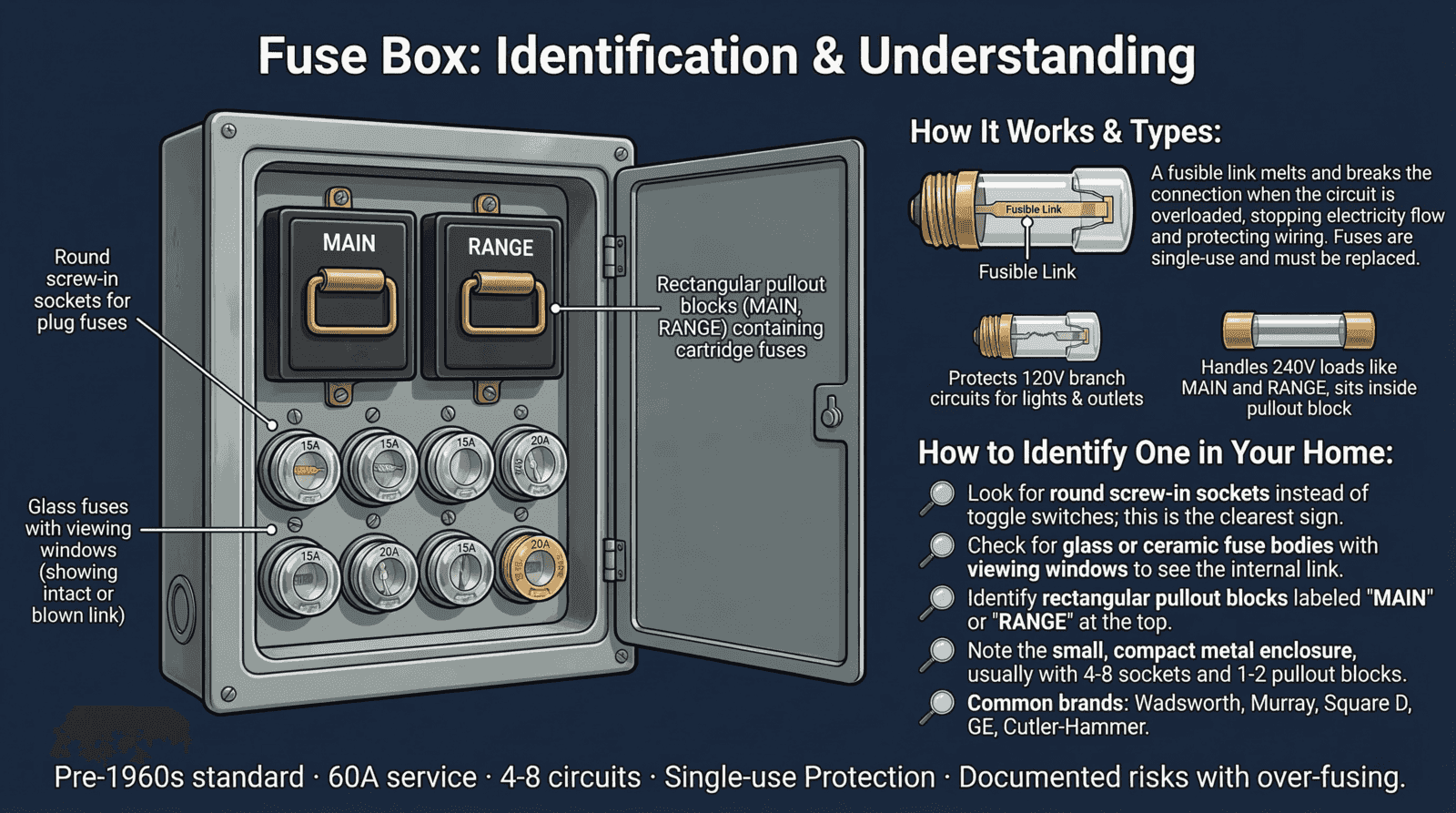
A fuse box is an electrical panel that uses fuses instead of circuit breakers. Inside each fuse is a calibrated metal strip called a fusible link. When more current flows through the circuit than the wire can safely carry, the link melts and breaks the connection. That stops the flow of electricity and protects the wiring from overheating.
The difference between a fuse and a breaker comes down to reuse. A circuit breaker trips and can be reset with a toggle switch. A fuse is single-use. Once it blows, you unscrew it and put in a new one.
Residential fuse boxes use two types of fuses. Plug fuses screw into round sockets and protect 120-volt branch circuits for lights and outlets. Cartridge fuses sit inside rectangular pullout blocks and handle 240-volt loads like the electric range, water heater, and the main service disconnect. Pulling the main block out of the panel cuts power to the entire house.
Fuse panels were the standard in American homes from the early 1900s through the mid-1960s. Circuit breakers gradually took over as manufacturing costs dropped and homeowners preferred the convenience of resetting a switch over replacing a part.
How to Identify One in Your Home
Your electrical panel is usually in the basement, utility room, garage, or an older kitchen. Open the outer door and look for these indicators:
- Round screw-in sockets instead of toggle switches. This is the clearest sign. Where a modern panel has rows of breaker toggles, a fuse box has circular threaded sockets.
- Glass or ceramic fuse bodies with viewing windows. Plug fuses have a small window on the face so you can see whether the internal link is intact or blown.
- Rectangular pullout blocks at the top. These are typically labeled "MAIN" or "RANGE." Pulling the block straight out extracts the cartridge fuses and disconnects power.
- A small metal enclosure. Fuse panels are compact. Most hold four to eight fuse sockets and one or two pullout blocks. They're noticeably smaller than a modern breaker panel.
Common brands: Wadsworth, Murray, Square D, General Electric (GE), and Cutler-Hammer all manufactured residential fuse panels.
⚠️ Don't remove the inner metal cover (the deadfront). The bus bars behind it carry full household voltage. Leave that to a licensed electrician.
Not sure what you're looking at? Take a photo of the label and fuse layout and send it to us. We can usually identify it from a clear picture.
What's the Concern?
Overfusing
This is the primary real-world hazard with fuse panels. It's not a manufacturing problem. It's a human problem that's been building for decades.
Standard residential wiring uses 14 AWG (American Wire Gauge) copper conductors rated for 15 amps. The fuse on that circuit should be 15 amps. When a 15-amp fuse blows, it's doing exactly what it was designed to do: stopping the current before the wire overheats.
The problem is what happens next. A homeowner who doesn't have a 15-amp replacement grabs a 20-amp or 30-amp fuse from the drawer. It screws right in. All Edison-base plug fuses share the same thread pattern regardless of amperage rating. A 30-amp fuse fits a 15-amp socket perfectly.
Now the fuse allows twice the current that the wire was designed to carry. The wire heats up inside the wall. The fuse won't blow because it's rated for far more current than is flowing. The wiring insulation degrades, softens, and can eventually ignite. This happens inside wall cavities where you can't see it, smell it, or stop it.
Over 60 to 80 years, many of these panels have been through multiple homeowners. Some have bypassed the fuse entirely using conductive objects jammed into the socket. The result is a circuit with no overcurrent protection at all.
Capacity
Most fuse boxes provide 60-amp service. In the 1950s, that was enough. A typical home had a refrigerator, some incandescent lights, maybe a toaster and a radio. Four to eight circuits covered everything.
Today, 60 amps can't support a modern household. The math doesn't work. A single window air conditioner draws 12 to 15 amps. A microwave pulls another 12. Add a hair dryer, a space heater, and a home office setup, and you've exceeded the entire service capacity. There's no room to add circuits, and there's no room in the panel for more fuses.
No Modern Safety Features
Fuse panels can't accept AFCI breakers, whole-home Surge Protective Devices (SPD), or panel-level Ground-Fault Circuit Interrupter (GFCI) protection. These technologies require circuit breaker platforms with onboard microprocessors. No manufacturer has ever produced them in a plug-fuse format. The technology didn't exist when these panels were made, and it was never retrofitted.
The NEC now requires AFCI protection on most branch circuits (NEC 210.12), whole-home surge protection (NEC 230.67), and an exterior emergency disconnect (NEC 230.85). A fuse box can't meet any of these requirements.
What This Is Not
A fuse that blows is not a malfunction. It's the system working correctly. Fuse panels are not defective. They've never been recalled. The concerns above are about age, capacity, and what homeowners have done to them over the decades.
This is a different situation from panels with documented manufacturing defects, where the breakers themselves fail to trip during an overload. Fuse panels don't share that problem. The issue is that the technology is outdated, the capacity is insufficient, and modern safety features can't be added.
Fuse Box vs. a Modern Panel
| Feature | Fuse Box | Modern Panel (Square D, Eaton, Siemens) |
|---|---|---|
| Overcurrent protection | Single-use fuses. Must be replaced after each event. | Resettable circuit breakers. Flip the switch to restore power. |
| Service capacity | Typically 60 amps. | 100 to 200 amps standard. |
| Circuit spaces | 4 to 8 fuse sockets. No expansion possible. | 30 to 42 spaces. Room for current and future circuits. |
| AFCI protection | Not available. No AFCI fuses exist. | Standard on most circuits per NEC 2023. |
| Surge protection (SPD) | Cannot be installed. No compatible mounting. | Required per NEC 230.67. Integrated into the panel. |
| GFCI protection | Limited to point-of-use receptacles only. | Available at the breaker level in dual-function AFCI/GFCI configurations. |
| Emergency disconnect | Interior pullout blocks only. | Exterior disconnect required per NEC 230.85. |
| Overfusing risk | Any amperage fuse fits any socket of the same thread size. | Breakers are panel-specific and amperage-specific. Can't install the wrong size. |
| Insurance and lending | 60A service is often a hard decline. Panel age draws heavy scrutiny. | Accepted by all carriers and lenders. |
What Arc-Fault Circuit Interrupters (AFCI) Do
An arc fault is a spark caused by damaged wiring. A nail driven through a wire behind drywall. A cord pinched under furniture. A connection that's worked loose inside an outlet box. These sparks reach temperatures high enough to ignite wood framing, insulation, and drywall paper. Arc faults are a leading cause of electrical fires in homes.
A standard fuse can't detect an arc fault. The current draw from a spark is too small and too irregular to melt the fusible link. The fuse only responds to sustained overloads or dead shorts. A dangerous arc doesn't look like either of those.
An AFCI breaker has a microprocessor that continuously reads the electrical waveform on the circuit. It distinguishes the erratic signature of a dangerous arc from the normal sparking that happens when you flip a light switch or start a motor. When it detects a hazardous arc pattern, it shuts the circuit down.
No manufacturer produces AFCI protection in a plug-fuse format. The technology requires a circuit breaker platform. A fuse box can't accept it, and there's no retrofit path.
What This Means for Your Insurance
Fuse panels draw heavy scrutiny during underwriting. Carriers see a fuse box and flag two things: the 60-amp service capacity and the panel's age. Both are proxies for an electrical system that predates every modern safety feature.
A 60-amp service is often a hard decline on its own. Insurers know that a modern family will overload 60 amps. That raises the probability of thermal events. The fuse technology adds another concern: carriers can't guarantee that the homeowner hasn't overfused the panel at some point during its decades of service.
Some carriers require full replacement before they'll write a policy. Others require a licensed electrician to inspect and certify the panel's condition within 30 to 60 days. The trend across the industry is toward stricter enforcement on older electrical systems.
What This Means When You Sell Your Home
Home inspectors flag fuse boxes. The observation goes into the report: "fused electrical panel, 60-amp service, no AFCI protection, no main disconnect breaker." The buyer reads it. Their insurance company reads it. And the carrier may refuse to write a policy until the panel is replaced.
Without insurance, the lender won't close. The deal stalls.
Replacing the panel before listing gives you control over the timeline and cost. Doing it mid-negotiation with a closing date looming costs more and limits your options.
Modern Electrical Demands
A 60-amp service was sized for 1950s loads. A refrigerator, some incandescent bulbs, a radio. The total electrical footprint of a mid-century home barely touched 60 amps.
Modern 120-volt loads include home office setups with multiple monitors, kitchen appliances that didn't exist 50 years ago, window air conditioners, and space heaters. On the 240-volt side, electric vehicle chargers, heat pumps, and induction cooktops all need dedicated high-amperage circuits. A fuse box has no room for them and no capacity to feed them.
A 200-amp service, which has been the baseline for new construction for decades, provides more than three times the capacity of a 60-amp fuse panel. That's not overkill. That's what modern life requires.
Denver Area: Where These Panels Are Found
Fuse panels are common in Denver-area homes built from the early 1900s through the late 1950s. The oldest homes have been through multiple electrical eras, and many still have the fuse panel that replaced the original knob-and-tube wiring.
Core pre-war neighborhoods near the urban center have the highest concentration. Washington Park, Capitol Hill, Baker, Highland, Park Hill, and Congress Park all contain dense clusters of homes built before 1950. Many of these were originally wired with knob-and-tube and upgraded to 60-amp fuse service during mid-century renovations.
The post-war suburbs built between 1945 and 1960 represent the tail end of the fuse era. Harvey Park, University Hills, older sections of Lakewood, Wheat Ridge, and Arvada all have homes from this period. These were built during the transition from fuses to breakers, and original fuse panels still show up in unrenovated homes.
| Area | Primary Build Period | Notes |
|---|---|---|
| Washington Park / Capitol Hill / Baker | 1900s-1940s | Pre-war homes, many upgraded from knob-and-tube to fuses |
| Highland / Park Hill / Congress Park | 1910s-1940s | Dense older housing stock near urban core |
| Harvey Park (SW Denver) | 1954-1960s | Post-war suburban development |
| University Hills | 1950s-1960s | Mid-century residential expansion |
| Older Lakewood / Wheat Ridge | 1940s-1960s | Early Jefferson County suburbs |
| Arvada | 1950s-1960s | Post-war growth along the northwest corridor |
Not every old panel is a problem panel. Square D, GE, Murray, Siemens, and Cutler-Hammer all made panels installed in Denver-area homes during the same era, and many of those panels (with circuit breakers, not fuses) are still in acceptable condition. If you're not sure what you have, our panel identification guide covers the most common panels found in Denver-area homes.
What Are the Options?
What you need depends on your specific panel, your service, and your wiring. We need to see it before we can tell you what makes sense.
The estimate is free, and we'll walk you through exactly what your panel needs and why.
What Does Replacement Look Like?
If a full panel replacement is the right call, here's the actual process:
- We come look at it. We check the existing panel, the wiring, the service entrance, the meter base, and figure out the full scope. No charge for the estimate.
- Permit. We pull the electrical permit with your local jurisdiction. Lakewood, Denver, Arvada, Westminster, wherever you are. A permit is required by law for panel work in Colorado. No permit means no inspection, no equipment warranty, and problems when you sell.
- Xcel coordination. Your service wires are always live from the utility side. We submit a disconnect request through Xcel's builder portal and schedule the meter pull. That typically takes 5 to 10 business days.
- The work. Plan for a full day without power. The old panel, bus bars, and fuses all come out. The new panel goes in with:
- A new lever bypass meter with a built-in handle that lets Xcel or a first responder cut power from outside (NEC 230.85)
- Modern breakers meeting UL (Underwriters Laboratories) 489 standards
- AFCI protection where NEC 2023 requires it (NEC 210.12)
- GFCI protection in kitchens, bathrooms, garages, and other required locations
- Whole-home surge protection (NEC 230.67)
- An intersystem bonding bar for cable, phone, and data grounding (NEC 250.94)
- Two driven copper ground rods, bonded together and back to the panel (NEC 250.52, 250.53)
- Ground connection to the main cold water pipe within the first 5 feet of where it enters the foundation (NEC 250.52(A)(1))
- Every circuit properly sized, torqued to spec, and labeled
- Inspection. A local electrical inspector checks the entire installation: connections, grounding, bonding, breaker sizing, labeling, code compliance.
- Power restored. Once the inspector signs off, they submit a meter release to Xcel Energy. Xcel installs the meter and turns power on.
The full process from first visit through final inspection takes days to weeks when you factor in permits and Xcel scheduling.
Payment
A 50% deposit is required before work begins. That locks in your date and lets us start the permit and Xcel coordination. The remaining 50% is due after the inspection passes and power is back on.
Warranty
Parts: One year on all electrical parts, starting from the date of final inspection.
Workmanship: We stand behind our installation work. Full warranty terms →
Frequently Asked Questions
What is a fuse box?
A fuse box is an electrical panel that uses fuses instead of circuit breakers for overcurrent protection. Inside each fuse is a metal strip designed to melt when too much current flows through it. That breaks the circuit and stops the flow of electricity. Unlike a circuit breaker, which you can reset by flipping a switch, a blown fuse has to be unscrewed and replaced with a new one. Most residential fuse boxes were installed between the 1940s and early 1960s and provide 60-amp service with four to eight circuits.
Is a fuse box dangerous?
The fuse itself is not dangerous. A fuse that blows is doing exactly what it was designed to do. The real concerns are what has happened to these panels over the decades. Homeowners often replace blown fuses with higher-amperage ones that don't match the wire size, and that creates a fire hazard inside the walls. Beyond that, most fuse boxes provide only 60-amp service with no room to add circuits, and they can't accept arc-fault protection, surge protection, or other safety features that current code requires. I need to see your specific panel to tell you what condition it's in and what it needs.
Why does my fuse keep blowing?
A fuse that blows is doing its job. Something on that circuit is drawing too much current. It could be too many appliances on one circuit, a failing appliance, or a wiring issue. I need to see your panel and your wiring to tell you whether it's a circuit problem or a sign the panel needs to be replaced.
Will my insurance drop me for having a fuse box?
It depends on the carrier, but fuse panels draw heavy scrutiny during underwriting. The 60-amp service is often a hard decline on its own. Some carriers require a licensed electrician to inspect and certify the panel before they'll write a policy. Others require full replacement within 30 to 60 days. The trend across the industry is toward stricter enforcement on older electrical systems, and a fuse box checks every box that makes underwriters nervous.
How do I know if I have a fuse box?
Open the outer panel door. If you see round screw-in sockets instead of toggle switches, you have a fuse box. The fuses themselves have glass or ceramic bodies with a small viewing window. You may also see rectangular pullout blocks labeled 'MAIN' or 'RANGE' at the top of the panel. The enclosure is usually a small metal box in the basement, utility room, or an older kitchen. Common brands include Wadsworth, Murray, Square D, GE, and Cutler-Hammer.
Can I just add more circuits to my fuse box?
No. Fuse boxes have a fixed number of sockets, and there's no way to add more inside the existing enclosure. Every fuse needs its own full-size socket. Even if you added a subpanel for more circuit spaces, all the power still flows through the original 60-amp service, which is the real bottleneck. The only way to get more capacity and more circuits is a full panel and service upgrade.
Not Sure What You Have?
Send us a photo. We'll tell you what you have and whether it needs attention.
Sources
- National Fire Protection Association (NFPA): Home Electrical Fires Fact Sheet. Statistical data on residential electrical fire causes and contributing factors.
- U.S. Consumer Product Safety Commission (CPSC): Electrical Safety in the Home. Overview of residential electrical hazards including overcurrent protection failures.
- Eaton: NEC 2023 Emergency Disconnect Requirements (NEC 230.85). Technical guidance on exterior disconnect for dwelling units.
- Eaton: NEC 2023 Surge Protection Requirements (Article 230.67). Technical guidance on whole-home surge protective device requirements.
- Colorado DORA: State Electrical Board Adopts 2023 National Electrical Code, effective August 1, 2023.
- InterNACHI: Overcoming Objections to Inspecting Fuse Panels. Home inspection standards and fuse panel identification guidance.
- NEC 2023: Sections 210.12, 230.67, 230.85, 250.52, 250.53, 250.94. As adopted by Colorado metro municipalities.
This page is for informational purposes. References to the National Electrical Code (NEC) are based on the 2023 NEC as adopted by Colorado at the time of writing and are for context only. They do not replace the currently adopted code in your jurisdiction. Your local Authority Having Jurisdiction (AHJ) and electrical inspector determine what applies to your project. Electrical work should only be performed by a licensed electrician.