
Pushmatic Electrical Panels
Pushmatic panels were installed in homes from the 1950s through the early 1980s. Instead of toggle switches, they use push-button breakers that rely on internal grease to operate smoothly. After decades of use, that grease dries out and the breakers seize. A seized breaker can't trip during an overload, which means it can't protect the circuit.
There is no Consumer Product Safety Commission (CPSC) recall on Pushmatic panels. The problem isn't fraud or a design defect. These panels are simply past their useful life. They can't accept arc-fault breakers, whole-home surge protection, or a single main disconnect. Replacement brings your home's electrical system up to current code and safety standards.
This page is for general education only. Every panel, wiring configuration, and home is different. Nothing here should replace a hands-on evaluation by a licensed electrician who can see your specific equipment. If you have questions about your panel, talk to a qualified professional before making any decisions.
What Is a Pushmatic Panel?
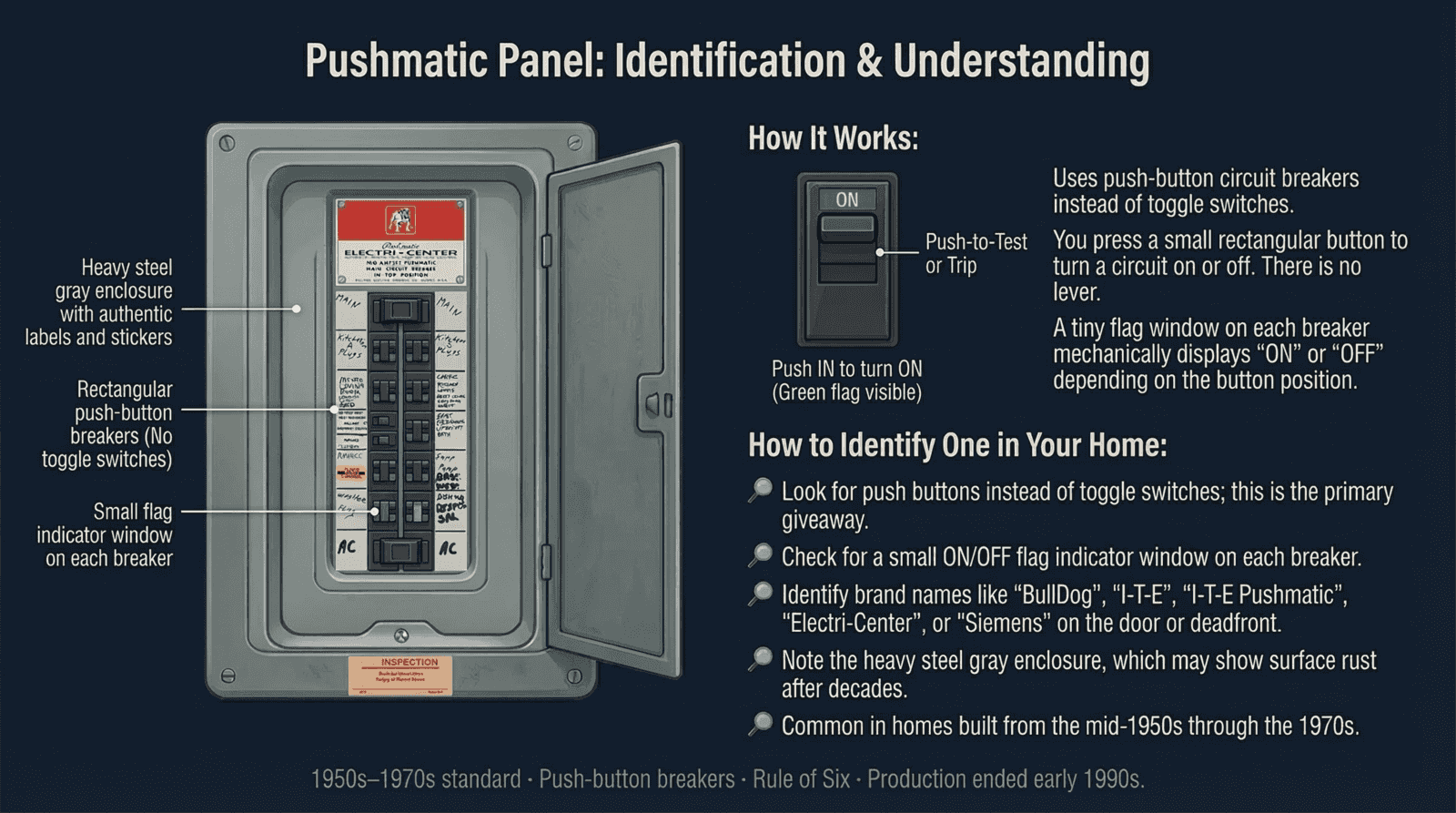
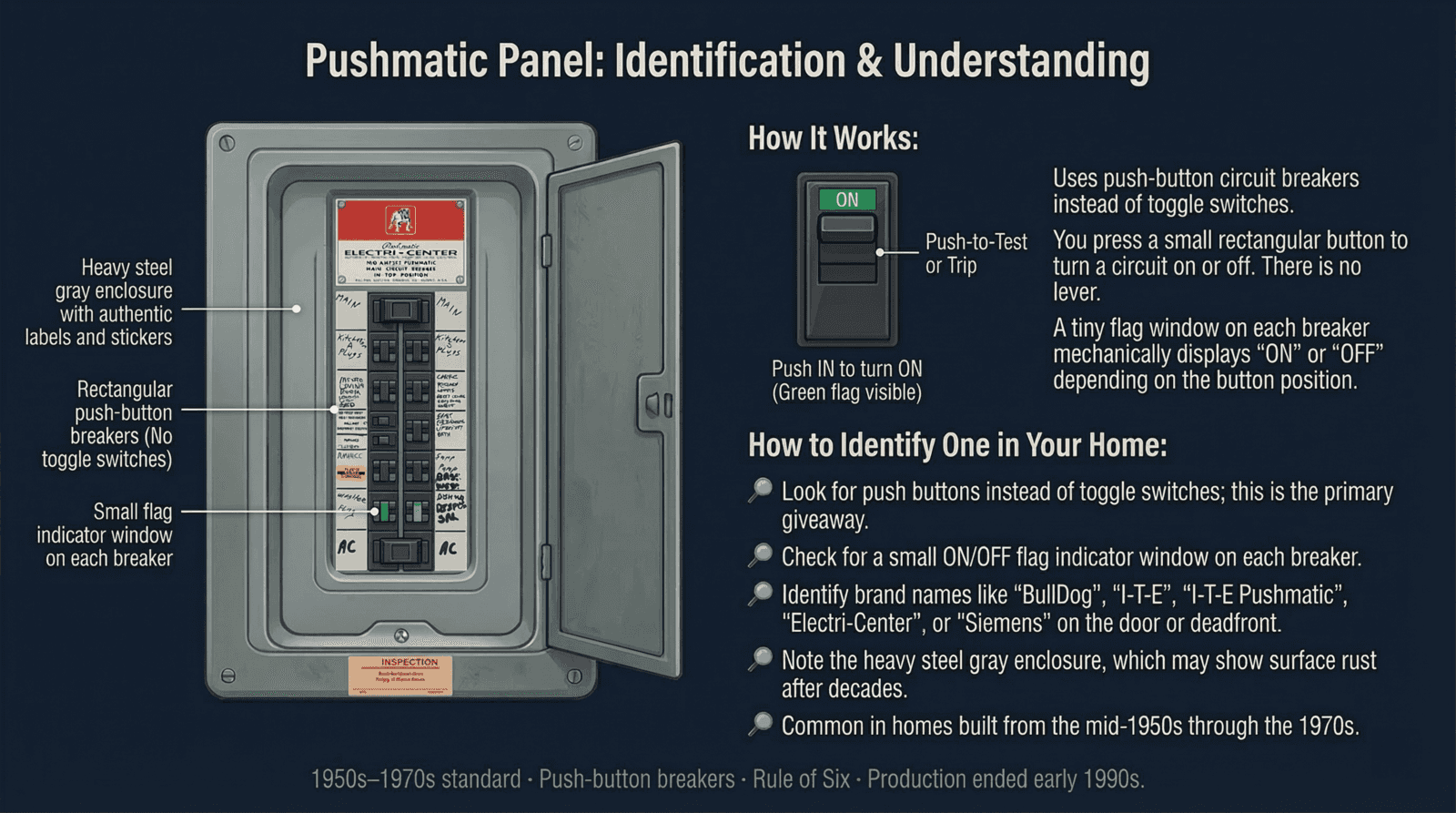
A Pushmatic panel is a residential electrical panel that uses push-button circuit breakers instead of the toggle switches found in modern panels. You press a small rectangular button to turn a circuit on or off. There's no lever. A tiny flag window on each breaker shows "ON" or "OFF."
Bulldog Electric Products Company, based in Detroit, developed the Pushmatic breaker and sold it inside a steel enclosure they called the "Electri-Center." The two names refer to different parts: "Pushmatic" is the breaker, "Electri-Center" is the box it sits in. These panels were popular with tract home builders across the Denver metro area from the mid-1950s through the 1970s.
The company changed hands multiple times over the following decades. You might see "BullDog," "I-T-E," "I-T-E Pushmatic," or even "Siemens" on a panel that contains the same Pushmatic breakers. Production ended in the early 1990s when Siemens discontinued the product line in favor of modern toggle-style panels.
How to Identify One in Your Home
Your electrical panel is usually in the garage, basement, or a utility closet. Open the outer swinging door and look for these markers:
- Push buttons instead of toggle switches. This is the giveaway. Small rectangular buttons that you press in and out. No other residential panel uses this design.
- ON/OFF flag indicator. Each breaker has a small window that mechanically displays "ON" or "OFF" depending on the button position.
- Brand names: "BullDog," "I-T-E," "I-T-E Pushmatic," "Electri-Center," or "Siemens" on the door, deadfront, or data sheet inside the door.
- Heavy steel gray enclosure. These boxes are thick-gauge steel, usually painted industrial gray. After 50+ years, surface rust is common.
- Installation era. If your home was built between the mid-1950s and late 1970s in the Denver area, a Pushmatic panel is a strong possibility.
⚠️ Don't remove the inner metal cover (the deadfront). Leave that to a licensed electrician. The bus bars behind it carry full household voltage.
What's Wrong With Pushmatic Panels?
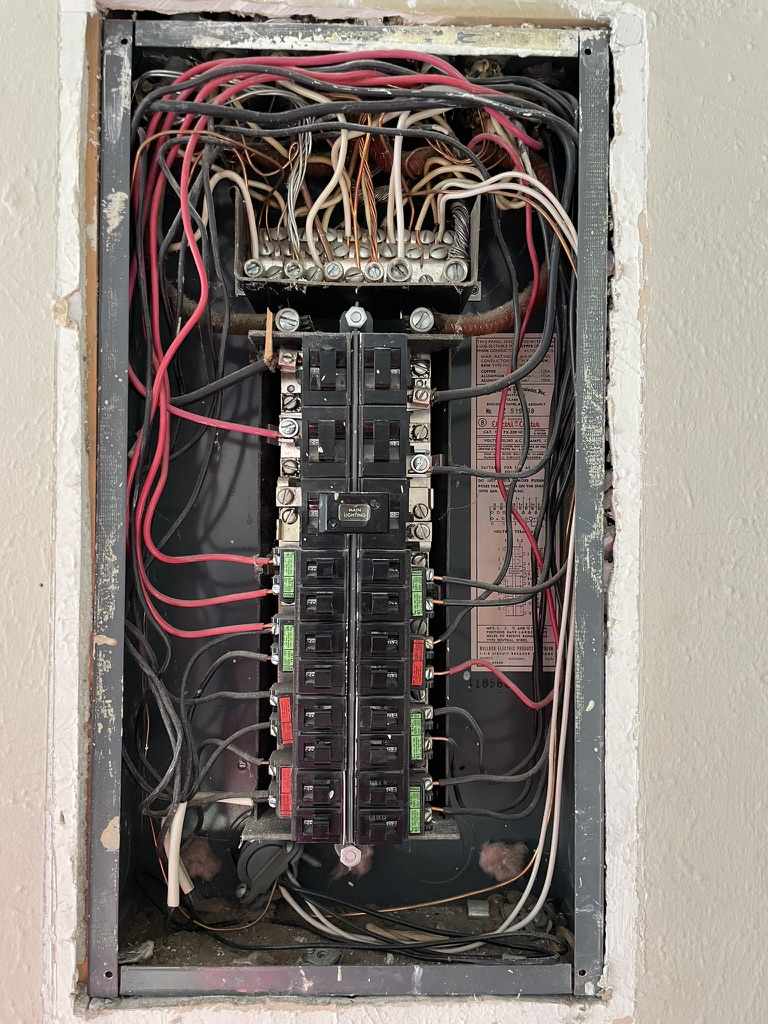
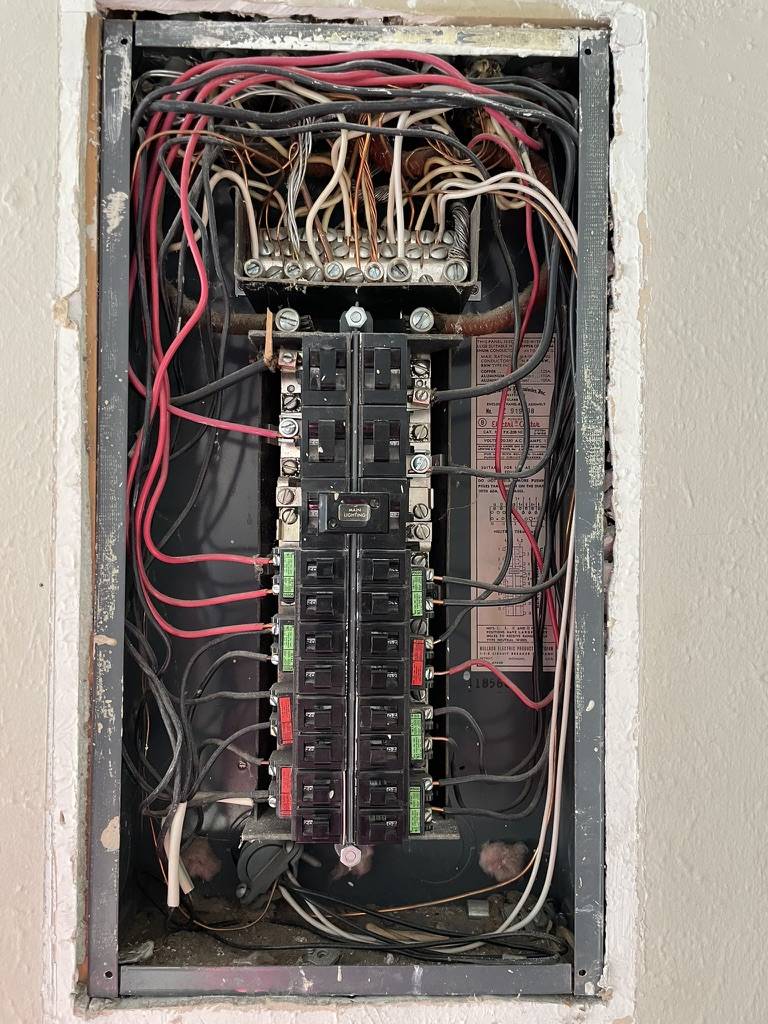
Pushmatic panels weren't built with a flaw. They were built for a different era. The engineering was competent for the 1950s, but these panels are now 50 to 70 years old. Three specific problems come with that age.
Grease Degradation and Mechanical Seizing
The push-button mechanism inside a Pushmatic breaker relies on sliding linkages and over-center springs. At the factory, these parts were packed with dielectric grease to keep everything moving smoothly. After decades of thermal cycling (the constant heating and cooling that happens every time current flows through the breaker), that grease dries out and hardens.
When the grease petrifies, the internal mechanism binds. A bound breaker may not trip during an overload. The spring tension that's supposed to snap the contacts open can't overcome the friction of the seized mechanism. Current keeps flowing through wiring that's already too hot. That's how electrical fires start.
This is the primary safety concern with Pushmatic panels. It affects every breaker in the panel, and it gets worse with time.
False Status Indicators
The mechanical flag that displays "ON" or "OFF" on each breaker can fall out of sync with the actual state of the internal contacts. Field electricians report finding breakers where the flag reads "OFF" and the button appears depressed, but the electrical contacts inside are still engaged. The circuit is live, and the breaker says otherwise.
This is dangerous for anyone working on their home's wiring. You look at the panel, see "OFF," and start working on what you believe is a dead circuit. It isn't.
Early Models: Thermal-Only Trip Mechanism
Modern circuit breakers are "thermal-magnetic." They have two trip mechanisms: a bimetallic strip that bends under sustained heat from an overload, and an electromagnet that trips instantly during a short circuit (a zero-resistance fault where current spikes to hundreds or thousands of amps).
Based on professional analysis and historical records, the earliest Pushmatic breakers only had the thermal element. No electromagnet. That means they responded to sustained overloads, but they couldn't react fast enough to a dead short. A dead short needs to be interrupted in milliseconds. A thermal-only breaker takes longer because it has to physically heat up before it trips.
Later Pushmatic models (after the I-T-E acquisition in 1954) added magnetic trip capability. The problem: there's no way to tell which type you have without taking the breaker apart. From the outside, they look the same.
What This Is Not
The CPSC has never issued a recall for Pushmatic panels or breakers. A 1988 Siemens inspection program covered certain I-T-E load centers manufactured in 1986-1987, but that involved enclosure materials and was completely unrelated to the Pushmatic product line. Any contractor claiming these panels were "federally recalled" is misrepresenting the facts.
Pushmatic panels also don't share the specific defects associated with other panels with documented defects. The bus bar connection in a Pushmatic panel uses bolted fasteners rather than the friction-fit clips found in most residential panels. That bolted connection is a different design approach. The safety concerns here are about age and mechanical degradation, not a manufacturing defect.
Pushmatic vs. a Modern Panel
| Feature | Pushmatic | Modern Panel (Square D, Eaton, Siemens) |
|---|---|---|
| Trip mechanism | Push-button. Early models thermal-only. Later models thermal-magnetic. No way to tell from outside. | Toggle switch. All standard models are thermal-magnetic. |
| Bus bar connection | Breakers bolted directly to bus bar. | Plug-on jaw or bolt-on with mechanical lock. |
| AFCI (Arc-Fault Circuit Interrupter) | Not available. No AFCI breaker was ever made for Pushmatic panels. | Standard on most circuits per NEC (National Electrical Code) 2023. |
| GFCI (ground-fault circuit interrupter) protection | Not available at the breaker. Requires subpanels or downstream devices. | Standard. Available in dual-function AFCI/GFCI configurations. |
| Surge protection | None. No Type 1 or Type 2 SPD (Surge Protective Device) fits the panel. | Required per NEC 230.67. Integrated into the panel. |
| Main disconnect | Many are split-bus (up to six separate disconnects, no single shutoff). | Single main breaker standard. Exterior disconnect required per NEC 230.85. |
| Insurance and lending | Flagged by inspectors. Many carriers restrict or deny coverage. | Accepted by all carriers and lenders. |
What Arc-Fault Circuit Interrupters (AFCI) Do
An arc fault is a spark caused by damaged wiring. A nail driven through a wire behind drywall. A cord pinched under furniture. A connection that's worked loose inside an outlet box. These sparks reach temperatures high enough to ignite wood framing, insulation, and drywall paper. Arc faults are a leading cause of electrical fires in homes.
A standard circuit breaker can't detect an arc fault. The current draw from a spark is too small and too irregular to trigger a traditional overcurrent trip. The breaker only responds to sustained overloads or dead shorts. A dangerous arc doesn't look like either of those.
An AFCI breaker has a microprocessor that continuously reads the electrical waveform on the circuit. It distinguishes the erratic signature of a dangerous arc from the normal sparking that happens when you flip a light switch or start a motor. When it detects a hazardous arc pattern, it shuts the circuit down.
Pushmatic panels can't accept AFCI breakers. No manufacturer has ever produced one for the Pushmatic platform. The breaker footprint, the enclosure geometry, and the push-button mechanism are all incompatible with the electronics required for arc-fault detection. This technology didn't exist when these panels were made, and it was never retrofitted.
What This Means for Your Insurance
Insurance underwriters in Colorado flag Pushmatic panels alongside other aging panel brands on their checklists. The reasons are different from panels with documented defects, though. With Pushmatic, the triggers are the panel's extreme age and, in split-bus configurations, the absence of a single main disconnect.
Insurance technical bulletins specifically cite the hardening of internal springs and the stiffening of push-button mechanisms as unquantifiable risks for reliable circuit interruption. The lack of a single main shutoff complicates emergency response during a fire or flood, and that's another underwriting concern.
If your Pushmatic panel gets flagged, you'll typically get 30 to 60 days to replace it or face non-renewal. Some carriers refuse to write new policies on homes with these panels. Others apply surcharges or coverage limitations.
What This Means When You Sell Your Home
When a home with a Pushmatic panel goes on the market, the home inspector flags it. The buyer's insurance company refuses to write a policy or requires replacement before binding. The buyer's lender won't close without insurance. The deal stalls.
Home inspectors are trained to flag Pushmatic panels as obsolete equipment that needs professional evaluation. The brand name alone triggers the recommendation, regardless of the panel's apparent condition. Most inspection reports recommend replacement by a licensed electrician before closing.
Replacing the panel before listing gives you control over the timeline and cost. Doing it mid-negotiation with a closing date looming costs more and limits your options.
Modern Electrical Demands
Pushmatic panels were sized for 1950s and 1960s electrical loads. Most are 60-amp or 100-amp services with 12 to 24 circuit spaces. A 1960s home might have had an electric range, a clothes dryer, and a handful of outlets per room.
Today's homes run air conditioning, heat pumps, home offices with multiple monitors, kitchen appliances that didn't exist 50 years ago, and (increasingly) electric vehicle chargers. A 60-amp panel can't support those loads. Even a 100-amp panel is often not enough.
Beyond capacity, Pushmatic panels lack the safety features that current code requires: arc-fault circuit interrupters (AFCI), whole-home surge protection (NEC 230.67), and an exterior emergency disconnect (NEC 230.85). You can't add any of those to a Pushmatic panel. A replacement panel brings all of it.
Age Alone Is a Factor
The newest Pushmatic panels are over 40 years old. Most are 50 to 70.
Circuit breakers are mechanical devices. They rely on springs, bimetallic strips, and contact surfaces that degrade with use and time. After decades of thermal cycling, breaker springs lose tension. Contact surfaces oxidize. Internal lubricants dry out and harden. The breaker still flips on and off by hand, but its ability to trip automatically at the rated threshold gets worse over time.
A Pushmatic breaker installed in 1965 has been through 60 years of load cycles. Every day, current flows through it, heats it up, and cools it down. The mechanical parts that protect your home are wearing out in ways you can't see from the outside. At some point, the age of the equipment is reason enough to have it evaluated.
Denver Area: Where These Panels Are Found
Pushmatic panels are common in Denver-area homes built during the 1950s, 1960s, and 1970s. The city added approximately 31,000 single-family homes during the 1950s alone, and large-scale tract builders standardized their electrical supply chains to keep up with demand.
The most prominent of these builders was Perl-Mack Enterprises, founded in 1951 by Jordon Perlmutter and Samuel Primack. Perl-Mack built thousands of homes across multiple developments: Perl-Mack Manor in Westminster (approximately 2,300 homes starting in 1955), Northglenn (starting in 1959), Southglenn (1961), and the Montbello neighborhood in northeast Denver (1970). Because Perl-Mack standardized their building materials, the electrical panels in these homes are highly uniform.
| Area | Primary Build Period | Notes |
|---|---|---|
| Westminster (Adams County) | 1955-1970s | Perl-Mack Manor and surrounding developments |
| Northglenn (Adams County) | 1959-1970s | Perl-Mack planned community |
| Montbello (Denver) | 1970-1980s | Perl-Mack development in northeast Denver |
| Arvada (Jefferson County) | 1950s-1970s | Post-war suburban expansion |
| Lakewood (Jefferson County) | 1950s-1970s | Western metro expansion |
| Littleton (Arapahoe County) | 1950s-1970s | Southern metro growth |
Not every old panel is a problem panel. Square D, GE, Murray, Siemens, and Cutler-Hammer were all installed in Denver-area homes during the same era, and none of them carry the same concerns. If you're not sure what you have, our panel identification guide covers the most common panels found in Denver-area homes.
Your home's build year is on your property tax records or your county assessor's website. That's the starting point. The only way to know for certain what panel you have is to look at it.
Can a Pushmatic Panel Be Repaired?
Aftermarket breakers exist for Pushmatic panels, and individual breaker failures can sometimes be addressed. But a new breaker doesn't add AFCI protection, surge protection, or a main disconnect. It doesn't fix the other aging breakers still in the panel. And the panel still triggers the same insurance and resale problems.
Many Pushmatic panels were also installed as split-bus configurations with no single main disconnect, which adds another layer of code non-compliance.
What your panel needs depends on its specific condition, your service size, and your local code requirements. We need to see it before we can tell you what makes sense. The estimate is free.
What Does Replacement Look Like?
If a full panel replacement is the right call, here's the actual process:
- We come look at it. We check the existing panel, the wiring, the service entrance, the meter base, and figure out the full scope. No charge for the estimate.
- Permit. We pull the electrical permit with your local jurisdiction. Westminster, Arvada, Lakewood, Littleton, wherever you are. A permit is required by law for panel work in Colorado. No permit means no inspection, no equipment warranty, and problems when you sell.
- Xcel coordination. Your service wires are always live from the utility side. We submit a disconnect request through Xcel's builder portal and schedule the meter pull. That typically takes 5 to 10 business days.
- The work. Plan for a full day without power. The old panel, bus bars, and breakers all come out. The new panel goes in with:
- A new lever bypass meter with a built-in handle that lets Xcel or a first responder cut power from outside (NEC 230.85)
- Modern breakers meeting UL 489 standards
- AFCI protection where NEC 2023 requires it (NEC 210.12)
- GFCI protection in kitchens, bathrooms, garages, and other required locations
- Whole-home surge protection (NEC 230.67)
- An intersystem bonding bar for cable, phone, and data grounding (NEC 250.94)
- Two driven copper ground rods, bonded together and back to the panel (NEC 250.52, 250.53)
- Ground connection to the main cold water pipe within the first 5 feet of where it enters the foundation (NEC 250.52(A)(1))
- Every circuit properly sized, torqued to spec, and labeled
- Inspection. A local electrical inspector checks the entire installation: connections, grounding, bonding, breaker sizing, labeling, code compliance.
- Power restored. Once the inspector signs off, they submit a meter release to Xcel Energy. Xcel installs the meter and turns power on.
The full process from first visit through final inspection takes days to weeks when you factor in permits and Xcel scheduling.
Payment
A 50% deposit is required before work begins. That locks in your date and lets us start the permit and Xcel coordination. The remaining 50% is due after the inspection passes and power is back on.
Warranty
Parts: One year on all electrical parts, starting from the date of final inspection.
Workmanship: We stand behind our installation work. Full warranty terms →
Frequently Asked Questions
Is a Pushmatic panel dangerous?
It's not dangerous the way some panels with documented defects are. There's no CPSC recall, no fraud finding, and no independent lab data showing a systemic defect. The problem is age. The internal grease that keeps the push-button mechanism working dries out over decades. When that happens, breakers can seize and fail to trip during an overload. That's a real hazard, but it comes from obsolescence, not a design flaw. I recommend replacement because these panels are past their useful life and can't accept any modern safety features.
Is there a recall on Pushmatic or Bulldog panels?
No. The CPSC has never issued a recall for Pushmatic or Bulldog panels or breakers. A 1988 Siemens inspection program covered certain I-T-E load centers made in 1986-1987, but that involved panel enclosure materials and had nothing to do with the Pushmatic product line. Any contractor telling you these panels were "federally recalled" is wrong.
Can I buy replacement breakers for a Pushmatic panel?
Aftermarket breakers exist, but replacing one breaker doesn't solve the bigger issues. The panel still can't accept AFCI protection, surge protection, or a main disconnect. The other aging breakers are still degrading. And the panel still creates the same insurance and resale friction. What your panel actually needs depends on its condition and your service size. I need to see it to give you the right answer.
Will my insurance drop me for having a Pushmatic panel?
It depends on your carrier. Some Colorado insurers flag Pushmatic panels during underwriting or at renewal. The triggers are usually the panel's age and the lack of a single main disconnect. You may get a non-renewal notice with 30 to 60 days to replace, or a surcharge. The trend is toward stricter enforcement.
How do I know if I have a Pushmatic panel?
Open your electrical panel door and look at the breakers. If you see small rectangular push buttons instead of toggle switches, you have a Pushmatic panel. Each breaker will also have a tiny window that displays "ON" or "OFF." The panel enclosure is heavy steel, usually painted gray. Look for the names "BullDog," "I-T-E," "I-T-E Pushmatic," "Electri-Center," or "Siemens" on the door or the data sheet inside. No other residential panel uses the push-button design.
My Pushmatic panel has worked fine for 50 years. Why replace it now?
Because breakers don't trip every day. They sit there for years until there's an overload or short circuit. That's the one moment they need to work. After 50 years of thermal cycling, the springs lose tension, the grease hardens, and the contacts oxidize. The panel looks fine from the outside. But the internal parts that protect your home are degraded in ways you can't see without pulling it apart.
Not Sure What You Have?
Send us a photo. We'll tell you what you have and whether it needs attention.
Why So Many Names on One Panel
If you've seen "BullDog," "I-T-E," "Electri-Center," and "Siemens" on what looks like the same equipment, you're not confused. The product line passed through multiple corporate owners over nearly a century. Each owner relabeled the same hardware. This table tracks who owned what and when.
| Year | Event |
|---|---|
| 1902 | Frank brothers found the Mutual Electric and Machine Company in Wheeling, West Virginia. Develop the "BullDog" trademark for electrical switches. |
| 1915 | Company relocates to Detroit, becomes BullDog Electric Products Company. |
| By 1952 | BullDog introduces the Pushmatic push-button breaker and Electri-Center enclosure. First verified in Architectural Record trade advertising, May 1952. |
| 1954 | I-T-E Circuit Breaker Company (Philadelphia) acquires BullDog Electric for 227,272 shares of stock. Products relabeled "I-T-E Pushmatic." |
| 1966 | I-T-E merges with Imperial-Eastman to form I-T-E Imperial Corporation. |
| 1976 | Gould Inc. acquires I-T-E Imperial. Division operates as ITE-Gould. |
| 1983 | Siemens-Allis purchases the I-T-E electrical division from Gould. Products co-branded "Siemens/I-T-E" for several years. |
| Early 1990s | Siemens discontinues the Pushmatic product line. Shifts manufacturing to modern toggle-style load centers. |
Sources
- CPSC database: No recalls exist for Bulldog, Pushmatic, or I-T-E Pushmatic panels or breakers.
- Architectural Record, May 1952: Bulldog Pushmatic Electri-Center product listing. Confirms "Electri-Center" as enclosure name, "Pushmatic" as breaker name.
- Westinghouse Electric Corp. v. Bulldog Elec. Prod. Co., 106 F. Supp. 819 (N.D.W. Va. 1952). Federal court records documenting the push-button breaker mechanism.
- Commonwealth Edison Co. v. Allis-Chalmers Mfg. Co., 245 F. Supp. 889 (N.D. Ill. 1965). Confirms I-T-E acquisition of BullDog Electric in June 1954 for 227,272 shares.
- NRC Inspection Report 99901177/90-01. Documents Siemens-Allis acquisition of I-T-E division from Gould in March 1983.
- The Silver Lining Insurance Technical Bulletin WB-2685: "Pushmatic Electric Panels," November 2019. Documents breaker flag desynchronization and spring degradation risks.
- Denver's Single-Family Homes by Decade: 1950s. DenverUrbanism, 2012. Approximately 31,000 homes built in Denver in the 1950s.
- History Colorado: Perl-Mack Enterprises builder archive. Founded 1951, Perl-Mack Manor (2,300 homes), Northglenn, Southglenn, Montbello developments.
- Colorado DORA: State Electrical Board Adopts 2023 National Electrical Code, effective August 1, 2023.
- Connecticut Electric UBIP product line: ETL listed to UL Standard 489 for use in Pushmatic/Bulldog panels.
- NEC 2023: Sections 110.3(B), 210.12, 230.67, 230.85, 250.52, 250.53, 250.94. As adopted by Colorado metro municipalities.
- Siemens announces free I-T-E Circuit Breaker Box Inspection Program, 1988 (unrelated to Pushmatic).
This page is for informational purposes. References to the National Electrical Code (NEC) are based on the 2023 NEC as adopted by Colorado at the time of writing and are for context only. They do not replace the currently adopted code in your jurisdiction. Your local Authority Having Jurisdiction (AHJ) and electrical inspector determine what applies to your project. Electrical work should only be performed by a licensed electrician.