
Split-Bus Electrical Panels
A split-bus panel is a wiring configuration, not a specific brand. Instead of one main breaker that shuts off all power, the panel has up to six separate disconnects in the upper section. To fully de-energize the house, you have to throw all of them. The National Electrical Code (NEC) restricted this design in the early 1980s. The 2020 and 2023 NEC tightened the rules further, requiring a single exterior emergency disconnect for all homes.
This isn't a defect. The panel works as designed. But the design is outdated, and replacement brings a single main disconnect, arc-fault protection, surge protection, and the capacity modern homes need.
This page is for general education only. Every panel, wiring configuration, and home is different. Nothing here should replace a hands-on evaluation by a licensed electrician who can see your specific equipment. If you have questions about your panel, talk to a qualified professional before making any decisions.
What Is a Split-Bus Panel?
In a modern electrical panel, power comes in through one large main breaker. Flip that breaker, and everything in the house goes dead. A split-bus panel doesn't work that way.
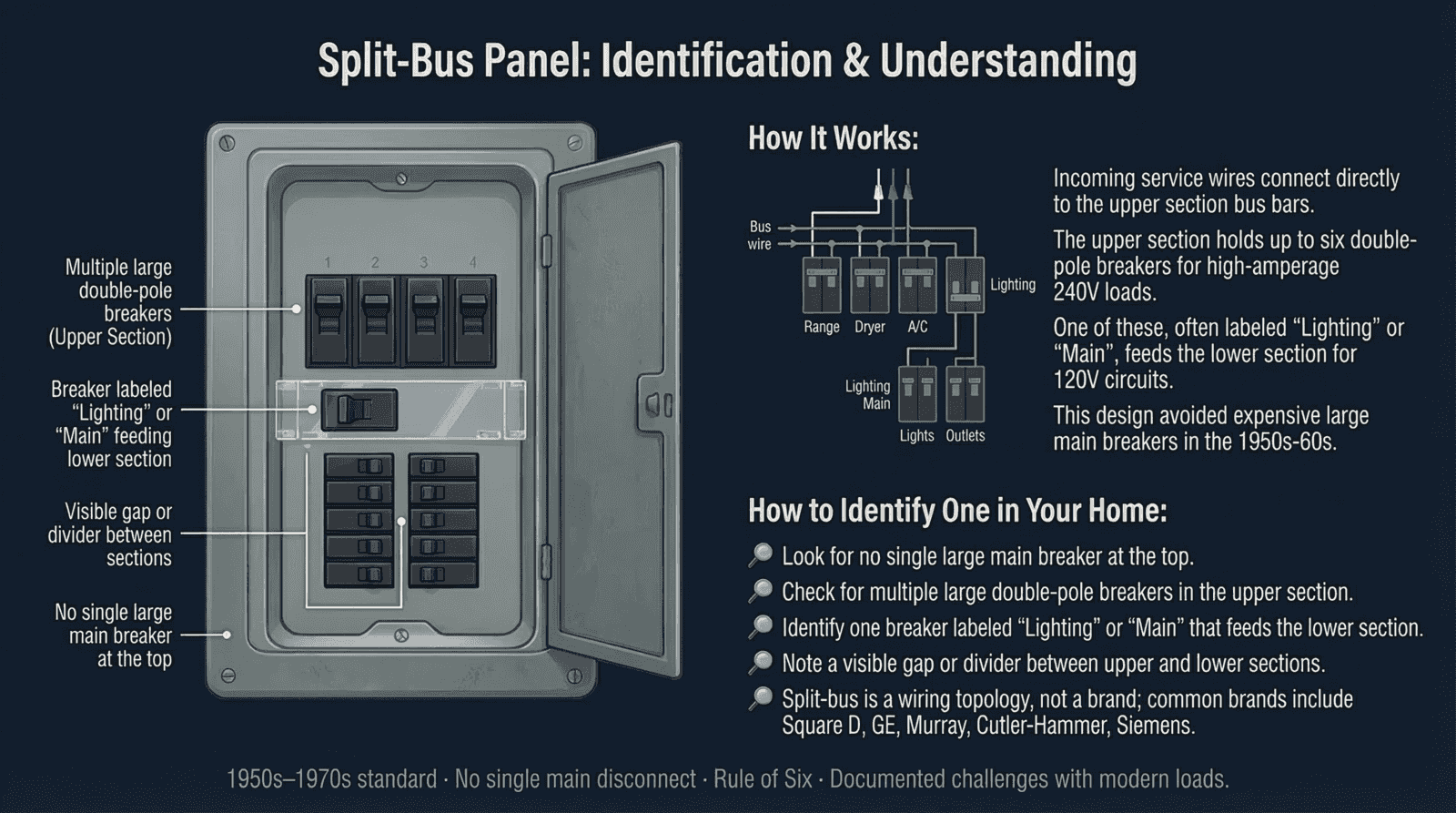
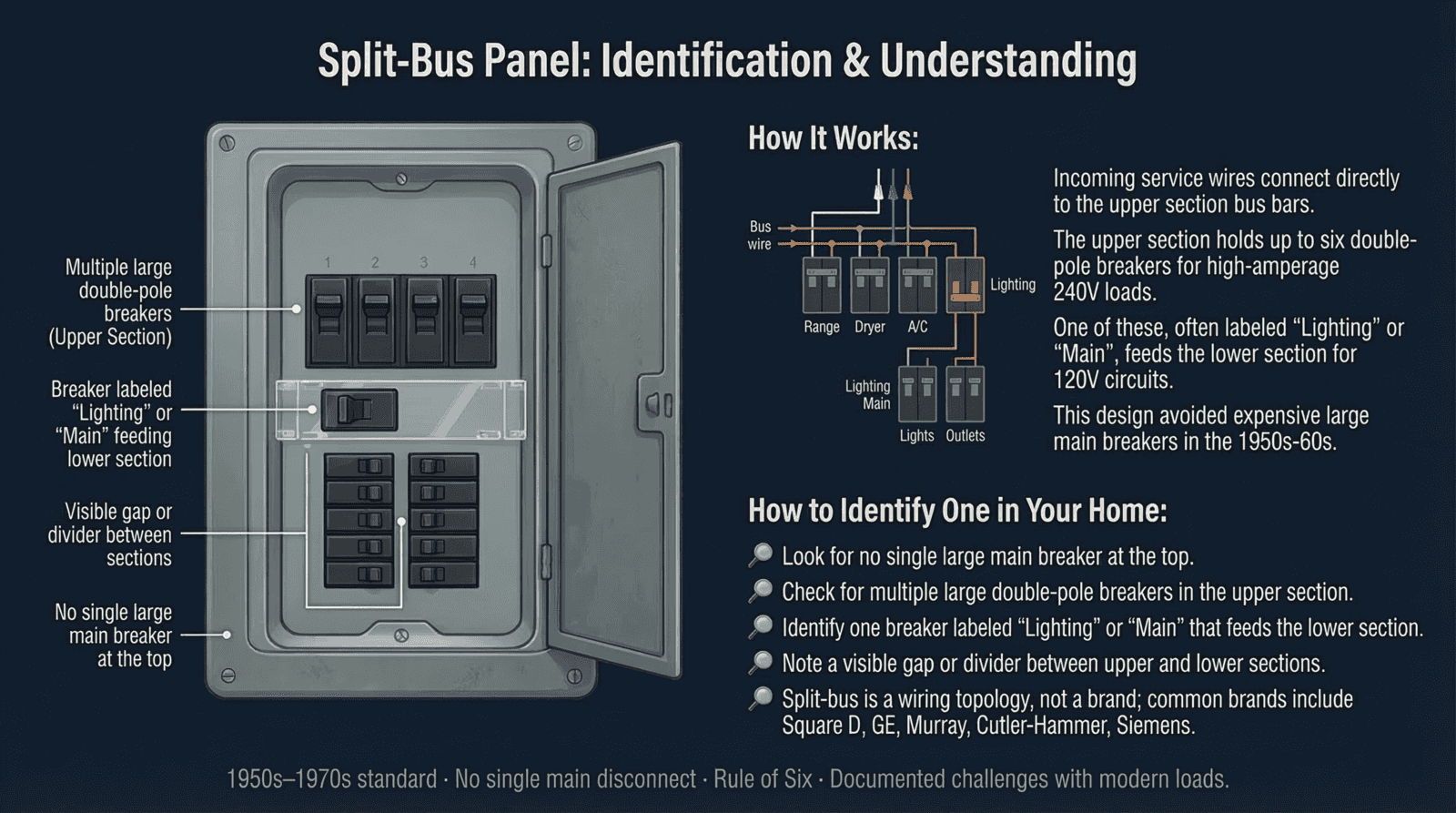
Instead, the incoming service wires connect directly to the bus bars in the upper section of the panel. That upper section holds up to six double-pole breakers, each feeding a high-amperage 240-volt load: the electric range, clothes dryer, water heater, air conditioning. One of those upper breakers, typically rated at 50 or 60 amps and labeled "Lighting" or "Main," feeds the lower section of the panel. The lower section runs all the 120-volt circuits: lights, outlets, and small appliances.
Builders used this design because high-amperage main breakers were expensive to manufacture in the 1950s and 1960s. By splitting the panel into two sections and using several smaller breakers, manufacturers could deliver a 100-amp or 150-amp panel at a fraction of the cost. The design met every code requirement of the era.
Any brand can be a split-bus panel. Square D, General Electric, Murray, Cutler-Hammer, Siemens, and others all produced them. The split-bus label describes the wiring topology, not the manufacturer.
How to Identify One in Your Home
Your electrical panel is usually in the garage, basement, or a utility closet. Open the outer swinging door and look for these indicators:
- No single large main breaker at the top. This is the clearest sign. Modern panels have one breaker (usually 100A, 150A, or 200A) that controls everything. A split-bus panel doesn't.
- Multiple large double-pole breakers in the upper section. These are typically 30A, 40A, or 50A breakers feeding individual 240-volt appliances.
- One breaker labeled "Lighting" or "Main" that feeds the lower section. This is the bridge between upper and lower. It only controls the 120-volt circuits below it.
- A visible gap or divider between upper and lower sections. Some panels have a metal plate or blank space separating the two bus bar sections.
- Any brand name. Split-bus isn't tied to a single manufacturer. You might see Square D, GE, Murray, Cutler-Hammer, or another name on the same configuration.
⚠️ Don't remove the inner metal cover (the deadfront). The bus bars behind it carry full household voltage. Leave that to a licensed electrician.
Not sure what you're looking at? Take a photo of the label and breaker layout and send it to us. We can usually identify it from a clear picture.
Why the Code Changed
The NEC allowed the split-bus configuration for decades. The provision was called the "Rule of Six," and it let builders install panels with up to six service disconnects instead of a single main breaker. For most of the mid-twentieth century, this was standard practice.
That started changing around 1981. The NEC restricted new split-bus installations for residential panels, and by the mid-1980s, the configuration was no longer permitted for new homes. Manufacturers had also caught up. Advances in breaker manufacturing brought the cost of high-amperage main breakers down enough that the economic argument for split-bus disappeared.
The bigger shift came in 2020. The NEC eliminated the permission to install two to six service disconnects in a single enclosure entirely (NEC 230.71). The same code cycle introduced NEC 230.85, requiring an exterior emergency disconnect for all dwelling units. The 2023 NEC refined those requirements further.
The National Fire Protection Association (NFPA) Code-Making Panel 10 explained the reasoning: first responders need to cut power fast during a fire, flood, or other emergency. Six switches inside a smoke-filled house is too slow. One clearly labeled switch on the outside wall is what the code now requires.
The code evolved because our understanding of safety evolved. Split-bus panels weren't banned because they were defective. They were phased out because we found a better way to protect people.
What's the Concern?
Emergency Disconnect Takes Too Long
In a fire or flood, first responders need to de-energize the building before they can safely enter. A modern panel has one main breaker. One throw, and everything goes dead.
A split-bus panel requires up to six separate throws. In a smoke-filled room, finding and flipping six breakers takes time. Seconds matter. NEC 230.85 exists because of this exact problem: it requires a single exterior disconnect so power can be cut from outside without entering the house at all.
The "Lighting Main" Doesn't Kill Everything
The breaker labeled "Lighting" or "Main" only controls the lower section of the panel. Turn it off, and the lights go out. The 120-volt outlets go dead. It feels like the power is off.
But the 240-volt circuits in the upper section are still live. The range, dryer, water heater, and A/C breakers are still energized. A homeowner who turns off the "Main" breaker and starts working on wiring may not realize they're standing next to live 240-volt connections. That's a serious electrocution hazard.
The Lighting Main Is a Bottleneck
Every 120-volt circuit in the house runs through one breaker: the lighting main. It's typically rated at 50 or 60 amps. In the 1960s, that was plenty. A home had a refrigerator, some lamps, maybe a TV.
Today, those same circuits feed microwaves, gaming computers, space heaters, hair dryers, and air fryers. Running several of those at once can push past 60 amps easily. When that happens, the lighting main trips and everything on the lower bus goes dark. The breaker is doing its job. The problem is that 60 amps isn't enough for the way we use electricity now.
What This Is Not
A split-bus panel is not inherently more likely to cause a fire than a main-breaker panel of the same era. The bus bars and breakers use the same physics either way. A Square D split-bus panel from 1970 isn't defective. The copper conducts the same current, the breakers trip using the same thermal-magnetic mechanisms, and the connections are the same quality.
The concerns with Federal Pacific and Zinsco panels come from specific manufacturing defects: breakers that fail to trip, bus bars that corrode and melt, and fraud in safety testing. Those problems have nothing to do with the split-bus configuration. A split-bus panel from a reputable manufacturer doesn't share those issues.
Split-Bus vs. a Modern Panel
| Feature | Split-Bus Panel | Modern Panel (Square D, Eaton, Siemens) |
|---|---|---|
| Main disconnect | Up to six separate breakers. No single shutoff. | Single main breaker. One throw kills everything. |
| Emergency disconnect | Interior only. No exterior option. | Exterior disconnect required per NEC 230.85. |
| 120V capacity | All 120V circuits fed through a single 50-60A lighting main. | All circuits fed through the main breaker (100-200A). |
| Arc-Fault Circuit Interrupter (AFCI) | Not available on most split-bus platforms. | Standard on most circuits per NEC 2023. |
| Surge protection | None. No Surge Protective Device (SPD) fits most split-bus panels. | Required per NEC 230.67. Integrated into the panel. |
| Ground-Fault Circuit Interrupter (GFCI) | Limited or unavailable at the breaker level. | Standard. Available in dual-function AFCI/GFCI configurations. |
| Panel capacity | 12 to 24 spaces typical. Limited expansion room. | 30 to 42 spaces standard. Room for future circuits. |
| Insurance and lending | Flagged by some inspectors and carriers. | Accepted by all carriers and lenders. |
What Arc-Fault Circuit Interrupters (AFCI) Do
An arc fault is a spark caused by damaged wiring. A nail driven through a wire behind drywall. A cord pinched under furniture. A connection that's worked loose inside an outlet box. These sparks reach temperatures high enough to ignite wood framing, insulation, and drywall paper. Arc faults are a leading cause of electrical fires in homes.
A standard circuit breaker can't detect an arc fault. The current draw from a spark is too small and too irregular to trigger a traditional overcurrent trip. The breaker only responds to sustained overloads or dead shorts. A dangerous arc doesn't look like either of those.
An AFCI breaker has a microprocessor that continuously reads the electrical waveform on the circuit. It distinguishes the erratic signature of a dangerous arc from the normal sparking that happens when you flip a light switch or start a motor. When it detects a hazardous arc pattern, it shuts the circuit down.
Most split-bus panels can't accept AFCI breakers. The breaker platforms are too old, and no manufacturer produces AFCI breakers in the form factors these panels require. This technology didn't exist when these panels were made, and it was never retrofitted.
What This Means for Your Insurance
Split-bus panels aren't flagged as universally as some other panel types. A carrier that immediately denies coverage for a Federal Pacific panel might not have the same automatic response to a split-bus Square D. But the configuration does draw attention during underwriting, especially on older homes.
The triggers are the panel's age and the lack of a single main disconnect. Insurers view those as proxies for an electrical system that predates modern safety features: no AFCI, no surge protection, no exterior emergency disconnect. Some carriers require replacement within 30 to 60 days. Others apply surcharges or coverage limitations.
If you're buying a new policy or renewing an existing one and the underwriter orders an inspection, the split-bus configuration will likely be noted.
What This Means When You Sell Your Home
Home inspectors are trained to flag the absence of a single main disconnect. That finding goes into the report regardless of the panel's brand or condition. The buyer reads "no main disconnect" and their insurance company may refuse to write a policy, or require replacement before binding. The buyer's lender won't close without insurance. The deal stalls.
Inspectors don't have to identify it as "split-bus" for it to cause friction. The observation that six breakers must be thrown to cut all power is enough.
Replacing the panel before listing gives you control over the timeline and cost. Doing it mid-negotiation with a closing date looming costs more and limits your options.
Modern Electrical Demands
The 50-60 amp lighting main was sized for 1960s loads. A refrigerator, some incandescent bulbs, a single television. That's not how homes run today.
Modern 120-volt loads include home office setups with multiple monitors, kitchen appliances that didn't exist 50 years ago, window air conditioners, and space heaters. On the 240-volt side, electric vehicle chargers, heat pumps, and induction cooktops all need dedicated high-amperage circuits. Most split-bus panels don't have room for them.
Beyond capacity, split-bus panels lack the safety features that current code requires: AFCI protection (NEC 210.12), whole-home surge protection (NEC 230.67), and an exterior emergency disconnect (NEC 230.85). You can't add any of those to a split-bus panel. A replacement panel brings all of it.
Denver Area: Where These Panels Are Found
Split-bus panels are common in Denver-area homes built from the mid-1950s through the late 1970s. The configuration was the industry standard during this period, and local builders installed it across brands.
In southwest Denver, the Harvey Park neighborhood contains approximately 170 Cliff May homes built starting in November 1954. These post-and-beam modular homes were designed to accommodate electric ranges and heating, and their original 100-amp services were typically wired as split-bus. The configuration kept costs down while providing the 240-volt circuits these homes needed.
In the northern suburbs, Perl-Mack Enterprises built thousands of tract homes across Westminster, Northglenn, and other communities starting in 1955. Perl-Mack standardized their building materials for speed and cost. Historical records from nearby developments in the Westminster and Northglenn area confirm the builder's focus on affordable, modern electrical capacity, which aligns with the split-bus approach that was standard practice during that era.
| Area | Primary Build Period | Notes |
|---|---|---|
| Harvey Park (SW Denver) | 1954-1960s | Cliff May homes, modular construction |
| Westminster (Adams County) | 1955-1970s | Perl-Mack developments and surrounding tracts |
| Northglenn (Adams County) | 1959-1970s | Large planned community development |
| Green Mountain / Lakewood (Jefferson County) | 1960s-1970s | Western metro suburban expansion |
| Arvada (Jefferson County) | 1950s-1970s | Post-war suburban growth |
| Wheat Ridge | 1950s-1960s | Early suburban ring development |
Not every old panel is a problem panel. Square D, GE, Murray, Siemens, and Cutler-Hammer were all installed in Denver-area homes during the same era, and the breakers and bus bars from those manufacturers are generally reliable. The split-bus configuration is the concern, not necessarily the hardware. If you're not sure what you have, our panel identification guide covers the most common panels found in Denver-area homes.
What Are the Options?
What you need depends on your specific panel, your service, and your wiring. Every split-bus installation is different. The brand, the age, the condition of the bus bars, the service size, and what your local jurisdiction requires all factor into the recommendation.
We need to see it before we can tell you what makes sense. The estimate is free, and we'll walk you through exactly what your panel needs and why.
What Does Replacement Look Like?
If a full panel replacement is the right call, here's the actual process:
- We come look at it. We check the existing panel, the wiring, the service entrance, the meter base, and figure out the full scope. No charge for the estimate.
- Permit. We pull the electrical permit with your local jurisdiction. Lakewood, Denver, Arvada, Westminster, wherever you are. A permit is required by law for panel work in Colorado. No permit means no inspection, no equipment warranty, and problems when you sell.
- Xcel coordination. Your service wires are always live from the utility side. We submit a disconnect request through Xcel's builder portal and schedule the meter pull. That typically takes 5 to 10 business days.
- The work. Plan for a full day without power. The old panel, bus bars, and breakers all come out. The new panel goes in with:
- A new lever bypass meter with a built-in handle that lets Xcel or a first responder cut power from outside (NEC 230.85)
- Modern breakers meeting UL (Underwriters Laboratories) 489 standards
- AFCI protection where NEC 2023 requires it (NEC 210.12)
- GFCI protection in kitchens, bathrooms, garages, and other required locations
- Whole-home surge protection (NEC 230.67)
- An intersystem bonding bar for cable, phone, and data grounding (NEC 250.94)
- Two driven copper ground rods, bonded together and back to the panel (NEC 250.52, 250.53)
- Ground connection to the main cold water pipe within the first 5 feet of where it enters the foundation (NEC 250.52(A)(1))
- Every circuit properly sized, torqued to spec, and labeled
- Inspection. A local electrical inspector checks the entire installation: connections, grounding, bonding, breaker sizing, labeling, code compliance.
- Power restored. Once the inspector signs off, they submit a meter release to Xcel Energy. Xcel installs the meter and turns power on.
The full process from first visit through final inspection takes days to weeks when you factor in permits and Xcel scheduling.
Payment
A 50% deposit is required before work begins. That locks in your date and lets us start the permit and Xcel coordination. The remaining 50% is due after the inspection passes and power is back on.
Warranty
Parts: One year on all electrical parts, starting from the date of final inspection.
Workmanship: We stand behind our installation work. Full warranty terms →
Frequently Asked Questions
What is a split-bus electrical panel?
A split-bus panel is a wiring configuration, not a brand. Instead of one main breaker that kills all power, it has up to six double-pole breakers in an upper section that each control a different 240-volt circuit. One of those upper breakers (the "lighting main") feeds the lower section, which runs your 120-volt lights and outlets. To shut off all power, you have to turn off every breaker in the upper section. Any manufacturer's panel can be wired this way. Square D, GE, Murray, Cutler-Hammer, and others all made split-bus panels.
Is a split-bus panel dangerous?
It's not dangerous the way panels with documented manufacturing defects are. The breakers and bus bars work the same physics as any panel from the same era. The concerns are practical: there's no single switch to kill all power in an emergency, the "lighting main" label tricks people into thinking everything is off when 240-volt circuits are still live, and the 50-60 amp lighting main wasn't sized for modern 120-volt loads. The National Electrical Code (NEC) changed because our understanding of safety evolved, not because these panels were defective.
Can a main breaker be added to a split-bus panel?
That depends on the specific panel, the service size, and what your local inspector will approve under current code. I can't answer that without seeing your setup. The free estimate covers exactly this: I look at what you have and tell you what it needs.
Will my insurance drop me for having a split-bus panel?
It depends on the carrier. Split-bus panels aren't flagged as universally as some other panel types. But the lack of a single main disconnect, combined with the panel's age, puts them on the radar during underwriting reviews and renewals. Some carriers require replacement within 30 to 60 days. Others apply surcharges. The trend is toward stricter enforcement on older electrical systems.
How do I know if my panel is split-bus?
Open the outer panel door (don't remove the inner metal cover). If there's no single large main breaker at the top, and instead you see several large double-pole breakers in the upper section with one labeled "Lighting" or "Main" that feeds the lower section, you have a split-bus panel. There's often a visible gap or divider between the upper and lower sections. This can appear on any brand of panel.
Is a split-bus panel the same as a Federal Pacific panel?
No. Split-bus is a wiring configuration, not a brand. Any manufacturer's panel can be wired as split-bus: Square D, GE, Murray, Siemens, Cutler-Hammer, and yes, Federal Pacific. The documented safety concerns with Federal Pacific panels come from manufacturing defects in their Stab-Lok breakers, which fail to trip at rates between 51% and 65%. That's a completely separate issue from the split-bus topology. A Square D split-bus panel from 1970 doesn't share those defects.
Not Sure What You Have?
Send us a photo. We'll tell you what you have and whether it needs attention.
How the Code Evolved
| Era | What Changed |
|---|---|
| 1930s | NEC expands branch circuit allowances for residential electrification. Multiple disconnects permitted. |
| 1965 | Split-bus configuration codified for widespread residential use. Up to six 240V disconnects in the upper section. |
| 1978 | NEC adds an exception allowing single-pole 120V breakers in the mains section under certain conditions. |
| ~1981 | NEC restricts new split-bus installations for residential panels. |
| Mid-1980s | Split-bus configuration no longer permitted for new residential installations. Manufacturing costs for main breakers have dropped enough to eliminate the economic rationale. |
| 2020 | NEC 230.71 eliminates permission for two to six service disconnects in a single enclosure. NEC 230.85 introduces the exterior emergency disconnect requirement. |
| 2023 | NEC 230.85 refined. Colorado adopts the 2023 NEC statewide (effective August 1, 2023). Exterior disconnect required when service equipment is replaced. |
Sources
- Structure Tech Home Inspections: "Inspecting Split-Bus Panels." August 2019. Overview of split-bus identification, homeowner confusion, and the Rule of Six.
- Electrical Contractor Magazine: "Six Disconnect Rule: 2020 NEC Revision Has Major Impacts." Analysis of NEC 230.71 changes eliminating multiple disconnects in single enclosures.
- NFPA Code-Making Panel 10 Meeting Agenda, January 2024. Substantiation for Rule of Six elimination and compartmentalization requirements.
- Eaton: NEC 2023 Emergency Disconnect Requirements (NEC 230.85). Technical guidance on exterior disconnect for dwelling units.
- Mike Holt Enterprises: "Service Disconnecting Means, NEC 230.71 (2020)." Video analysis of the 2020 code change and its impact on existing split-bus installations.
- Mid-Mod Colorado: "Cliff May Homes in Denver's Harvey Park Neighborhood." Documents 170 post-and-beam homes built starting November 1954 by D.C. Burns Realty.
- History Colorado: Perl-Mack Enterprises builder archive. NPS Form 10-900 for St. Stephen's Lutheran Church, Adams County. Documents Perl-Mack Manor (approximately 2,300 homes, Westminster, 1955-1959) and Northglenn development.
- Colorado DORA: State Electrical Board Adopts 2023 National Electrical Code, effective August 1, 2023.
- NEC 2023: Sections 210.12, 230.67, 230.71, 230.85, 250.52, 250.53, 250.94, 408.36(D). As adopted by Colorado metro municipalities.
This page is for informational purposes. References to the National Electrical Code (NEC) are based on the 2023 NEC as adopted by Colorado at the time of writing and are for context only. They do not replace the currently adopted code in your jurisdiction. Your local Authority Having Jurisdiction (AHJ) and electrical inspector determine what applies to your project. Electrical work should only be performed by a licensed electrician.