
Zinsco / GTE-Sylvania Electrical Panels
Builders installed Zinsco panels in millions of American homes from the 1950s through the early 1980s, with a concentration in the western United States. Independent testing by Dr. Jesse Aronstein found that 29% of Zinsco breakers fail to trip under standard overload conditions. When they fail, the breaker physically welds itself to the bus bar (the metal strip inside the panel that distributes power to all the breakers), making it impossible to disconnect the circuit even by flipping the switch to "off."
No government agency has recalled these panels. No court has ruled on them. But the engineering evidence is clear, the insurance industry flags them as uninsurable, and every major home inspection organization categorizes them as a safety hazard.
If you have a Zinsco panel, it needs to be replaced.
This page is for general education only. Every panel, wiring configuration, and home is different. Nothing here should replace a hands-on evaluation by a licensed electrician who can see your specific equipment. If you have questions about your panel, talk to a qualified professional before making any decisions.
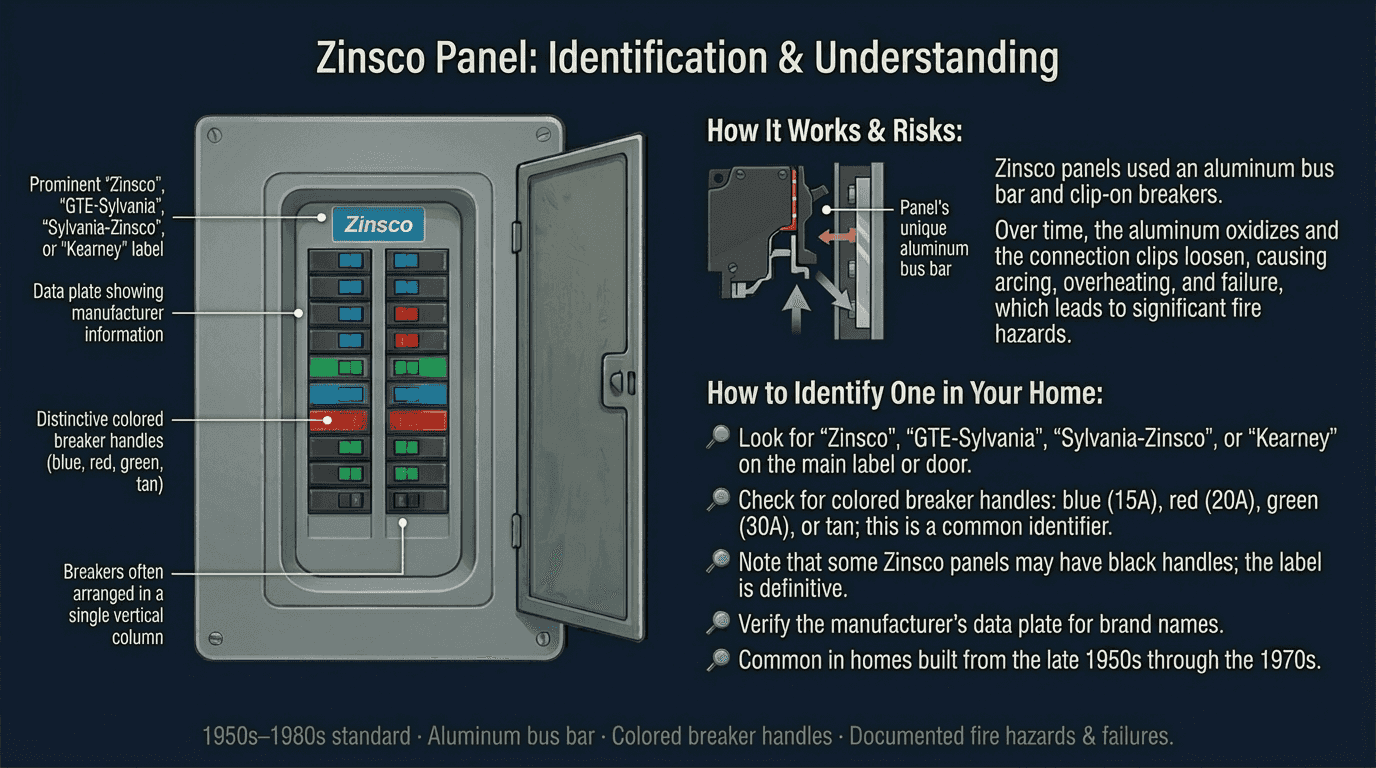
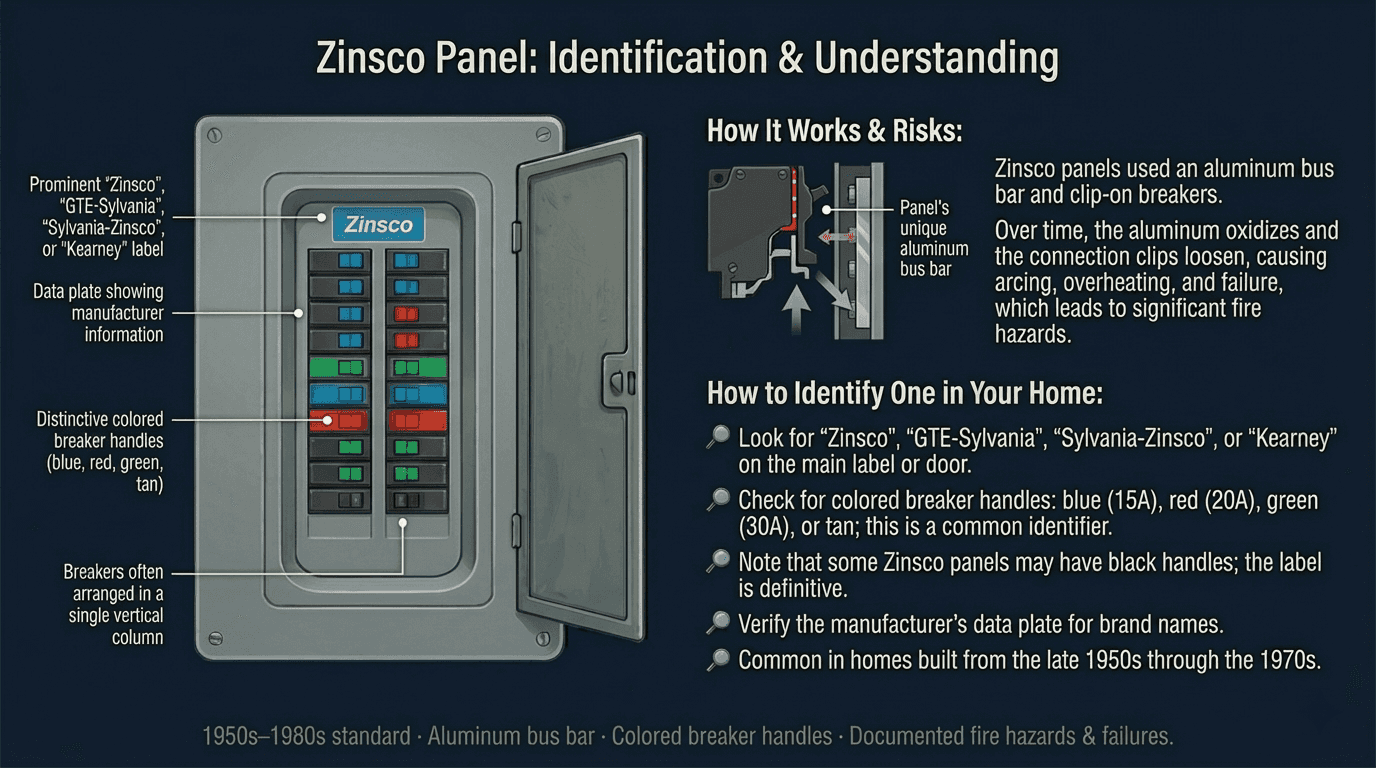
What Is a Zinsco Panel?
Zinsco Electric was founded in Los Angeles in the late 1920s. Emile Zinsmeyer, a sales manager for Frank Adam Electric in St. Louis, moved to LA to run the company's West Coast operations. After the 1929 crash, he bought out the remaining West Coast inventory and started his own company. His son Martin took over in 1943 and renamed it Zinsco Electric.
Under Martin Zinsmeyer, the company grew fast. The post-war housing boom in California and across the western states created enormous demand for residential electrical panels, and Zinsco captured a large share of it. Martin introduced color-coded breaker handles (blue for 15 amps, red for 20, green for 30) that became a quick visual identifier for the brand.
In 1973, GTE-Sylvania acquired Zinsco. The panels continued under the names "Sylvania-Zinsco" and "GTE-Sylvania" with the same internal design. In 1981, GTE-Sylvania divested the electrical division to a group of former executives who formed Challenger. Challenger immediately stopped manufacturing Zinsco-style panels but kept producing Zinsco breakers for the aftermarket. The panels were done by the early 1980s.
These panels are concentrated in homes built during the 1970s, though some installations date back to the late 1950s. In the Denver metro area, they show up primarily in neighborhoods built between 1970 and 1979.
How to Identify a Zinsco Panel
Your panel is usually in the basement, garage, or a utility closet. It can also be mounted on the outside of your home or on the interior wall directly behind your electrical meter. Open the outer swinging door and look for these identifiers:
What to look for:
- "Zinsco" on the label or data plate
- "GTE-Sylvania" or "Sylvania-Zinsco" on the label
- "Kearney" on the label (Kearney panels are Zinsco variants that use the same bus bar design)
- Colored breaker handles: blue, red, green, or tan. This is the most recognizable Zinsco feature.
The colored toggles are distinctive, but they're not the only configuration. Some Zinsco panels have black breaker handles that look similar to other brands. The label is the definitive identifier.
⚠️ Do not remove the inner metal cover (called the deadfront, which covers the live bus bars behind the breakers). Zinsco breakers can be physically welded to the bus bar underneath. Pulling a deadfront off a Zinsco panel without knowing what's going on behind it is a serious shock hazard. Leave that to a licensed electrician.
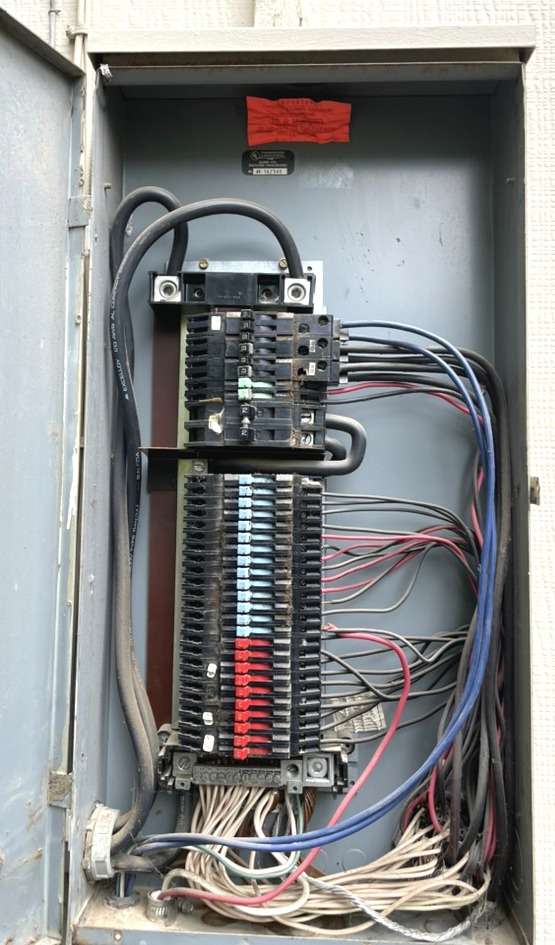
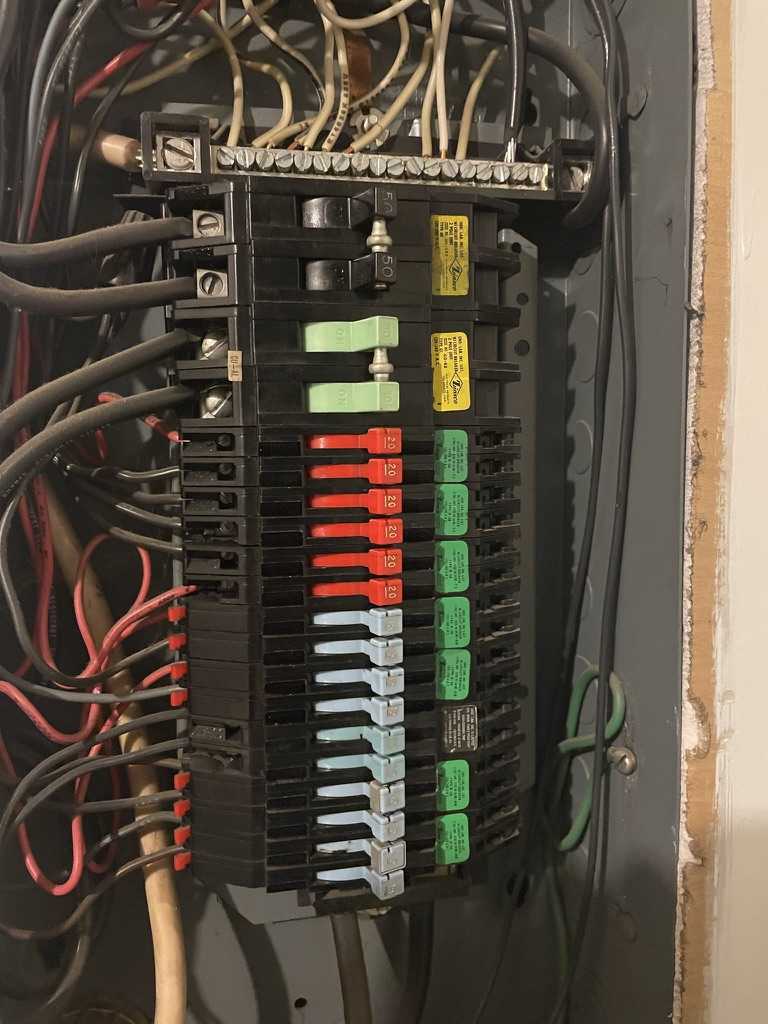
Not sure what you're looking at? Take a photo of the label and the breakers and send it to us. We can usually identify it from a clear photo.
What's Wrong With These Panels
The Short Version
A circuit breaker exists to do one thing: cut power when a wire carries more current than it can handle. That's what stands between an overloaded circuit and a fire inside your walls.
Zinsco breakers fail at this. Independent testing shows 29% of them won't trip when they need to. And when they fail, the failure is permanent. The breaker melts to the bus bar and can never be disconnected. Not by flipping the switch. Not by anything short of replacing the entire panel.
The Testing
Dr. Jesse Aronstein, a mechanical engineer and materials scientist, tested Zinsco breakers using the UL (Underwriters Laboratories) 489 standard: ramp current to 135% of the breaker's rating and hold it for one hour. If the breaker doesn't trip, it fails. This is the same test every new breaker in the country has to pass.
As of March 2017, Aronstein had tested 111 Zinsco-type breakers. Here's what the data shows:
| Breaker Type | Sample Size | Failures at 135% (UL Standard) | Failure Rate | Critical Failures (no trip at 200%+) |
|---|---|---|---|---|
| Zinsco (original) | 107 | 28 | 26.2% | 1 (0.9%) |
| UBI-Zinsco (aftermarket, made by Connecticut Electric) | 4 | 4 | 100% | 1 (25%) |
| Total | 111 | 32 | 28.8% | 2 (1.8%) |
For context: modern breakers from major manufacturers fail this test less than 1% of the time. A 29% failure rate means one in three Zinsco breakers won't protect the circuit it's connected to.
A 29% failure rate across 111 breakers is not a statistical fluke. Field testing by other industry professionals has produced similar numbers, with one study reporting a failure rate of 32%.
The UBI replacement breaker results deserve their own attention. In a targeted sample of four UBI-Zinsco double-pole breakers, all four failed to trip at the UL-mandated threshold. One of the four failed to trip even at 200% of its rating, which is classified as a critical safety failure.
How the Failure Happens
The problem starts where the breaker meets the bus bar.
The bus bar material. When Zinsco started out, their panels used copper bus bars. Those early panels (branded "Magnatrip") don't have this problem. But in the early 1960s, driven by copper shortages and cost pressure, Zinsco switched to an aluminum alloy. The alloy they used has a high rate of thermal expansion and is prone to a phenomenon called cold flow, where the metal slowly deforms under sustained pressure.
The connection design. Zinsco breakers don't bolt to the bus bar. They don't use high-tension spring jaws like modern panels. They use a rigid horseshoe-shaped clip that slides over the edge of the aluminum bus bar. It's a friction fit with no mechanical lock.
The failure cascade:
- Current flows through the connection. The aluminum heats up and expands. When the load drops, it cools and contracts.
- Over thousands of these thermal cycles (the repeated heating and cooling that happens with normal electrical use), the aluminum permanently deforms. The horseshoe clip that was tight when new gets loose.
- As the connection loosens, air reaches the raw aluminum surface. Aluminum oxidizes instantly when exposed to air, and unlike copper patina (which still conducts electricity), aluminum oxide is an insulator.
- Now you have electricity trying to push through an insulating oxide layer across a loose connection. The result is arcing. Localized temperatures at the arc point reach thousands of degrees.
- The intense heat melts the plastic breaker casing and welds the metal clip directly to the aluminum bus bar.
Once welded, the breaker's internal trip mechanism is destroyed by the heat transfer. The breaker can't trip during an overload because it's physically fused to the bus bar. The circuit is completely unprotected.
The "false off" problem. This is the detail that makes Zinsco panels particularly dangerous for anyone working on electrical circuits. Because the breaker is welded to the bus bar at the connection point, the toggle handle can be moved to the "off" position. It will click. It will feel like it's off. But the welded connection continues to conduct live voltage. The switch is disconnected from the actual current path.
If someone flips a Zinsco breaker to "off" and then works on the downstream wiring, they're touching a live circuit. This is a lethal shock hazard, and it's unique to the Zinsco failure mode.
Zinsco vs. a Modern Panel
| Feature | Zinsco | Modern Panel (Square D, Eaton, Siemens) |
|---|---|---|
| Bus bar material | Aluminum alloy. Prone to thermal expansion, cold flow, and oxidation. | Copper or high-conductivity aluminum alloys. |
| Breaker connection | Horseshoe clip, friction fit. No mechanical lock. | Bolted or heavy-duty plug-on jaw with mechanical retention. |
| Trip reliability | 28.8% failure rate (Aronstein, 111 breakers tested) | Less than 1% failure rate. Meets UL 489. |
| Failure consequence | Breaker welds to bus bar. Permanent. Cannot be disconnected. | Breaker trips and can be reset. Replaceable. |
| "Off" means off? | Not always. Welded breakers can conduct voltage in the "off" position. | Yes. Physical separation of contacts when toggled off. |
| AFCI (Arc-Fault Circuit Interrupter) | Does not exist for this platform. | Standard on most branch circuits per NEC (National Electrical Code) 2023. |
| GFCI (Ground-Fault Circuit Interrupter) | Not available in Zinsco configuration. | Detects current leakage as small as 4-5 milliamps. |
| Surge protection | None. | Whole-home surge protective device required per NEC 230.67. |
| Emergency disconnect | Not required when installed. | Required per NEC 230.85. Allows first responders to cut power from outside. |
| Insurance and lending | Flagged by inspectors. Denied or surcharged by most carriers. | Accepted by all carriers and lenders. |
What Arc-Fault Circuit Interrupters (AFCI) Do
This matters because it's the biggest safety advancement that Zinsco panels can't accommodate.
An arc fault is a spark caused by damaged wiring. A nail through a wire behind drywall. A cord pinched under furniture. A connection that's worked loose inside an outlet box. These sparks reach temperatures high enough to ignite wood framing, insulation, and drywall paper. Arc faults are a leading cause of electrical fires.
A standard breaker can't detect this. The current from a spark is too small and too irregular to trigger a traditional overcurrent trip.
An AFCI breaker has a microprocessor that reads the electrical waveform on the circuit continuously. It distinguishes the erratic signature of a dangerous arc from the normal sparking that happens when you flip a light switch. When it detects a hazardous pattern, it shuts the circuit down.
Zinsco panels have no capacity for AFCI protection. The technology didn't exist when these panels were made, and no aftermarket AFCI breaker fits the Zinsco bus bar.
No Recall. No Lawsuit. No UL Revocation.
Unlike some other hazardous panel brands, Zinsco has no government recall, no court ruling, and no UL revocation on its record. That absence is worth understanding.
No CPSC recall. The Consumer Product Safety Commission never issued a recall for Zinsco panels. No formal investigation produced public findings, and no regulatory action was ever taken.
No lawsuits. There are no class-action judgments, consumer fraud rulings, or mass tort settlements against Zinsco, GTE-Sylvania, or Challenger related to panel safety. Claims on contractor websites that Zinsco was "sued into bankruptcy" are not supported by court records.
No UL revocation. The UL listing for Zinsco panels was never revoked, suspended, or allowed to expire. The panels simply went out of production in the early 1980s when Challenger abandoned the design. UL does not retroactively withdraw listings for discontinued products unless forced by federal mandate.
So why is it still dangerous?
Because the absence of legal and regulatory action doesn't change the engineering. The aluminum bus bar still deforms. The horseshoe clip still loosens. The oxide layer still insulates. The arc still welds. The breaker still can't trip. None of that requires a court ruling to be true.
The hazard classification for Zinsco rests on three things that are independently verifiable:
- Laboratory testing. Aronstein's 111-breaker test showed a 29% failure rate at UL 489 standards.
- Field evidence. Decades of documented cases from licensed electricians and inspectors showing melted bus bars, welded breakers, and arc damage inside Zinsco panels.
- Material science. The thermal expansion, cold flow, and oxidation behavior of the aluminum alloy used in these bus bars is well-understood and predictable.
The regulatory system failed to act on Zinsco. That doesn't make the panels safe. It means nobody with the authority to issue a recall had the budget to do the testing required to justify one.
What This Means for Your Insurance
This usually comes up during a policy renewal or when buying a home. In Colorado, the major carriers (State Farm, USAA, American Family, Farmers, Allstate, Liberty Mutual, Nationwide) all have underwriting guidelines that flag Zinsco panels. Here's what that looks like:
- New policies. Carriers routinely refuse to bind coverage on a property with a Zinsco panel.
- Existing policies. Many carriers require a 4-point inspection when a home reaches 30-40 years. If that inspection turns up a Zinsco panel, expect a non-renewal notice with 30 to 60 days to replace it.
- Surcharges and exclusions. Some carriers will continue coverage but with a higher premium or with electrical fire damage excluded from the policy.
From an actuary's perspective, a breaker that can't trip is a breaker that can't trip. Zinsco panels fall under "obsolete panels with documented hazards" in underwriting guidelines.
What This Means When You Sell Your Home
When a home with a Zinsco panel goes on the market, here's the typical sequence:
- The buyer's home inspector identifies the panel and flags it as a safety hazard
- The report uses standard language from InterNACHI or ASHI (American Society of Home Inspectors) categorizing it as an immediate safety concern
- The buyer's insurance company refuses to write a policy, or requires replacement before binding coverage
- The buyer's mortgage lender won't close without active insurance
- The buyer negotiates a price reduction or demands replacement before closing
InterNACHI's published narrative for Zinsco panels instructs inspectors to tell clients that these panels are "reputed to have a significant rate of circuit breaker failure that can result in fire or electric shock hazard." That's the language that goes into the inspection report, and it's the language that triggers the insurance and lending chain.
As of February 13, 2025, Fannie Mae's updated Property Condition Assessment guidelines (Form 4099.G) classify Zinsco panels as requiring immediate replacement. This currently applies to multifamily properties. For single-family homes, the path runs through the inspector-insurer-lender chain described above, but the outcome is the same.
California has gone further. Senate Bill 382 mandates disclosure of "substandard" electrical systems during real estate transactions starting in 2026. The legislative analysis names Zinsco and GTE-Sylvania panels as known fire risks. Colorado doesn't have equivalent legislation yet, but the insurance market here produces the same practical result.
Replacing the panel before you list gives you time to plan the work and do it right. Doing it under the pressure of a closing deadline costs more and limits your options.
Can a Zinsco Panel Be Repaired?
No.
The problem isn't the breakers. It's the bus bar. The aluminum alloy in a Zinsco bus bar degrades over time through normal use. That degradation is permanent and irreversible. You can't put new breakers on a compromised bus bar and call it fixed.
Some companies sell aftermarket replacement breakers for Zinsco panels. Connecticut Electric makes them under the UBI brand. We don't install them. Aronstein tested UBI-Zinsco replacement breakers, and in his sample, all four failed the UL 489 overload test. One of the four wouldn't trip even at double its rated current. A new breaker on a bus bar that's been thermally cycling for 40 to 50 years doesn't address the root problem.
The fix is a full panel replacement. The enclosure, the bus bars, the breakers. All of it comes out. A new UL-listed panel goes in.
What Replacement Involves
Replacing a Zinsco panel is real electrical work. Here's what the process looks like:
- We come look at it. We check the existing panel, the wiring, the service entrance, the meter base, and figure out the full scope. No charge for the estimate.
- Permit. We pull the electrical permit with your local jurisdiction. Lakewood, Denver, Arvada, Wheat Ridge, wherever you are. A permit is required by law for panel work. No permit means no inspection, and no inspection means no documentation that the work meets code.
- Xcel coordination. Your service wires are always live from the utility side. We can't de-energize them with a switch. We submit a disconnect request through Xcel's builder portal and schedule the meter pull. That takes 5 to 10 business days typically. Xcel charges processing and reconnection fees, which we include in the estimate.
- The work. Plan for a full day without power. The old panel, bus bars, and breakers all come out. The new panel goes in with:
- A new lever bypass meter. This meter base has a built-in handle that lets Xcel or a first responder cut power from outside without entering the house (NEC 230.85).
- Modern breakers that meet current UL 489 standards
- AFCI protection where NEC 2023 requires it (NEC 210.12)
- GFCI protection in kitchens, bathrooms, garages, and other required locations (NEC 406.4)
- Whole-home surge protection (NEC 230.67)
- An intersystem bonding bar that gives cable, phone, and data lines a single grounding point (NEC 250.94)
- Two driven copper ground rods, bonded together and back to the panel (NEC 250.52, 250.53)
- A ground connection to the main cold water pipe within the first 5 feet of where it enters the foundation (NEC 250.52(A)(1))
- Every circuit properly sized, torqued to spec, and labeled so you know exactly what each breaker controls
- Inspection. A local electrical inspector visits and goes through the whole installation: connections, grounding, bonding, breaker sizing, labeling, code compliance. Most jobs pass on the first visit.
- Power restored. Once the inspector signs off, they submit a meter release to Xcel Energy. Xcel comes back to install the meter and turn power on.
What Does It Cost?
What you'll pay depends on the job. A straight panel replacement where the service entrance is in good shape is a different project than going from 100A to 200A with a new meter base and underground conduit. Panel size, condition of the existing installation, location, and local permit requirements all factor in.
We need to see your setup to give you a real number. Every house is different, and We'd rather tell you that than throw out a range that doesn't apply to your situation.
Payment
A 50% deposit is required before work begins. That locks in your date and lets us start the permit and Xcel coordination. The remaining 50% is due after the inspection passes and power is back on.
Warranty
Parts: One year on all electrical parts, starting from the date of final inspection.
Workmanship: We stand behind our installation work. Full warranty terms →
Frequently Asked Questions
How do I know if I have a Zinsco panel?
Open the outer door (not the inner deadfront). Look for "Zinsco," "GTE-Sylvania," "Sylvania-Zinsco," or "Kearney" on the label. The most recognizable feature is colored breaker handles: blue for 15 amps, red for 20, green for 30. But not all Zinsco panels have colored handles. Some use black toggles. The label is the definitive identifier. If you're not sure, send me a photo.
My Zinsco panel has worked fine for 45 years. Why replace it now?
It works fine as long as no breaker is asked to trip. The whole point of a breaker is to protect you during an overload or short circuit. Testing shows 29% of Zinsco breakers won't do that. And unlike most other breaker failures, a Zinsco failure is silent. The breaker welds to the bus bar inside the panel. You can't see it without pulling the deadfront off, and the breaker handle will still toggle back and forth like nothing is wrong.
How dangerous is a Zinsco panel?
Nearly 29% of tested Zinsco breakers failed to trip during overload conditions. When they fail, the breaker welds to the bus bar permanently. The "false off" problem means a welded breaker can show "off" on the handle while still conducting live voltage. That's a lethal shock hazard for anyone working on the wiring. Zinsco panels need to be replaced.
Will my insurance drop me for having a Zinsco panel?
Most likely. Colorado's major carriers flag Zinsco panels during underwriting. Some refuse new policies outright. Others issue non-renewal notices with 30-60 days to replace. If your home is approaching 30-40 years, your carrier may require an inspection, and the panel will get flagged.
Can I replace the breakers in a Zinsco panel?
No. Aftermarket replacement breakers (the UBI brand) were tested independently, and in the tested sample, all four failed the standard overload test. But even if the breakers were perfect, the bus bar is the problem. The aluminum in a Zinsco bus bar degrades through normal thermal cycling over decades. New breakers on a compromised bus bar doesn't fix the underlying failure.
Is there a recall on Zinsco panels?
No. The CPSC has never issued a recall for Zinsco panels. There's no court ruling, no UL revocation, and no formal federal investigation that produced public findings. But the City of Napa, California banned Zinsco meter mains for new installations in 2012, and California's SB 382 (effective 2026) names Zinsco panels as known hazards requiring disclosure during real estate transactions.
Is a GTE-Sylvania panel the same as a Zinsco panel?
Yes. GTE-Sylvania acquired Zinsco in the 1970s and continued manufacturing the same panels with the same bus bar design under the Sylvania and GTE-Sylvania names. A panel labeled "Sylvania" or "GTE-Sylvania" is a Zinsco panel with a different sticker. It has the same aluminum bus bars, the same breaker design, and the same documented failure modes.
What about Challenger panels? Are those the same thing?
No. Challenger bought the Zinsco product line from GTE-Sylvania in 1981 and immediately stopped making Zinsco-style panels. Challenger's own panels use a completely different bus bar design (originally from Bryant, now the Eaton BR line). Standard Challenger breakers are not interchangeable with Zinsco panels. However, Challenger did manufacture Zinsco-style replacement breakers for the aftermarket. If your panel says "Challenger" on the label (not "Zinsco" or "Sylvania"), it's a different product with a different risk profile.
Where Zinsco Panels Are Found in the Denver Area
Zinsco panels peaked during the 1970s. In the Denver metro, that decade saw massive suburban expansion across every county. If your home was built between 1970 and 1979 and the original panel has never been replaced, there's a reasonable chance it's a Zinsco or GTE-Sylvania system.
How to use this section: Your home's build year (available on your property tax records or county assessor's website) is the best starting point. The neighborhoods below saw their primary residential construction during the 1970s.
Jefferson County
| Neighborhood / City | Primary Build Period | Notes |
|---|---|---|
| Columbine | 1970s | Large subdivision development in unincorporated JeffCo |
| Ken Caryl Ranch | 1970s-1980s | Master-planned community, south JeffCo |
| Lakewood (western expansion) | 1970s | Growth beyond the original 1950s-60s core |
| Arvada (western areas) | 1970s | Expansion beyond Olde Town core |
Denver County
| Neighborhood | Primary Build Period | Notes |
|---|---|---|
| Montbello | 1970s | Major NE Denver expansion |
| Hampden South | 1970s | SW Denver development |
| Fort Logan | 1970s | SW Denver |
| Marston | 1970s-early 1980s | Far SW Denver |
Adams County
| Neighborhood / City | Primary Build Period | Notes |
|---|---|---|
| Thornton (expansion areas) | 1970s | Growth beyond the original 1953 core |
| Northglenn (expansion areas) | 1970s | Growth beyond the original 1959 core |
Arapahoe County
| Neighborhood / City | Primary Build Period | Notes |
|---|---|---|
| Centennial area | 1970s | Southglenn, Ridgeview Hills, Cherry Knolls |
| South Aurora (expansion) | 1970s | Eastern Arapahoe growth |
Boulder County
| Neighborhood / City | Primary Build Period | Notes |
|---|---|---|
| Boulder (1970s-era areas) | 1970s | Expansion beyond 1950s-60s core neighborhoods |
| Longmont (expansion areas) | 1970s | Growth beyond historic core |
Broomfield
| Neighborhood | Primary Build Period | Notes |
|---|---|---|
| Northmoor, Greenway Park, Lac Amora, Westlake Village | 1970s | Annexed during Broomfield's 1970s expansion |
A home's build date is a starting point, not a diagnosis. Not every home from the 1970s has a Zinsco panel, and some homes built outside this window had one installed during a renovation. The only way to know for certain is to look at the panel.
Not every old panel is a problem panel. Square D, GE, Murray, Siemens, and Cutler-Hammer were all installed in Denver-area homes during the same era, and none of them carry the same safety concerns. Homes from the 1970s and 1980s may also have other panels with known issues from overlapping production periods. If you're not sure what you have, our panel identification guide covers the most common problem panels found in Denver-area homes.
Corporate and Regulatory Timeline
| Year | Event |
|---|---|
| Late 1920s | Emile Zinsmeyer moves to LA to run Frank Adam Electric's West Coast operations |
| ~1929-1930 | Zinsmeyer buys out West Coast inventory, founds the Zinsmeyer Company in LA |
| 1943 | Martin Zinsmeyer purchases company from his father, renames it Zinsco Electric |
| Early 1960s | Zinsco switches from copper to aluminum bus bars |
| 1973 | GTE-Sylvania acquires Zinsco. Panels continue under "Sylvania-Zinsco" and "GTE-Sylvania" labels |
| 1981 | GTE-Sylvania divests electrical division. Challenger formed. Zinsco panel production ceases. |
| 1994 | Thomas & Betts acquires Zinsco aftermarket breaker tooling from Challenger/Westinghouse |
| 2005 | Thomas & Betts ceases Zinsco breaker production, destroys original molds |
| 2012 | City of Napa, CA bans Zinsco meter mains for new solar and major appliance installations |
| Feb 13, 2025 | Fannie Mae Form 4099.G classifies Zinsco panels as requiring immediate replacement (multifamily) |
| 2026 | California SB 382 names Zinsco as known hazard requiring disclosure in real estate transactions |
Sources
- Dr. Jesse Aronstein, independent testing of Zinsco circuit breakers, 111-breaker sample. Methodology per UL 489 standard. Test data published at InspectAPedia. (inspectapedia.com/electric/Zinsco-Failure-Test-Report.php)
- Mike Holt, "A History of Zinsco Electric." (mikeholt.com/newsletters). Primary corporate history source.
- InterNACHI Inspection Narrative Library, Zinsco Electrical Panels. (hinarratives.com)
- California Senate Bill 382 (Becker), Senate Judiciary Committee Analysis. Names Zinsco/GTE-Sylvania as known fire risks.
- City of Napa, California, Building Division memorandum, 2012. Banning Zinsco meter mains for new solar and major appliance installations.
- UL 489: "Standard for Molded-Case Circuit Breakers, Molded-Case Switches, and Circuit-Breaker Enclosures." Underwriters Laboratories.
- Fannie Mae Form 4099.G, "Known Problematic Building Materials and Property Design Issues." Effective February 13, 2025.
- NEC 2023 (National Electrical Code): Sections 210.12 (AFCI), 230.67 (surge protection), 230.85 (emergency disconnect), 250 (grounding and bonding), 406.4 (GFCI).
- InspectAPedia, "Zinsco Electrical Panels & Circuit Breakers." (inspectapedia.com/electric/Zinsco_Summary.htm). Full reference on identification and hazards.
- InspectAPedia, "B&C Kearney Electrical Panels & Circuit Breakers." (inspectapedia.com/electric/Kearney_Electrical_Panels.php). Kearney as Zinsco variant.
- Xcel Energy Colorado Service Guide. Builder portal process for residential service disconnect/reconnect.
- J.P. Simmons, field testing of Zinsco breakers, 32% failure rate reported. (thehomeinspectorsnotebook.com)
This page is for informational purposes. References to the National Electrical Code (NEC) are based on the 2023 NEC as adopted by Colorado at the time of writing and are for context only. They do not replace the currently adopted code in your jurisdiction. Your local Authority Having Jurisdiction (AHJ) and electrical inspector determine what applies to your project. Electrical work should only be performed by a licensed electrician.
Ready to replace your Zinsco panel? Learn about what a service change involves or call for a free estimate.
Have a Zinsco Panel?
Send us a photo and we'll do our best to identify it. Or schedule a free on-site assessment.